
Subscribe
Subscribe
- Motoring
- Style
- Home & Design
- Travel
- Food & Drink
- Specials
- News & Tech
- Videos
Pearl millet sways gently in the breeze, its silvered ears whispering promises of harvest, while pheasants (teetar, as the locals call them) call out from the thickets, their songs carrying across the fields like secret hymns of the land. Peacocks dot the fields, their iridescent feathers shimmering as they spread wings with a rustle, a monsoon symphony in motion. Upright and regal, purple (yes, you read it right) lady’s fingers pierce the air, while beds of tall sunflowers lift their golden faces towards the sun in wide, unguarded smiles. Rohida and khejri trees spread into generous canopies, offering shade and silence, while amla trees bow under the weight of glassy green fruit that catch the light. Jackfruit trees ready themselves for a season of bounty in the coming months, while butternut squash and zucchini vines curl luxuriously along the edges. In the distance, guava orchards breathe a quiet sweetness, while fig and pomegranate trees scatter their ripened jewels across a landscape both rustic and lush, alive with colour, abundance, and song.
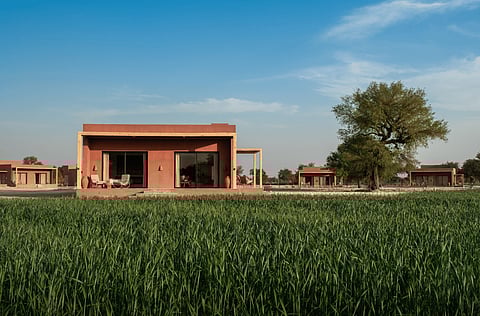
It is the last leg of the monsoon at Mharo Khet (which means ‘my farm’ in Marwari), where a rare lushness unfurls in Manai village on the outskirts of Jodhpur, in the arid Marwar region. Here, a 40-acre sweep of green feels almost miraculous, as though the land were drinking in every lingering drop of rain.

The farm unfolds like a living canvas, evocative of Van Gogh’s Wheatfield with Lark, where rawness and radiance coexist in harmony.
Having opened its gates this month, Mharo Khet now welcomes guests into this rare oasis, where the rhythms of harvest and song now meet the quiet indulgence of well-appointed cottages, inviting you to pause and reconnect with nature.
“Building the cottages at Mharo Khet was about creating a space where people could slow down and truly live the farm—wake up to birdsong, walk among the fields, taste food just harvested, and sleep under skies untouched by city lights. I wanted guests to immerse themselves and feel part of its rhythm,” says 36-year-old Rajnush Agarwal, who along with wife Vedika Prasad, has transformed their four-decade-old ancestral land into an experiential farm.
Set in a circular embrace within the farm, the 10 cottages, each a generous 2,000-square-foot retreat, is named after a classical Indian musical raga—an ode to the rhythm of the sun and the moods of the day.
Built from locally quarried sandstone in muted desert hues, every cottage features a courtyard, two outdoor decks with views of sunrise and sunset, and floor-to-ceiling sliding glass panels that draw the outside in, keeping the sweep of fields and skies always in view.
I stayed at Saveri, named after a morning raga. Inside, a spacious living area opened to a restful bedroom in shades of rust orange and yellow against grey—echoing the rising sun. A walk-in wardrobe, an expansive bathroom with double vanity sinks, and a rain shower with thermostatic controls led to a private, open-to-sky meditation courtyard. Each cottage carries its own terrazzo identity—lighter tones for morning ragas, deeper hues for evening—subtly tuned to the rhythm of the day, points out Agarwal.
The aesthetic is one of quiet luxury: minimalist, tactile, and rooted in agrarian life. Earthen lime-plastered walls echo the desert palette; reclaimed wood, handcrafted furniture, handloom upholstery, and stone bring authenticity. A triptych of Kutch embroidery, a carved wooden block, and a block print by Vedika adorn the walls and add a personal touch to the space. Her design sensibility is evident across the property, where every detail—from terracotta flower vases and mugs glazed within, to lacquered wooden centrepieces, handcrafted papier-mâché lamps, and mother-of-pearl inlays—offers comfort without excess. A cosy space that leaves you feeling cocooned rather than overwhelmed, and one you’ll want to return to at the close of each day.
At Mharo Khet, fresh produce takes centre stage and food becomes the most persuasive invitation to linger. The estate’s plant-forward philosophy finds its fullest expression in its dining spaces, each with its own rhythm.
The story began during the couple’s trip to Kyoto in 2019, where they were inspired by the city’s famed farm-to-table culture. “We realised that Michelin-starred restaurants prized Kyoto vegetables simply for their freshness, and wondered if we could do the same here,” says Agarwal, who holds a Master’s in Biomedical Engineering from Oxford University.
During the pandemic, the duo began cultivating non-native produce such as oyster mushrooms, Swiss chard, oregano, and moringa—ingredients rarely seen in Jodhpur—and delivered them within hours to local restaurants and vendors.
Today, Mharo Khet nurtures over 110 varieties of fruits, vegetables, herbs and flowers; strawberries, kale, and bok choy to basil, jalapeños, nasturtium, rajnigandha, and marigold among them.
With drip irrigation sustaining a thriving permaculture, another 2,500 plants are set to be introduced next year.A similar number was planted two years back. Its greenhouse, home to over 45 varieties year-round, is a botanist’s delight.
The crown jewel is Paeru, an open-to-sky fine-dining experience in a guava orchard. Here, a nine-course, gluten- and lactose-free menu celebrates life’s stages through plant-forward flavours—from the playful wonder of childhood to the contemplative calm of night. Borrowing inspiration from regional and world cuisine, expect creations such as melon crudo on a bed of coconut aji verde topped with curry leaf, cauliflower hummus with millet bakhri and pickled celery, baked squash with Goan recheado and cashew pakora, jackfruit haleem paired with bakarkhani topped with crispy quinoa, and berry shrikhand in a thyme cornetto.
“The menu keeps changing with the seasons, and almost 90 percent of ingredients are sourced from the farm,” says Agarwal.
Samaa, the all-day dining and bar, reimagines Indian classics with flair as is evident in the seven-course Chef’s Tasting Menu—from ragda pattice and pulled jackfruit ghee roast to mango Alleppey curry, Ladakhi dum aloo kulcha, and kalakand tres leches.
Meanwhile Aab, the poolside café, offers a playful escape for leisurely lunches or a sundowner swim. Don’t miss the herbal tisanes brewed from chamomile-mint to moringa-fig leaf blends—crafted with ingredients plucked straight from the fields.
The experiences are many, but the ethos is one: food that is rooted, conscious, and celebratory. At Mharo Khet, every meal is more than food; it’s a story of the land, told on a plate.
Life at the farm unfolds through experiences designed to immerse guests in its rhythms. Guided by saajhis—local artisans and collaborators—each moment is both rooted in tradition and deeply engaging.
My morning began with a half-hour traditional champi (Indian head massage), under the shade of a khejri tree, where the saajhi applied oil to my hair (if you chose) and kneaded away stress with practiced ease. Nearby, a wooden swing, strung from the khejri tree, invited quiet reflection in the breeze, a pause in the day to savour the farm’s unhurried luxury.
Later, I strolled through fields alive with figs and pomegranates warming in the sun, tender baby corn with pearly kernels, bursting red cherry tomatoes, delicate oyster mushrooms and fresh and crisp green moong beans. Walking past rows of basil, I breathed in their redolent perfume. Guests could learn sustainable farming or join chef-led cooking sessions that transforms freshly foraged produce into unforgettable plates—an immersion that is as enriching as it is indulgent.
Mine unfolded under open skies with Chef Ishan Ahluwalia and his team, cooking amid the fields with ingredients at their seasonal peak—Banarasi tamatar chaat with spinach tempura, herbed yoghurt and basil, and bajra chocolate cake with coconut jaggery, honeycomb and mint—both dishes a fine-dining ode to Mharo Khet’s terroir. I also tried my hand at weaving a mini charpoy, guided by a local artisan, the rustic craft slowly taking shape under my fingers—an heirloom I carried home as a keepsake.
Workshops ranged from Kathak lessons with dancer Vishakha Saraf to hour-long sound-healing sessions with practitioner Mandira Chaudhary, both conducted at Ira, the spacious glass-walled activity centre opening onto the farm. The expanse amplified every vibration into a deeply restorative calm.
Evenings took a spirited turn with Tipple Dabble, a cocktail workshop using farm-fresh ingredients. For lighter diversions, there is kite-flying, yoga, board games, or dips in the temperature-controlled pool.
Mharo Khet is not for the checklist tourist or hurried traveller; it beckons the discerning few who value terroir-driven cuisine, singular design, and a deep, personal connection to a farm life, where luxury is defined by authenticity, grace and meaningful experiences rather than marble-clad opulence and grandeur.
It is a sensory journey into life’s simple pleasures: living the farm, embracing its quietude, and carrying its lingering memories home.
Accommodation: Rs 53,100 per night (inclusive of taxes)
Private farm tour with curated dining at Paeru: Rs 7,080 per person (inclusive of taxes)