
Subscribe
Subscribe
- Motoring
- Style
- Home & Design
- Travel
- Food & Drink
- Specials
- News & Tech
- Videos
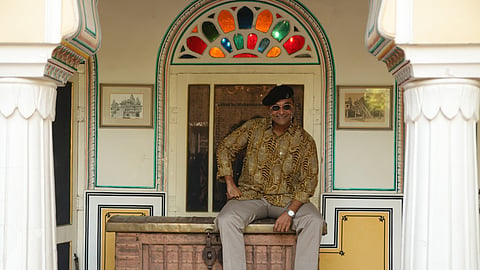
A few minutes from the restless rhythm of Jaipur, a haveli from 1892 stands hidden in plain sight. Sunlight spills across its old walls, shadows settle into its corridors, and a courtyard shaded by a champa tree planted years ago offers a moment of stillness. For Abhimanyu Alsisar, who is quick to call himself its custodian, this is no relic frozen in the past, it is a living inheritance.
The story begins with his great-great-great grandfather, Thakur Ganpat Singh, who served as the Minister of Forests and Shikar Khana under Jaipur’s royal family. In need of residence in the city, he set out to build a townhouse for himself. In its earliest days, Alsisar shares that the haveli was known as Alsisar ka Dera. ‘Dera’ usually translates to a residence where a Thakur resides in when in town.

In 1994, a part of the haveli was converted into a heritage hotel by Alsisar’s father, Thakur Gaj Singh. The move was part of a wider trend that had gathered momentum in the early 1980s, when several erstwhile royal families began opening their ancestral homes to guests. These properties, while rich in history, had become white elephants, demanding considerable resources to maintain. For Gaj Singh, an army officer at the time, the upkeep of a residence of this scale posed a challenge. This also marked his transition into entrepreneurship. He later extended the same vision to the family’s palace in Alsisar, known as Alsisar Mahal and Nahargarh in Ranthambore.
Gaj Singh’s own journey through the family’s history was shaped by tragedy and inheritance. He first became the Raja of Khetri in 1987. Following the untimely death of his father and younger brother in a road accident, he was made the Thakur of Alsisar in 1988.
The family continues to live in the haveli, in a separate courtyard in the rear of the property. At its heart lies a courtyard centered around a champa tree, planted by Alsisar’s father in his childhood, which over the years has grown into a magnificent presence. “My entire family lives here: my wife, my two daughters, my younger brother and his wife, their two sons, and my parents,” says Alsisar.
Alsisar divides his time between the family properties in Nahargarh, Ranthambore, and Alsisar Mahal, but is most attached to this family home.
The architecture of Alsisar’s haveli in Jaipur offers a glimpse into the social customs of the era in which it was built. At a time when purdah was practised in India, women’s lives largely revolved around the secluded zenana courtyards.
The Sheesh Mahal in the haveli today served as the women’s quarters, while Darbar Hall, also known as the Diwan Khana, formed the mardana or men’s section. When converted into a hotel, this space was enclosed, air-conditioned, and incorporated into the hotel as a restaurant.
The space retains its historic character with the gilded paintings and intricate frescoes. Alsisar is particularly fond of the frescoes rendered in a soft, unusual shade of green, a colour he considers a rarity among the havelis of the region.
By virtue of the titles held by his father, Alsisar and his younger brother Dhruv Singh were addressed as Kunwar Sahib, a traditional honorific loosely translating to ‘prince’. “I understood the significance of a title quite early in life,” he recalls, though its deeper meaning unfolded gradually as he grew up in the ancestral haveli.
His grandmother, he remembers, had several women working for her who had accompanied her when she married and moved into the family home. The haveli also housed its staff in dedicated quarters, with rows of rooms for those who worked there. With so many people living under one roof, the house was always bustling with activity. “They would call us Kunwar Sahib, and it was only as we grew older that we began to understand the meaning of the title,” he says.
For Alsisar, that understanding eventually came to be defined by responsibility rather than privilege. “I believe it is important to understand what the title represents. Only then does it truly register in your heart and mind that you are the custodian of the house. You have to work to ensure that the legacy grows and reaches further than it does today.”
Speaking of royalty, Alsisar is quick to acknowledge that its meaning has changed with the times. “India is a democracy today, and the days when royalty meant what it once did are long gone. I am a citizen just like everyone else. I am a businessman now, running businesses built on the inheritance my family has received.”
His grandmother, he recalls, was particularly mindful of the changing social order and often reminded the family that the old days were behind them. What mattered now, she would say, was learning to be a people’s person. It is a lesson that continues to stay with Alsisar.
Today, he runs hotels in both Khetri and the town of Alsisar, creating employment opportunities for people from the same villages with which his family’s history is intertwined. Over the past six months, Alsisar has been working on wildlife conservation, particularly at Khetri’s Leopard Conservation Park. He has been working on rewilding initiatives, with the aim of restoring the natural habitat and protecting the leopard population.
The larger vision, he explains, is to create a model in which conservation and livelihoods go hand in hand. “Who benefits from this? The local people. They can earn money and develop a source of income through the jungle. That is why protecting it is so important.”
Alsisar takes his role as custodian of the family’s ancestral legacy to heart. For him, the responsibility lies in keeping the haveli alive, allowing its story to evolve. He insists that it is not a question of ownership, but of stewardship. Legacy, in his view, is not merely inherited, but it is must preserved, nurtured and passed on.
“I want my daughters and the generations after to understand the value of this place and to take pride in carrying its story forward,” he says. At the same time, he is intent on shaping a legacy of his own, one rooted in art, culture, wildlife conservation, and hospitality. “I want to leave behind something meaningful, just as my ancestors did.”