
Subscribe
Subscribe
- Motoring
- Style
- Home & Design
- Travel
- Food & Drink
- Specials
- News & Tech
- Videos
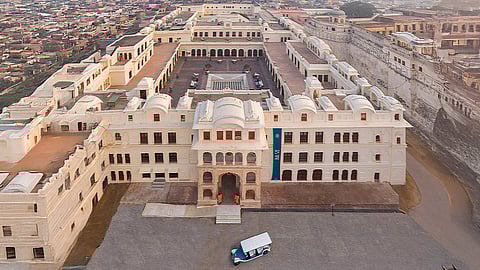
Patiala, a mighty former royal state, has several firsts to its credit: the Patiala Peg (a glorious, overflow of booze), the Patiala Salwar (before Issey Miyake, pleats must have originated up here), the Patiala Gharana (the genius and innovation of Hindustani classical music), Maharajah Bhupinder Singh and that Cartier necklace, and the National Institute of Sports where the absolute crème de la crème of Indian sportsmen have emerged (the muscular force of Neeraj Chopra, the resolve of Geeta Phogat, the strength of Mirabai Chanu). And now there’s Ran Baas, the Palace, which has recently been honoured as one of the world's most beautiful hotels of 2025 by Prix Versailles, supported by UNESCO and the International Union of Architects. Notably, it is the only Indian property to make it to the list.

Ran Baas (literally, ‘Home of the Queens'), is an extraordinary luxury hotel that forms part of the 18th-century Qila Mubarak. Set deep in the very heart of Patiala, the Qila is a magnificent ode to Punjab’s royal heritage. Past neat (but noisy), shops selling rainbow streams of pugrees and hand embroidered phulkari shawls and ‘sets’ (for ‘ladies’), food stalls with delicious mounds of chana bhatura, kulchas and fishy fry, one turns into a sweeping courtyard which is the entrance to the Qila and, in effect, Ran Baas.
The Qila was nearly wiped out until an alarming call from the World Monuments Fund put it on the ‘Most Endangered’ list. The government decided to lease out parts of the property and in stepped the indefatigable hotelier and woman-about-town, Priya Paul. As the promoter of THE Park Hotels, (which is a part of the mighty Apeejay Surrendra Park Hotels), Paul has a well-known penchant for heritage properties, and this project was a dream come true. Paintbrush in hand, she and one of India’s most respected heritage architects, Abha Narain Lamba, set about putting both house and hotel in order.
The result is stunning: 35 suites bedazzle, literally, as each one is inspired by Patiala’s famous jewels—the Art Deco Patiala Ruby Choker, the Tutti-Frutti necklace and of course, the 1,000-carat Patiala Necklace. Each suite is named after a gemstone--Pearl, Topaz or Sapphire. The outcome is a collection of rooms of astonishing beauty.
The day I arrived, I was ushered into a splendiferous suite after being greeted in a stunning reception area—think one part pale gold and cream, and another in dramatic black. I was taken to the Topaz Suite, resplendent in the vigorous colours of Punjab: the brilliant yellow of mustard fields and the deep green of the land which is India’s breadbasket.
My room featured rich Jamawar shawl motifs on the walls and the hues inspired by the dazzling sarpeches that used to sit on the turbans worn by smart princes of yore. The loo was large enough to park a vintage Rolls-Royce in. Drinks that evening were served in the deeply groovy bar, The Patiala— I love bars with sexy, low lighting, and this one is spot on. It’s spread across three levels, with Punjabi rap, Sufi music and bhangra beats streaming from overhead speakers.
There’s so much to see at Ran Baas that you need at least three days to watch it all unfurl: the Neel Restaurant, the Lassi Khana, now a spa that coddles a swimming pool; the incredibly layered Mubarak Garden; and the Rang Mahal, Sheesh Mahal and the Sunset Terraces.
After a madly satisfying dinner, guests (artists, writers, tycoons, heiresses), all repaired to the highest point in the hotel to kick back and relax. Sufiyana in the air, Patiala lights below like jewels on black velvet. Ran Baas heaven.