
Subscribe
Subscribe
- Motoring
- Style
- Home & Design
- Travel
- Food & Drink
- Specials
- News & Tech
- Videos
AI generated summary, newsroom reviewed
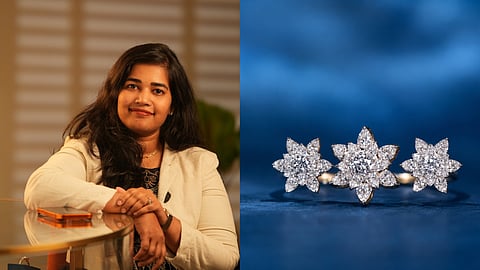
The day July 18, 2026, will be a special one for India's private space ambitions as Vikram-I, a small satellite launch vehicle, developed by Skyroot Aerospace, lifted off from Satish Dhawan Space Centre of ISRO. Even more special was the fact that Cosmos Diamonds also made it to space aboard Cosmic Bloom, a lotus of 32 lab-grown pear-cut diamonds totalling 16.9 carats set in BIS hallmark 18-karat gold. Sanjana Tripuramallu, founder of Cosmos Diamonds, speaks exclusively to Robb Report India ahead of the launch of the Lotus Collection in Bengaluru on August 1. Here are the excerpts of that conversation.

Sanjana Tripuramallu (ST): We were in conversation with the Skyroot team; we happened to remember a poem of Twinkle Twinkle Little Star, and one casual discussion led to the question, ‘Can we actually put a diamond in space?’ The more we explored it, the more meaningful the idea became. When we looked at it closely, it wasn't about sending a diamond to space. It was about what that diamond represented. Skyroot is redefining India's future in space technology, and at Cosmos, we believe lab-grown diamonds represent the future of the jewellery industry. Both companies started around the same time, both believed in something long before it became mainstream, and both are building through technology and innovation while staying deeply rooted in India. It felt like a very natural partnership.
ST: The lotus felt like the most natural choice from the very beginning. When we started thinking about what should represent India on such a historic mission, we wanted to choose something that carried meaning and would still feel relevant generations from now. The lotus has always been a part of India's cultural identity. You see it in our temples, architecture, art, and mythology. It's a symbol that has travelled through centuries, yet it still feels timeless. The Lotus Collection became the first expression of that vision. It brings together a timeless Indian symbol with a historic moment for the country.
ST: I think the biggest difference is that our story came before the design. We didn't sit down and decide to create a space-themed collection. It started with an idea: how do we celebrate innovation in a way that's meaningful? And the possibility of sending a lab-grown diamond into space in collaboration with Skyroot Aerospace. Once that became real, the
collection naturally evolved around that story. Every design decision came from that journey. The Lotus Collection is a result of something that happened. It carries a story that has authenticity behind it, and I think people can feel the difference when a collection is created from a genuine idea rather than a trend. That's what makes it special.
ST: We worked quite closely with the Skyroot team throughout the process to understand what was possible, what the mission requirements were, and how we could make the collaboration meaningful while respecting the integrity of the mission. They were incredibly open and supportive from the very beginning. Whether you're building rockets or building a new category in jewellery, it starts with believing in an idea before everyone else does.
ST: I don't think the two are separate anymore. I think a collectible becomes truly collectible because of the emotion and meaning attached to it. People today are looking for things they can connect with. They want to know the story behind what they're buying, why it was created, and what it represents. That emotional connection is what makes someone treasure a piece for years. Today's luxury buyer values authenticity more than anything. People are becoming more thoughtful about what they buy, and they're drawn to objects that have a genuine story, purpose, and lasting meaning. That's the kind of luxury I personally believe in.
ST: I think it adds another layer of meaning. Lab-grown diamonds already represent a shift in the industry. They're a result of science, technology, and innovation, and that's what drew me to them in the first place. People are beginning to value where something has been and the journey it has taken, not just how it was made. When a piece is connected to a real historic mission, it carries a story that stays with it forever. For me, that's where the value comes from. It's the coming together of innovation, craftsmanship, history, and emotion. Those are the things that make an object meaningful and something people will continue to value for generations.
ST: People today are becoming much more conscious about what they buy. They want to know where something comes from, how it was made, who made it, and the story behind it. That shift is happening across luxury, and jewellery is no different. Collectors are increasingly looking for pieces that have cultural and historical relevance, not just rarity. A piece that's
linked to a defining moment in innovation or history carries a different kind of value because it captures a moment that can never be recreated.