
Subscribe
Subscribe
- Motoring
- Style
- Home & Design
- Travel
- Food & Drink
- Specials
- News & Tech
- Videos
AI generated summary, newsroom reviewed
Cartier's panther first appeared decoratively, as a motif on a wristwatch designed in 1914, decades before it took on the sculptural, three-dimensional form the world now recognises. That breakthrough came in 1948, when the Duke of Windsor commissioned Jeanne Toussaint, then Cartier's Director of Fine Jewellery, to create a fully realised panther brooch for his wife, the Duchess of Windsor, a crouching gold and enamel panther perched atop a cabochon emerald weighing over 116 carats. Toussaint worked alongside designer Pierre Lemarchand, a frequent visitor to Paris's Vincennes Zoo, to translate the animal's naturalism into jewelled form. The Duchess was reportedly so taken with the design that she went on to acquire more than six further panther pieces. This year, the house has added five new animal portraits to its jewelled fauna: a tiger, a parrot, a carp, a crocodile, and a rhinoceros.

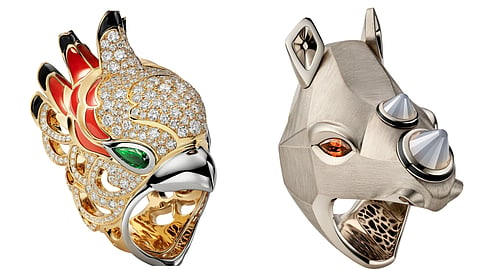
The five new creatures join The Gallery of Animal Portraits, a new ring collection under the Faune and Flore de Cartier line, launched globally on September 1, 2026. Each ring is built around a sculpted animal head, a format Cartier first used for a panther head ring in the 2000s. Cartier's animal jewellery history predates the panther by decades. Birds and insects entered the maison's repertoire at the start of the twentieth century, followed by reptiles, felines, and chimeras, then the zebra and the elephant. The panther eventually came to reign over this fauna, curling into a full diamond coat or appearing sculpted in the round on a watch dial. Robb Report India breaks down the five new rings, their materials, and the savoir faire behind each one.
Every piece in The Gallery of Animal Portraits is made in Cartier's jewellery workshops. The jeweller chisels each head, fuses metals—platinum and yellow gold for the parrot—and alternates surfaces of polished or hand-brushed white gold for the rhinoceros, as close as possible to the animal's original colour. The paving techniques are specific to the Maison: fur setting and calibrated sapphires set in rails to evoke the tiger's striped coat; a galuchat-effect paving in white diamonds sprinkled with sapphires—a jewellery metaphor for ice and crystallisation. The lapidary softens the rhinoceros's horns in opalescent smoky quartz highlighted with a line of black lacquer, carves the carp's gills in dumortierite quartz, and readjusts by hand the parrot's coral and onyx feather tuft. Beyond surfaces, the finishing is tactile and in some cases mechanical: the crocodile's jaw articulates, opening and closing; the interior of the rhinoceros's mouth is perforated to echo the cracked appearance of its skin; the striated palate of the carp is suggested in alternating white and rose gold. These are decisions that have no audience—they will be invisible to almost everyone who sees the piece. The Maison makes them anyway.
Pierre Rainero, Director of Image, Style and Heritage at Cartier, frames the collection's intent precisely: "The Cartier fauna is distinguished by its character. First of all, in the choice of species—big cats, reptiles, savannah animals—and also in the creative treatment, between naturalism and extreme stylisation. Through the interplay of design, materials, and execution, Cartier questions the very perception of the animal and opens up extraordinary possibilities for exploring forms. Each creature, each creation reveals its own symbolic force, reflects an attitude, a personality trait or a state of mind. It becomes an opportunity to deliver a message about yourself."
The five Faune and Flore de Cartier rings are made in white gold, platinum, and rose gold, set with onyx, sapphire, emeralds, diamonds, coral, tsavorite garnets, spessartite garnets, smoky quartz, aquamarine, grey agate, and dumortierite quartz. Each is produced in Cartier's jewellery workshops.