
Subscribe
Subscribe
- Motoring
- Style
- Home & Design
- Travel
- Food & Drink
- Specials
- News & Tech
- Videos
There is a particular stillness to a Hermès show that feels increasingly rare in the churn of Paris Fashion Week. After many seasons of witnessing the brand's collections march down the runway, I've come to learn that it's a sign of their unmistakable clarity in everything the house attempts. A chair, a show, a perfume, a lipstick case, an eyelash curler. If it isn't deeply clever, unusual and focused on design and an underscoring joy, it won't come out to meet the world.
At the Fall/Winter 2026 show at the Garde de Républicaine in Paris, this clarity seemed more pronounced.
From my seat—wedged between actor and singer Shibani Dandekar and designer and Hermès client Krésha Bajaj—the mood settled even before the first look emerged. Bajaj leaned in early and remarked, "It's always about what you discover later." It felt like an apt preface. Hermès tends to unfold itself in increments rather than spectacular moments of show and pomp.

At first glance, the collection seemed pared back, even austere. But closer attention revealed a relentless interrogation of material.
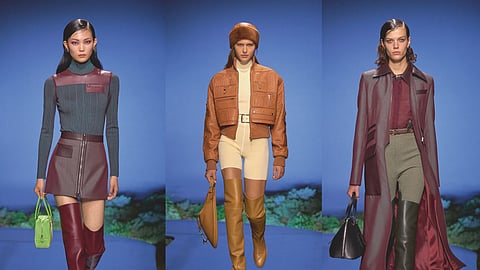
Leather is the chosen material language at Hermès. There were pieces that appeared almost weightless despite their density, cut with a precision that allowed them to fall like cloth. A burgundy leather trench—one of the standout pieces—embodied this balance.
What stood out most was the tactility. You could almost feel the garments from the front row. A brushed shearling lining glimpsed through a half-fastened jacket. The faint grain of treated leather trousers, softened to the point of fluidity. There was a technical clarity to many of the pieces. Diagonal zips sliced across torsos, closures became design lines—clever use of details that brought structure and glamour.
There was a subtle return to nature with the brand's theme of the year: Venture Beyond. But, of course, Hermès approached it obliquely.
If there was a nod to nature, it was handled with the same discipline as the clothes themselves. Earthy tones—deep burgundy, moss, tobacco—anchored the collection, but nothing felt literal. Instead, the idea of nature came through in texture and tactility, in how materials absorbed light, in how garments moved. Or in the set that absorbed us. As Dandekar later said, "I really loved the enchanted kind of feel that the set had. You were actually walking on grass when you walked in."
The vibe of the show itself felt otherworldly—the set a bit like an unidentified flying object had landed on another planet. And some of the clothes did nod to skiwear—done Hermès style in colours of ochre, auburn and waist-snatching tight Lycra biker shorts.
If the materials spoke softly, the styling sharpened the message.
There was a disciplined layering at play—coats over tunics, tunics over trousers, each element calibrated rather than piled on. The silhouettes leaned long and lean, with an emphasis on linearity that felt both modern and timeless.
Accessories were not afterthoughts but anchors. Belts cinched with almost architectural intent. Boots that rose just enough to meet the hemline without disrupting it—one of Dandekar's favourites from the show. Bags—structured, discreet—were integrated into the look rather than spotlighted, reinforcing the brand's refusal to chase visibility over longevity.
Even as parts of the global luxury market show signs of recalibration, Hermès continues to demonstrate resilience, particularly in markets like India. A recent Mint Lounge report noted that while several luxury players are experiencing a slowdown, Hermès has maintained steady growth, supported by a client base that values craftsmanship and longevity over trend-driven consumption.
A longtime wearer and collector of the brand, Bajaj shared that for her, Hermès isn't just about one iconic item—it's about how everything fits into a wardrobe over time.
She has older Hermès pieces—particularly from the Jean-Paul Gaultier era—in her wardrobe that, according to her, had a certain boldness yet remained firmly within the house's language. Those vintage accessories and clothing are her favourites for how they feel collectible but still wearable.
This is reflected in the brand's focus on continuity—the way pieces remain relevant across decades, the absence of forced reinvention. It is a perspective that aligns closely with what was seen on the runway.
Perhaps that is its most compelling proposition today. In a landscape defined by acceleration, Hermès continues to operate at its own pace—refining, adjusting, perfecting.
Leaving the show, what lingered was not a single look but a cumulative impression. What the brand continues to do—both on and off the runway—is resist urgency.