
Subscribe
Subscribe
- Motoring
- Style
- Home & Design
- Travel
- Food & Drink
- Specials
- News & Tech
- Videos
AI generated summary, newsroom reviewed
For thirty nine years, British textile brand Christy has designed the official towel of the Wimbledon Championship. Officially beginning in 1987, the collaboration has introduced a new design every single year since. Perhaps one of the international sport’s most recognisable objects, the Wimbledon towel adds a vibrant touch to the Centre Court at London's All England Lawn Tennis and Croquet Club (AELTCC).
Over these past four decades, what primarily began as a practical item has grown into something much bigger. An estimated 2,500 towels disappear from the tournament grounds every year — each missing towel is a living proof that everybody wants a piece of it. "It is equally a keepsake that players and fans treasure long after The Championships have concluded," shares Vanshika Goenka, CEO of Christy. "It's wonderful to see legendary players like Roger Federer, Novak Djokovic and Iga Świątek speak about taking the towels home for themselves, their families and support teams."
However, behind this quintessentially British tradition sits a long-standing partnership. Welspun, the Indian textile giant and guardian of Christy, orchestrates this annual collaboration of luxury, heritage, and innovation — and while the towels might be used on the grassy courts of Wimbledon, they are produced in a faraway land, in the city of Vapi in Gujarat. Follow us as we take you through the history behind this legendary collaboration and what the latest 2026 collection has in store.

Christy’s history dates back to 1850, when a cotton mill in Manchester began weaving the softest bath towels the world had ever seen, famously crafting their very first towel for the Queen of England. Ever since, the brand has been associated with an inherently British style that has sustained through time. Originally, these renowned towels were manufactured in the Greater Manchester area in the UK. In July 2006, Welspun India acquired the heritage towel brand, following which production was relocated to Vapi, Gujarat in 2010.
"Christy brings nearly 175 years of British heritage, while Welspun brings the innovation, scale and manufacturing excellence that transform those designs into the iconic towels seen on Centre Court," reflects Goenka. Vapi’s advanced manufacturing capabilities transformed how these towels were made, proving that Indian craftsmanship and production technology could effortlessly meet the uncompromising standards of The Championship.
"Bringing production to India has enabled us to create a more agile and integrated manufacturing process while preserving everything that makes the Championship towel so distinctive. By combining Christy's design heritage with Welspun's manufacturing expertise and Indian craftsmanship, we've improved production efficiencies and created the flexibility to meet the evolving needs of The Championship, all without compromising on quality," notes Goenka.
This geographic move highlights the prominent role played by India’s textile industry across sourcing, manufacturing, and supply chain management. Textiles have been one of India’s oldest and fastest growing industries. As one of the world’s largest cotton producers, India offers an extensive raw material base and centuries of traditional expertise across different regional practices.
Designed each year in Christy’s Manchester studio, the Wimbledon towel is engineered to withstand the rigours of a Grand Slam tournament. With close to 50,000 towels being crafted each year for The Championship and official Wimbledon retail, the process begins nearly eighteen months in advance, with each towel taking approximately seven days to complete. "The towels are woven using a yarn-dyed jacquard technique, where coloured yarns are woven directly into the fabric rather than printed onto the surface. It's an intricate process that brings together heritage craftsmanship with technical precision," shares Goenka.
The towels are made using Welspun's patented HygroCotton® spinning technology, which enhances softness, absorbency and moisture management. Moreover, in a move towards sustainability, the towels bear the Oeko-Tex MADE IN GREEN certification and utilise cotton sourced through the Better Cotton Initiative. The parent company Welspun has also eliminated all unnecessary plastic packaging, opting for FSC-certified card packaging instead.
Between Manchester and Vapi, Christy’s iconic Wimbledon towel has become a material archive of every annual championship, each design bookmarking a moment in history. The inaugural batch of towels released in 1987, were designed in alternating stripes of deep green and purple with no explicit branding on the face. The 1997 towel marked a notable change in style with the addition of the official Wimbledon logo and tournament dates as prominent design features, establishing a template for future designs.
These two additions turned the practical towel into a cultural object, a collectible worth keeping. Recently, on the hundredth anniversary of the Centre Court in 2022, Christy designed a detailed architectural plan of the court onto a large state-ment sized towel which could be folded and packed into its own fabric carry bag to commemorate the event.
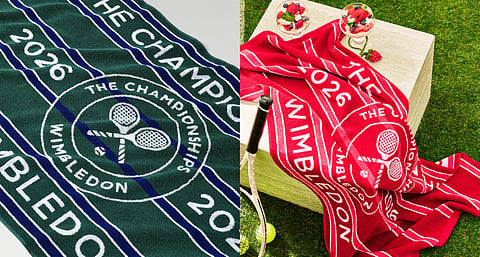
The 2026 Collection effortlessly moves from the court to the home. While the instantly recognisable green and purple towels remain at the heart of the collection, Goenka explains that each year a seasonal colourway celebrates a different facet of the Wimbledon experience. "For 2026, that's strawberry red, a nod to one of Wimbledon's most beloved rituals: strawberries and cream on The Hill," she shares.
For the first time in history, Christy has also released a Championships Mini Collection for children who are fans of the tournament or might not have even picked up a racquet yet. You can choose between the Future Champions edition, featuring embroidered rackets on the hood or Pip the Straw, a playful character rooted in this season’s signature colour.
The Heirloom Collection: Embodying the philosophy that the most responsible thing a textile can do is last, the Heirloom Collection gives previous seasons’ towel a considered second life by upcyling leftover cotton terry towels into tote bags, robes, and cosmetic pouches, bridging the gap between sporting history and sustainable luxury.