
Subscribe
Subscribe
- Motoring
- Style
- Home & Design
- Travel
- Food & Drink
- Specials
- News & Tech
- Videos
AI generated summary, newsroom reviewed
Fashion has always been one of those art forms that changes with the times, picking up the mood of an era almost without meaning to. And if you look back through Indian fashion history, there is one event in particular that marks a genuine turning point: the Calico fashion show of 1958. That year, Ebrahim Alkazi invited Bhanu Athaiya to design what would become independent India's first travelling promotional fashion show, commissioned by Calico Mills. It was staged at the "India '58" Trade Fair in New Delhi, and it has stood ever since as one of the pivotal moments in the story of Indian fashion.
As Robb Report India celebrates its first anniversary, we look back at the pioneering firsts that have shaped India’s luxury and lifestyle landscape.

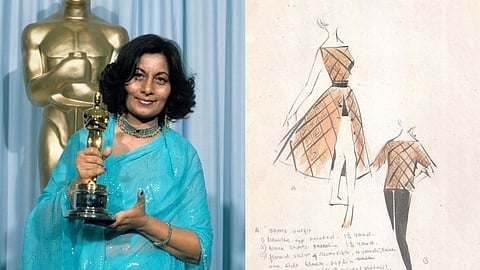
The year 1958 turned out to be a genuine turning point for Indian fashion, and it happened because of an unlikely commission. Ebrahim Alkazi, already a towering figure in Indian theatre, was the one who brought the project together for Calico Mills, blending art, craft and performance into a single travelling show. What made it so different from anything before was the person he chose to design it: the artist Bhanu Rajopadhye Athaiya, whose work would go on to leave a lasting mark on Indian fashion. Her designs were never just clothes. They told a story about India itself, weaving together handwoven fabric, fine embroidery and a real sense of design, so that every outfit carried something of the country's heritage in it. When the models walked out wearing them, they were not just modelling garments, they were putting Indian craftsmanship on display for the world to see, the same textile traditions that had shaped the country's identity for centuries.
Bhanu's designs from that first Calico show carry enormous historical weight, but they are fragile too, in the most literal sense. These were never simply garments, they were delicate pieces of art in their own right, and that same delicacy means they have not aged well with time. Many of the original sketches are now too fragile to be put on display. And yet none of that takes away from what they meant. The 1958 Calico show remains a defining moment in Indian fashion history precisely because Bhanu's work went beyond clothing altogether, becoming a living record of India's cultural heritage. Even if the designs themselves can no longer be exhibited, their legacy has outlasted the paper and thread they were made from, standing as proof of the artistry and dedication of the people who helped shape Indian culture.
Bhanu went on to become one of Hindi cinema's defining costume designers, working across more than a hundred films for directors like Guru Dutt, Raj Kapoor and Yash Chopra, quietly shaping how generations of Indians pictured glamour on screen. That story reached its most famous chapter in 1983, when she won the Academy Award for Best Costume Design for Gandhi becoming the first Indian ever to hold an Oscar, a good quarter century before Indian cinema became a regular presence at the ceremony. She was also nominated for a BAFTA for the same film, and was remembered in the Academy's In Memoriam segment in 2021, the year after she passed away.
Later in life, she carried that same instinct for craft, for heritage, for cloth with a story behind it into new spaces. She taught fashion design and the history of Western fashion at NIFT Mumbai, curated shows for the Ministry of Textiles celebrating Tamil Nadu's silk and cotton handlooms and Bengal's weaving traditions, and even took Indian costume all the way to New York, giving an illustrated talk at the Cooper Hewitt Museum under a programme fittingly called "Living in Harmony." Wherever she went, the thread stayed the same: Indian craft deserved a place on the biggest stages in the world, not as a curiosity, but as genuine luxury.
The Calico show was not a one-off for Bhanu Athaiya, but part of a much longer relationship with Indian textiles and design that ran through her whole career. She went on to design a fashion show built around West Bengal's handloom traditions, showing just how easily she could move between regions and pick up the particular character of each one's craft. Her influence on the industry went beyond design work too, since she served on the founding board of governors of the National Institute of Fashion Technology for four years, helping shape how fashion would be taught and practised in India from the very start, and she later returned to NIFT Mumbai as a teacher, passing on her knowledge of fashion design and the history of Western fashion to a new generation. Her work with the Ministry of Textiles carried that same spirit further still, as she designed NIFT presentations showcasing Tamil Nadu's silk and cotton handlooms in Chennai and West Bengal's silk, cotton and handicraft traditions in Calcutta, keeping India's textile heritage in front of new audiences. And her reach eventually stretched well beyond India's borders, when she gave an illustrated talk and costume display at the Cooper Hewitt Museum in New York, sponsored by Air India as part of the Festival of India, under the fitting theme "Living in Harmony," a reminder that the cultural and artistic threads she worked with had never really respected borders in the first place.