
Subscribe
Subscribe
- Motoring
- Style
- Home & Design
- Travel
- Food & Drink
- Specials
- News & Tech
- Videos
AI generated summary, newsroom reviewed
For the first time in the history of the world-famous Pirelli Calendar, better known simply as The Cal, India takes centre stage, shot by two distinguished photographers. The 2027 edition foregrounds India as the protagonist in a collaboration between renowned Norwegian photographer Sølve Sundsbø and the Indian master Raghu Rai, creating a jugalbandi, the Indian tradition of a creative dialogue between two masters, through Western and Indian perspectives.

Following Rai's recent passing, however, of photographer Rai that was mourned by the whole country, his daughter Avani Rai, herself an internationally acclaimed photographer, stepped in to carry forward and realise her father’s intentions for the series.
The calendar was photographed across India, with Sundsbø's chapter shot between Jaigarh Fort in Jaipur and Ajabgarh in Rajasthan, while Avani Rai brought her father's vision, originally limited to the studio, into the streets of Old Delhi, revisiting many of the locations he photographed throughout his career.
Reflecting on her decision to move the project beyond the studio and into the streets, Rai reflected: “Originally, when my father was putting it together, the idea was to have his older, unpublished works as the backdrop and frame, and it was supposed to be in a studio.” Later, she explained that when she decided to take up the project, she “felt that he [Raghu Rai] belonged to the streets. So, I took the same idea he was putting together into the streets, to the people he photographed throughout his life. And I stand behind him: I frame him, I frame his work and I frame the reality that exists 30, 40 or 50 years later.”
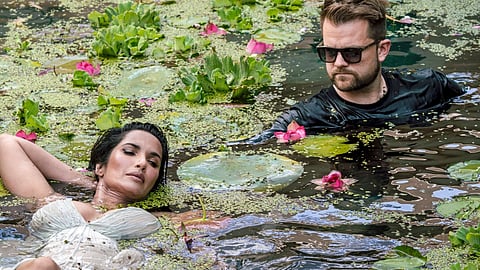
For his part, Sundsbø remarked that “When we started talking about it, it was quite clear that I couldn’t do this project on my own. I had no right to do it on my own.” Later, informed that Raghu Rai himself would be part of the project, the Norwegian photographer was delighted as he takes the late Indian photographer to be something akin to “a photography god.” Sundsbø’s contribution focuses primarily on portraits. “I’m concentrating on portraits of people from this country,” he says, “and then I’m leaving Avani the harder job of trying to capture more of its soul.”
In terms of casting, Sundsbø’s lineup includes actresses such as Aditi Rao Hydari and Avantika Vandanapu, actress and producer Freida Pinto, musician and composer Anoushka Shankar, poet and performer Rupi Kaur, models Lakshmi Menon and Bhavitha Mandava, author, producer, television host and culinary entrepreneur Padma Lakshmi, as well as photographer Avani Rai herself. On the other hand, Avani Rai’s cast entails more than 200 people, including everyday people, dancers, street artists, artisans, musicians and performers, as well as Avani’s own mother, Gurmeet Rai.
After all was said and done, when the photographers were asked what they hoped people would feel upon encountering the works, Sundsbø spoke of embracing the colour, flowers, intense light and visual richness that, to him, express India's timeless character without reducing it to a single narrative. Avani Rai, meanwhile, turned his gaze towards continuity. “I decided to take this project onto the streets, amongst people he [Raghu Rai] has spent his life photographing and where he belongs. When people look at these images, I want them to experience this continuity.”