
Subscribe
Subscribe
- Motoring
- Style
- Home & Design
- Travel
- Food & Drink
- Specials
- News & Tech
- Videos
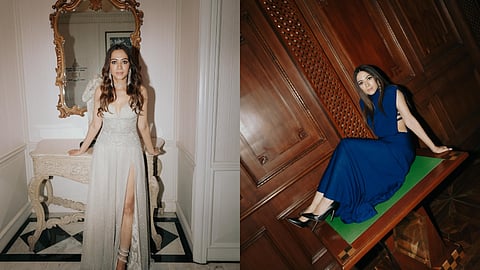
Krésha Bajaj has never looked at couture as “clothes." Every piece that leaves her studio carries the work of artisans who sit with beads, crystals, and hand-embroidery for countless hours. With her new flagship store now open at DLF Emporio in New Delhi, she invites people to experience her world in person. “We wanted the store to feel like a private atelier,” she says in an exclusive conversation with Robb Report India. “A place where people can see, touch, and understand the soul of the craft,” she adds.
Robb Report India (RRI): With the recent surge of media attention on Indian craftsmanship, how do you see this changing the economics and aspirations of craft communities?
Krésha Bajaj (KB): I have always felt that Indian karigari is intricate, special, and deeply rooted in who we are. Globally, it has been admired for years, not only in fashion but also in interiors, furniture, and crockery. Right now, the surge is louder because several luxury houses are looking to India for inspiration, and are using our techniques and motifs in their collections. Some pieces even look identical! For instance, when the Kolhapuri chappal technique was used abroad and the final product resembled the original Indian design, it sparked a conversation. But the truth is that whether it is zardozi, hand embroidery, or block printing, people have been drawing from Indian craft for a long time.
RRI: There is a growing debate about how artisans are represented in fashion coverage and on social media. How do you ensure the names and skills behind each Krésha Bajaj piece remain visible and credited?
KB: At Krésha Bajaj, we always speak about our artisans and our team because one person does not make a brand. That belief shows in everything we do. On our website, we talk about our artisans. On Instagram, we show them working. In our recent bridal campaign, Aurelia, we not only show the models wearing the pieces, but we also showed the faces of the craftsmen who created them. Their hands, their work, and their identity is a core part of our narrative.
RRI: When translating intimate narratives into commercial collections, how do you balance personal storytelling with scale while protecting craft integrity?

KB: For me, protecting craft integrity is about honouring the craft and keeping it alive. Many people move away from detailed techniques because they take time. In our studio, after every bead is embroidered, the artisan ties a knot. It means that if a thread ever opens, the embroidery will not unravel. It takes longer, but it lasts. Others prefer quick or inexpensive shortcuts, but shortcuts do not stand the test of time.
The Love Story Lehenga is often spoken about because it visually tells a personal story with letters, dates, and illustrations. But honestly, storytelling exists in every piece we make. We look at every ensemble as a person. Our outfits are a ‘she.’ She has a name, a life, and a history.
In the Acropora collection, each piece came from my diving logbook. One garment is blue because, during a dive, we saw nothing for a long time, and then suddenly, through the thermocline, there was a burst of light. We placed crystals at the centre to capture that exact moment.
In Aurelia, inspired by Miss Havisham from The Great Expectations, one of the pieces was designed as if it had been left in a garden. Threads take the shape of creepers. The embroidery grows over the fabric like a memory that never left. That, to me, is storytelling through craft.
RRI: How do you view the Delhi market in terms of client sensibility, bridal demand, and appetite for contemporary luxury?
KB: New Delhi has been incredibly welcoming. I wanted to stay true to the aesthetic of the brand. Yes, we create special pieces depending on the market, but we never compromise our signature look. New Delhi loves traditional saris, Mumbai prefers pre-draped ones, so we kept that in mind while planning. But our embroidery, colours, and designs remain the same.
The response has been amazing. People kept saying that the store felt like a breath of fresh air—that was the biggest compliment for me!
RRI: What are three wardrobe staples from your collection that offer immediate impact and long-term wearability?
KB: My signature hand-beaded scalloped cape. You can fold it into your handbag, and throw it on for any occasion—whether you are at the office, at an event, or stepping into a cocktail evening. It works with denims, saris, lehengas, and even a swimsuit.
Second, our corsets. My favourite is the pearl corset. It is metal-boned and cinches the waist beautifully. You can pair it with trousers, skirts, lehengas, saris, or shorts.
Lastly, our beaded pants. They look like jewellery and at first people think they are not wearable. But once they try them, they realise how versatile they are. Many clients have worn theirs six or seven times in just a few months! For me, that is the biggest win, when a piece becomes your go-to because it makes you feel confident every single time.
RRI: How do you measure success today?
KB: It is everything. Growth, global appreciation, and client happiness matters. But above all, it is about my team and my artisans. Nothing is possible without them. Every single piece we make is handmade. Even a jacket or blazer is hand-hemmed and fully finished by-hand. For me, the simplest measure of success is when demand becomes higher than supply. That is when you know your work is truly connecting with people.