
Subscribe
Subscribe
- Motoring
- Style
- Home & Design
- Travel
- Food & Drink
- Specials
- News & Tech
- Videos
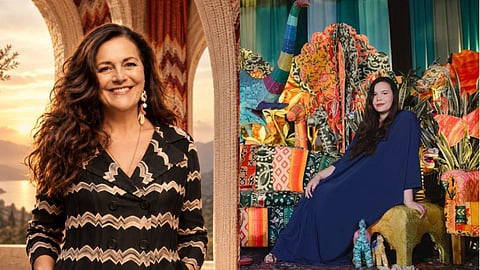
When invited to build a pop-up at the Experience Design Summit (EDS) in Jaipur, Teresa Missoni began where her family always begins: with the cloth. The summit, held at Mundota Fort & Palace, brings together international voices from design, culture, hospitality and storytelling. Its founder, Samit Garg, asked her to explore how beautifully cultures can come together. Seen through an Italian fashion lens, Rajasthani fabrics and crafts became a world of rich patterns, playful animal forms and bold colour.
Later, Teresa and her mother, Angela, sat down with Robb Report at The Imperial, Delhi, at a gathering hosted with Avarna Jain, Vice Chairperson of Saregama and Chairperson of RPSG Lifestyle Media.

It was Ottavio "Tai" Missoni and Rosita Jelmini who founded the house in Gallarate, northern Italy, in 1953. By his daughter’s own admission, Ottavio was never much into fashion. Rosita, however, came from a family that ran a shawl-making textile factory. When they got to work, their first catwalk collection came in 1967, and the zigzag knitwear they became known for helped launch Italian ready-to-wear. After a few glorious years, in 1997 the founders handed the main line to their youngest child, Angela, who led the creative side for 24 years and stepped down in 2021. Rosita moved to Missoni Home and passed away in January 2025, aged 93.
Teresa is the third generation; she designs and illustrates, and once created a capsule collection for the American label Eloquii, drawing on her travels in Africa, India and Sardinia.
When asked about creation and the vision at the get-go, for Angela, design begins in the hands. "You have to wear the dress; never let the dress wear you," she says. "Before choosing a fabric, I want to feel it." Colour comes even earlier: "you do your colour cards first," she explains. It is an old habit from the Missoni factory, where yarns and colours had to be settled long before the dresses, so that production could keep pace. For Teresa, however, much in tandem though she might be with her mother, a certain tactile element takes a more important seat when starting out on a project. “I begin designing, it's the touch, the fabric, how it feels on your skin and your body. Before choosing a fabric, I want to feel it. Nine times out of ten, I like to wear things that, even if they're beautiful, feel like a second skin,” she says.
How does one incorporate the demands and trends of the hour without diluting originality and individuality? To this end, Angela is clear that carrying a legacy did not mean living in the archive. "I never worked from the archives," she says. "I wasn't working on the old things, but I had the memory of them." Teresa, on the other hand, comes with an angle of mindful reformation. Her parents, she says, "invented a style, which was like a language, and I was able to update its lexicon and vocabulary."
She does not believe the family simply inherited it. "They say you have it in your blood, but I don't think so," she says. Instead, she was lucky to grow up among extraordinary people. Teresa agrees, recalling her grandparents: her grandmother arranging a house, her grandfather choosing the flowers for his garden and the colours of his clothes at the same time. "That's what we carry outside the business," she says.
The two are less sentimental about the industry today. "I don't think fashion today is a good place for creative people," Angela says. "It's about merchandising." She remembers realising things were shifting at a Herald Tribune luxury conference held in London, when talk turned from fashion to luxury, the fine line between the two only to soon get blurred. Fashion can be luxury, she says, but it doesn't alone have to be that.
Teresa, who grew up reading fashion magazines and watching shows online, holds the speed of images and a certain flattening of culture accountable. She would order a piece after a Missoni show, and by the time it arrived, she says, owing to mindless replication and ubiquity, "I was already tired of it." Constant exposure, she adds, "took the dream away."
In Jaipur, "it was a love letter to Rajasthan; that was the idea," Teresa says. She asked the organisers for a list of crafts and tried to bring them into one coherent world. It had to be pleasant to see and to touch, and it "had to scream Rajasthan, but in an unexpected way." Perhaps in a way as to see Rajasthan through Italian eyes.
Her method is consistent, whether in India or Sardinia, where she recently worked with the shop Cabana. For that project she tracked down the last artisan still making a vintage style of souvenir vase, in Dorgali, and drew on the old designs for new ceramics. "First you need to be very true to the technique," she says, "and then put your view on it." Sustainability, for the mother-daughter duo, starts with respecting the maker. Every bit left over has a value, she says, and "you take, and you give back." She had hoped the Jaipur pieces could be sold for charity, though time ran short.
Asked how their approaches differ and where they converge, for the two represent two generations of the same creative family, Teresa is generous. She learned from watching: playing with fabric cut-outs in the family factory after school, and seeing a way of working. "I don't think two people can have exactly the same vision," she says. "They can agree, and like each other's vision, but each has their own."
Angela closes with a lesson from her own mother, Rosita, who had a gift for finding four-leaf clovers. When one of Teresa's cousins asked how she did it, Rosita answered: "In life you have to search for your luck."