
Subscribe
Subscribe
- Motoring
- Style
- Home & Design
- Travel
- Food & Drink
- Specials
- News & Tech
- Videos
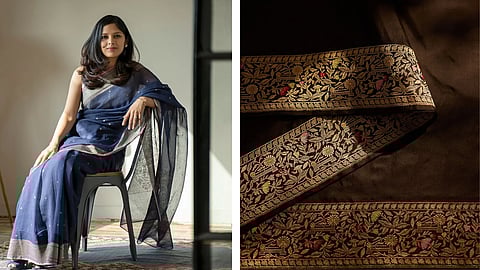
Born in Banaras and built on the belief that true luxury lies in mastery, material integrity, and time-honoured skill, Tilfi is steadily reshaping the vocabulary of contemporary Indian craft. As a craft brand rooted in the handloom traditions of Varanasi, the team approaches heritage with innovation and technical rigour, before contextualising it for contemporary relevance.
Founded in 2016 by Aditi Chand alongside Udit and Ujjwal Khanna, Tilfi emerged from a five-decade-old family legacy in Banarasi weaving, but with a distinctly modern ambition: to create a global, craft-first luxury house grounded unapologetically in its city of origin. Even its name signals this intent.
“Tilfi” refers to a Banarasi weaving technique in which three coloured yarns run continuously without a break, symbolising the brand’s three ideals: Pure (natural materials), Handmade (craft-led processes), and Banaras (deep regional roots).
Today, working with over 2,000 specialised artisans and producing exclusively in Banaras, Tilfi oversees everything from first sketch to final weave—marrying in-house design with generational expertise. In conversation with Robb Report India, Chand reflects on building an enduring brand anchored in heritage, rigour, and the confidence of handmade excellence.

Aditi Chand (AC): Yes, I do often describe myself as an accidental entrepreneur because I did not come from a conventional fashion or design background. What prepared me was my professional, academic, and personal experiences.
Growing up, I lived and travelled across the length and breadth of our country as well as overseas. That gave me a deep sensitivity to culture, people, and tradition. Academically, my journey gave me rigour and an orientation towards structure, systems, and long-term organisation building.
I wasn’t trying to build a fashion brand. I was trying to build something enduring, and that has shaped both my journey and Tilfi’s from the beginning.
AC: One of the most misunderstood ideas is that buying directly from a weaver automatically supports the craft. Banarasi weaving is not an individual effort. It is the product of an ecosystem. Every textile is the outcome of a collective—design, graphing, loom setting, dyeing, weaving, finishing, marketing. No single participant is more important than the other.
Sustaining craft requires strengthening that ecosystem. It doesn’t need quick fixes or charity. At Tilfi, we take a long-term view—investing in skills, designing with intention, and maintaining consistent demand so livelihoods improve sustainably. That’s how we correct the narrative.
AC: Reinvention must be born out of mastery. You cannot meaningfully reinvent something you don’t deeply understand. Heritage gives you the codes and grammar; reinvention builds on that foundation. We don’t treat craft as a surface aesthetic. Innovation must come from deep respect and technical understanding. The line is immersion in tradition before attempting to rewrite.
AC: It began almost as a happy accident while designing our first store in Banaras. We wanted to explore crafts native to the city and discovered metal repoussé. It is a GI craft that predates handloom weaving. Its expression had largely been limited to temples, and we saw potential for new interpretations, much like we had done with weaving. For over four years, we created pieces only for our own spaces. The response was overwhelming, and earlier this year, we formally opened up metal repoussé as a body of work for Tilfi. It felt like a natural extension of our language into a new medium.
AC: Choosing to pursue the highest possible quality in Banarasi craftsmanship. It limits scale, speed, and access. But it was a conscious, long-term choice. We chose to go deep instead of wide. That decision has defined our identity, the trust we’ve built, and the investments we’ve made within the ecosystem over the past decade.
AC: Handloom pieces age gracefully. They carry time. They soften, yet deepen. They hold memories of the wearer and of the hands that created them. That human presence is irreplaceable.
AC: By insisting on excellence at every level. Even with simpler techniques, that persistence must remain. Scale doesn’t mean dilution. It means better systems and higher standards. We will grow slowly, but we won’t compromise on integrity or our value system.
AC: As a global name synonymous with India-born, craft-first luxury. A house that stands for excellence, timeless design, and cultural depth. We want to build a brand that is rigorous in its craft and generous to its people—deeply rooted in Banaras and the communities that make our work possible.