
Subscribe
Subscribe
- Motoring
- Yachting & Aviation
- Style
- Home & Design
- Travel
- Food & Drink
- Specials
In recent years, as conversations around representation in women’s cricket continue to shape global culture, Smriti Mandhana has emerged at the forefront. Among the most accomplished players of her generation, Mandhana has played a pivotal role in the growth of women’s cricket in India. As the first Indian woman cricketer to score centuries across all three formats of the game, Mandhana has played a key role in bringing greater attention to women’s cricket, inspiring a new generation of athletes.
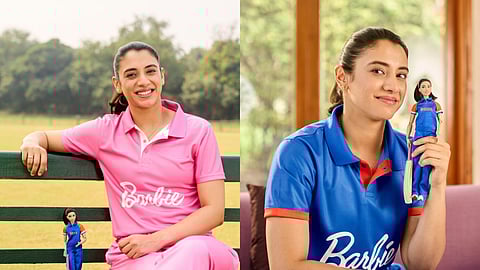
Recognising her influence, Barbie has named Mandhana as part of its first-ever Dream Team Role Models. The cricketer will represent India in the inaugural cohort alongside global athletes and changemakers, including Serena Williams, Chloe Kelly, and Stephanie Gilmore. The doll is crafted as a symbolic tribute to her achievements and influence in the sports industry. For our digital campaign, Women at the Helm, we spoke with Mandhana about why women representation in sports is important, and what global recognition means to her.
Smriti Mandhana: For me, leadership has always been about being practical and straight forward. It's about the kid who showed up early for nets, helped pick up the balls post practice, and the one who clapped the loudest when a teammate did well. In my early years, I didn't call it leadership. Rather, I just did those things because I cared about the team. Over the years, these small habits carved the way I am now.
Mandhana: I feel every milestone brings personal joy and is a constant reminder of how far the game and I have come. I celebrate the wins because they’re the result of showing up. But I also think about the girls watching who might never have seen those numbers attributed to a woman before. That perspective makes the moment bigger than me. I try to treat milestones as both a 'thank- you' to the people who supported me and a nudge to keep pushing for more visibility and opportunity for everyone.
Mandhana: When a girl sees someone who looks like her on TV, in the papers, or now as a Barbie, that is what representation is to me. That visual shifts the idea of her own limits from "that's not meant for me" to "hey, wait. That could be me." This transition, I feel is powerful than anything because it makes risk-taking and initiation feel worth it. I think that outcomes, selections, pay, and crowds often follow that inner change, but the belief is something that must come first.
Mandhana: Like any other player, I try to keep my focus on all things practical and on the things that are in my control. Two things that help me grounded when the noise gets louder are my family a few close teammates. But, on the other hand, I also treat criticism as a data that's useful for my own betterment. I think the more you build confidence through consistency, the less people's expectations affect how you feel about yourself.

Mandhana: It was emotional, both for me and my family. All I could imagine was that somewhere, a little girl could open a box and see a cricketer who looks liek her. For me, the doll was more about what it represented, i.e., acceptance, visibility, and access for girls to dream in ways that weren't offered to them before. It also meant that sports belong to girls just much as as anyone else.
Smriti Mandhana: I hope they say that the path got easier. That there were more coaches, better facilities, and that playing for India was a normal dream for a young girl. That is when I'll feel we did something right. I want young atheletes to feel they inherited a game with more room to grow and more people cheering them on.