
Subscribe
Subscribe
- Motoring
- Style
- Home & Design
- Travel
- Food & Drink
- Specials
- News & Tech
- Videos
AI generated summary, newsroom reviewed
Deeply rooted in physics and engineering, Kent Engineering & Foundry or KEF as they are known globally has more than 60 years of experience in extracting pristine sound from more than mere black boxes. Always the ones to lead by function, they have also continually pushed the boundaries of form and working with one of the world’s leading industrial designers has only solidified their position.
The LS Luxe is Ross Lovegrove's fourth collaboration with the British audio house and they treat the cabinet as sculpture first, engineering second, and still manage to get the acoustics right. Launched in the US and EU for roughly $4000, the LS Luxe is slated to come to Indian dealers by October and will sit between KEF’s iconic LS50 Wireless II and LS60 wireless speakers.

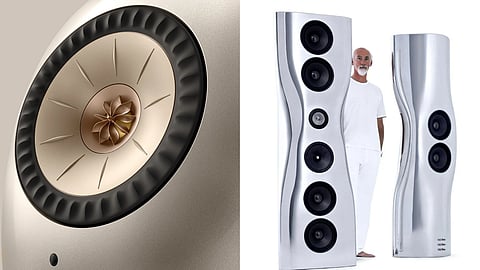
So, while every other wireless speaker is designed to disappear into a room, the KEF LS Luxe was designed to impress even before it plays a single note. It totally abandons the rectangular box approach that has defined stereo speakers since the 1950s for a smooth, egg-shaped shell with no visible front baffle, no trim ring, and the KEF logo demoted to the rear so nothing interrupts the silhouette.
This is the newest expression of the collaboration with Ross Lovegrove that started back in 2007 with the Muon, a 2-metre, 115-kilogram aluminium monolith formed using a super-forming process borrowed from aerospace manufacturing. It was hand finished, individually signed, and limited to 100 pairs at $2,20,000 a pair at current market value.
The Welsh designer has become one of the defining voices of organic industrial design, drawing inspiration from biology and natural evolution rather than geometric minimalism as can be seen in the Muon, LS Luxe and even the concept car he’s designed for Renault. His portfolio stretches far beyond audio, encompassing work for Apple, Sony, Vitra, Kartell, Louis Vuitton Moët Hennessy and architectural installations that blur the boundaries between product design and sculpture. Museums including New York's MoMA and Paris' Centre Pompidou have permanently collected his work, cementing his influence far beyond consumer electronics.
Back to the KEF LS Luxe, the instinct isn't decoration here but rather the elimination of every hard angle on the speaker cabinet which causes sound waves reaching the edge to bend and scatter around, a phenomenon called diffraction. It colours the output before it reaches a listener, which is why Lovegrove's continuous curved shell, down to a rear heatsink follows the body line instead of interrupting it and is designed to propagate the sound waves evenly throughout the room as they emanate from the Uni-Q driver.
KEF's 12th generation 6.5-inch Uni-Q driver places the tweeter at the acoustic centre of the mid-bass cone, so the two behave as a single point source and widen the usable sweet spot well beyond one chair. Behind the tweeter sits MAT, KEF's Metamaterial Absorption Technology, a maze-like structure the brand describes as an acoustic black hole and claims to absorb 99 per cent of the sound radiating backward off the tweeter before it can reflect through and muddy the signal. A new closed-loop system, Velocity Control Technology, monitors driver movement in real time to hold distortion down at any volume, following its debut in KEF's XIO soundbar.
Connectivity is comprehensive with HDMI eARC for hooking up to a TV, AirPlay, Google Cast, Spotify Connect, and Roon Ready arriving in 2027. The engineering continues beneath the surface. Dedicated Class AB amplification powers the high frequencies while Class D amplification drives the bass, all managed by KEF's latest Music Integrity Engine.
Audio purists may still want the freedom to endless swap cables and experiment with different kinds of amplifiers to power their speakers, but the KEF LS Luxe isn’t meant for that audience. Luxe is all about adding sophistication through a reductive design process and the belief that the finest objects should belong in our homes as naturally as possible, only drawing attention to themselves when someone presses ‘Play.’