
Subscribe
Subscribe
- Motoring
- Style
- Home & Design
- Travel
- Food & Drink
- Specials
- News & Tech
- Videos
The famous edict delivered by Steve Jobs in 2010 was finally buried by Apple with the introduction of its first ever touchscreen laptop, the MacBook PROLED XDR. Apple didn’t offer any reason for not defending its iconic founder's strong aversion towards touchscreen laptops, but it’s safe to assume that Apple is a lot more accommodating of different workflows now rather than dictating them. The way we create, design, and interact with our digital worlds has simply outgrown the defined boundaries of the trackpad. Some interactions may just be quicker, more accurate or simply more intuitive with a pinch and zoom action directly on the screen instead of multiple swipes of the trackpad. Now you have the option of choosing one or the other.

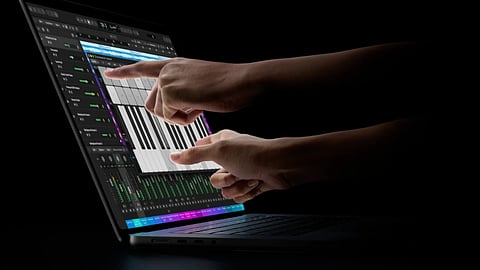
This is a philosophical pivot besides a radical tech implementation to get creative professionals closer to their work than ever before. Apple has engineered the touch sensor directly into the display panel itself rather than layering it on top like others and this is crucial in stripping away latency so it genuinely feels like you are touching your content. For an architect or interior designer, a complex 3D rendering can be spun, pinched and manipulated with the flick of a wrist. Even musicians can now play virtual instruments directly on the glass. New APIs will allow third-party app developers to optimise their software for touch-on-MacOS but from the get go, Apple has dropped names like Notion, Canva, Zoom, Microsoft Word, Excel, PowerPoint, Outlook, Adobe Lightroom, DaVinci Resolve, Blender, Maxon Cinema 4D, Maxon ZBrush, and Shapr3D amongst others
The real breakthrough here is the new PROLED XDR display that utilizes tandem OLED technology, essentially stacking two self-illuminating pixel layers. The result is a staggering 2000 nits of peak brightness and an absurd 10,000,000:1 contrast ratio that eliminates blooming and halos. Every panel is factory-calibrated, with reference modes for cinema, photography and print and Genlock support even syncs the display to a camera's capture for virtual production. For a filmmaker grading HDR footage on a flight or a fashion designer for whom the exact shade of a crimson fabric can make or break a seasonal line, this is absolute colour truth. Professionals finally have a portable, reference-caliber monitor they can slip into a leather tote.
Aesthetically the celebrated glowing Apple logo on the back of the screen is back! But more functionally, the bezels have shrunk further, yielding space for the Dynamic Island, which is an absolute delight of a feature borrowed from the iPhone. The existing MaxBook Pro is already one of the best sounding laptops. However, the PROLED XDR now extracts 50% deeper bass from its six-speaker audio set-up. Under the hood, the sheer brute force of the M5 Pro and M5 Max chips ensures the beauty is matched by
unrelenting brawn. When paired with up to 128GB of unified memory and 16TB of storage, there is virtually no workflow this machine cannot crush. Paired with Nanotexture finish on the display and the 40-core CPU option, you could easily breeze past the Rs 18 lakh mark to own the top-spec machine! Deliveries begin on November 9 in India and you could also opt for the entry level 14in M5 Pro PROLED XDR variant that starts at Rs 3,49,900 and get a taste of Apple’s latest and greatest laptop, ever.