
Subscribe
Subscribe
- Motoring
- Style
- Home & Design
- Travel
- Food & Drink
- Specials
- News & Tech
- Videos
Come September, there is a distinct energy in the air of Mumbai. The local train still runs and the traffic still crawls. The citywide festive energy settles over Lalbaug, Parel and Goregaon, among many other areas lasting for almost eleven days without pause. Streets turn into rivers of colour. Dhol beats bounce off apartment blocks. Somewhere above the crowd, a trishul catches the light on top of a pandal and underneath it sits an idol so large, so detailed that people queue for hours just to stand in front of it for a few seconds. This is Ganeshotsav and at its heart, is a Ganpati murti that someone spent months building by hand.
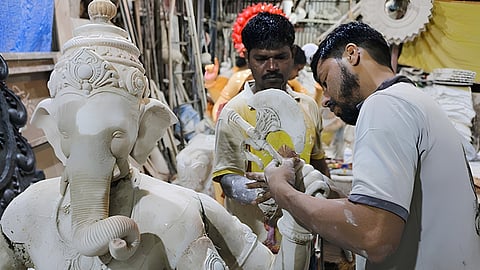
It's easy to see the finished idol and miss the craftsmanship that got it there. But behind every towering Bappa is a family, often the same family for eighty or ninety years running, who treat idol-making like an inheritance. And now as the nation comes together in a season of faith, tradition and celebration, it is also time to look at the hands behind these revered idols and the artisans who bring them to life.

Take the Kambli family of Mumbai. Since 1935, Ratnakar Kambli and his sons have shaped the Lalbaugcha Raja, working from their own workshop before travelling to the pandal to assemble the idol and add the final, painstaking touches. The ethereal eyes are always last, because in the tradition, an idol isn't truly alive until its eyes are drawn on. Nearby, in the same Lalbaug and Parel belt, the Khatu family have been sculpting since 1947 and their fingerprints are on more than just their own idols. Most of central Mumbai's master sculptors today trace their training straight back to the Khatu workshop, which makes them something like the grandparents of the whole local craft.
Travel south to Hyderabad's Dhoolpet hub and you'll find Lakshmi Narayan Singh Kalakar and Umesh Singh Kalakar, known for building massive, richly detailed, eco-friendly idols that anchor some of the state's biggest pandals before being shipped across the country. And then there's Pen, a small town in Raigad district that does the heaviest lifting of all. Pen is India's real idol-manufacturing capital, turning out fifty to sixty thousand Ganesha idols every year for buyers as far away as the US and Canada, alongside hundreds of thousands more sold across India. Veteran sculptor Khandu Bhagat is one of several senior figures still leading generations of local families through this work, alongside the Mhatre family, who have spent decades handcrafting thousands of traditional idols a year and sending Maharashtrian craftsmanship out into the world.
Also working out of Pen is the Hazare family, where Pandurang Hazare has spent more than seventy years making traditional shadu mati idols with pure clay and no toxic paints or Plaster of Paris, using methods that have barely changed since his own father's time. It's surely a slower, costlier way of working and these days it's almost a luxury in itself.
Back in Pune, the Palkar and Vedpathak family have kept the city's most historic idols looking exactly as they should. Shankarrao Palkar has spent decades painting Pune's iconic murtis, including the much-loved Akhil Mandai Ganpati and his daughter, Sangeeta Vedpathak, now carries that same legacy forward.
What connects these families is more than tradition. It is the patience, skill and devotion they bring to their craft, qualities that cannot be measured in money alone. A hand-sculpted idol, shaped by a family that's been doing this for three or four generations carries gravity that a factory-made piece never could. It is sculpted with history, intention and hours upon hours of human attention. That's the real indulgence at the centre of Ganeshotsav, more than the gold jewellery draped over some idols or the elaborate decor of the richest pandals. It's the fact that a family in Lalbaug or Pen or Dhoolpet chose, once again this year, to spend their whole year preparing for these eleven days.
So when you're standing in a in a crowded pandal this Ganeshotsav, watching the idol sway gently as it's carried towards the sea for visarjan, spare a thought for the hands that built it. Behind that serene, painted face lies a family workshop, generations of fathers and children, and a tradition built on craftsmanship, patiently and lovingly passed down. And somewhere along the way, there is always a modak waiting to be earned.