
Subscribe
Subscribe
- Motoring
- Style
- Home & Design
- Travel
- Food & Drink
- Specials
- News & Tech
- Videos
Zain Nadeem Rais is reimagining India’s supercar culture. As the founder of The Supercar Route, a part motoring, part access-led travel concept from Mumbai, Rais is building a community that brings together performance cars, landscape, heritage, and high-end travel.
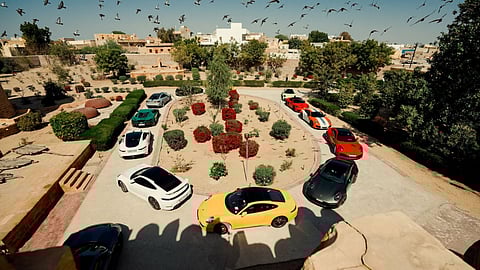
The vision has already taken shape through long-format road journeys across routes such as Sikkim’s Old Silk Route, record-setting drive to Cho La Pass and Nathu La, and the latest being a Desert Storm Drive to Jaisalmer, positioning driving as a more immersive way to experience ‘the real India’. Featuring 17 of the world’s finest supercars, the journey traversed the breathtaking landscapes of Rajasthan. The journey took shape from February 6-10, 2026, with over 60 participants from across the country.
In this exclusive interview, Rais reflects on the rise of experiential motoring in India, the intersection of luxury and purpose, and why the country’s most compelling stories may be found on the road.

Zain Nadeem Rais (ZNR) : In 1967, when India had a war with China, these passes were occupied, and the Indian Army fought back hard to win them for us. Yes, the conditions there are not easy. But I feel Cho La Pass and Nathu La Pass are places every Indian should visit, as they have huge historical significance. The temperatures, the terrain, the low oxygen — all of it makes you realise what it takes to be there. But that is why taking a drive there felt significant.
ZNR: I was approached by the Black Cat Division of the Indian Army’s Eastern Command, and they wanted to open Cho La Pass under Bharat Ranbhoomi Darshan. They wanted people visiting Nathu La to also see Cho La, given its historical significance. When they asked me if I could bring supercars there, I was instantly on board, given that the roads are in good condition.
ZNR: There were 200 bends one way, the oxygen levels were constantly low, and many of us felt uneasy even at the base station. But everyone was determined, and the spirits were high. Even when people were uncomfortable, they still wanted to complete the drive.
ZNR: India is evolving in terms of its supercar culture. What I understood from this drive is that people here want more than mere city drives and quick meets now. Rather, they are ready for experiences that are meaningful, different, and challenge them. If our supercars can do this (we have some of the lowest cars in India in terms of ground clearance), then any car group can do it.
ZNR: For most of us, the biggest takeaway was seeing how the Indian Army lives and works. The common public does not usually have any connection with them, but this drive changed that for us. They invited us in, sang for us, hosted a flag-in ceremony, and took pictures with us below the Indian flag at Nathu La Pass at 14,000 feet. There was a lot of mutual respect and admiration. At last, all 35-40 of us had a memorable photo frame to carry back home.
Coming from Mumbai, we have always been so far removed from their side of reality, so when we got to witness how the Indian Army works tirelessly on the border day and night, so we can sleep peacefully in our homes, a lot of emotion got attached to the site. That is what made it much more than just another drive.
ZNR: This is definitely not a race. There is no award for the fastest person to reach the top, and this is entirely a group drive where everyone looks out for each other. We make sure there is proper ground discipline and training, and a lot of information is shared beforehand. The prep work itself takes almost 60 days. We have checklists ready even before loading the cars. These cars are extreme performance machines — yes — but the discipline and training start from the minute an enthusiast signs up.
ZNR: Safety remains a priority — from deciding what kind of clothes to wear to following a strict ‘no alcohol’ policy on any of the days. If any guest is feeling unwell or is unsure about driving in tough terrains, we ask them to step down or continue as a co-passenger till they feel fit enough to drive again. We have health cards for every member placed on the windscreen, which mention their health issues, the medicines they are taking, allergies they have, emergency contacts, and their blood type.
We do not do a route with black ice or excessive potholes, and we end our drive by 5 or 6 pm before the sun sets. Everyone also keeps a 25 to 30-foot distance between each other. The backup car, the recovery vehicle, the car with the mechanics, and the flatbeds all travel last, so if anyone is inconvenienced, they can be picked up quickly.
ZNR: Jaisalmer has a mix of history, landscape, and hospitality that works beautifully for such experiences. You have it all — the desert, the forts, the royal famillies, and the local food. We had lunch under a tree at the beautiful ruins of Ghotaru Fort. We even drove an hour away to Mohangarh Fort (the last fort of India) and saw how the royal family had completely revived it. These little experiences made the Desert Storm Drive special.
A lot of HNIs and famillies go outside India for experiential luxury, but I believe India is absolutely ready to offer the same. Throughout our Desert Storm Drive, we spent time with royal famillies, enjoyed dinners at forts and desert sundowners far away from the city, went off-roading, and relished Rajasthani food and music in the middle of the dunes. These are the things people remember, and money alone cannot buy this.
ZNR: Wherever we decide to go, background checks are done first, and a verification process takes place to understand what the local community is like and how we can benefit them.
For instance, in Himachal, we visited a monastery to meet the children who start their training as young as three years of age. In Sikkim, we had a networking dinner with local communities, industrialists, and travel companies curating experiences. In Jaisalmer, we worked with Desert Trails, a local company focussed on creating experiences that are very different from the usual ones.
We let local travel partners come back to us with ideas that are true to the place. We also involve the media and allow people to donate to support the cause. That way, it helps us give back and offer visibility to people who are already doing meaningful work there.