
Subscribe
Subscribe
- Motoring
- Style
- Home & Design
- Travel
- Food & Drink
- Specials
- News & Tech
- Videos
The most desirable homes are increasingly looking like five-star suites inclusive of high-end services and amenities similar to those available in luxury hotels. Branded residences are ultra-luxe private homes that result from a partnership between a realestate developer and a hotel or lifestyle brand.
These homes are priced much higher than nonbranded luxury homes. A sprawling, sea-facing home, for instance, can be priced anywhere from ₹5 crore to ₹99 crore, according to September 2025 article in the Indian, English-language daily newspaper The Hindu.
Collaborations include those between The Four Seasons and Provenance Land, Marriott International with Whiteland Corporation, Trident Residences that partnered with the Oberoi Group and real estate developer BI Luxury Residences, and The Leela that partnered with Raheja Developers. Hospitality group IHCL (Indian Hotels Company Ltd. that manages the Taj Hotels among others) is developing the Taj Sky View Hotel and Residences, in Chennai, in partnership with the AMPA Group. Yoo Pune is branded by hospitality and residential brand Yoo and developed by Panchshil Realty. Trump Tower Mumbai, a Trump‑branded residential tower, is developed by Lodha Group. More recently, luxury watch and jewellery brand Jacob and Co entered the market through a tie-up with real estate developer M3M for building branded residences in Noida.

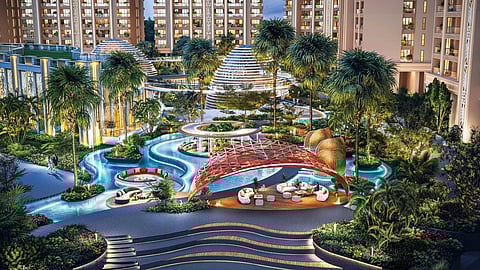
The idea behind a branded residence is to have a home that is built and serviced like a five-star hotel. This translates to amenities including a gym, spa, pool, media centre, guest lobby, movie theatre, conference room, and round-the-clock security. Laundry and house-cleaning services, à la carte dining and catering options, and 24/7 concierge services can also be included.
“The core philosophy of branded homes is to bring hotel-style living into residential life,” says Sudeep Bhatt, director of strategy at Whiteland Corporation.
Aside from five-star services and amenities, round-the-clock security, privacy, and living with a community of like-minded people, there’s also the prestige factor, according to Vipindas Ramadas, director of residences of Four Seasons.
“Today’s homebuyers prioritise convenience and an environment that supports and enhances their well-being and lifestyle,” says Penny Trinh, vice president of mixed-use development, Asia Pacific excluding Greater China, Marriott International.
In keeping with the need for convenience and an environment that is supportive of well-being and affluent lifestyles, wellness and recreation amenities such as sky lounges, clubhouses, state-of-the-art fitness centres, spas, and gourmet restaurants are essential features of the Marriott’s branded residences, adds Trinh.
“The appeal of these residences is in the blend of privacy and personalised service,” says Suma Venkatesh, executive vice president of real estate and development, IHCL.
The Westin Residences Gurgaon, a partnership between real estate developer Whiteland Corporation and Marriott International, targets possession in the early 2030s. Pre-booking prices start from ₹6.68 crore to over ₹11.25 crores for flats from 2,693 square feet (3 BHK) to 4,328 square feet (4 BHK) saleable area, according to the developer’s official website.
The Taj Sky View Residences and Hotel in Chennai that is being built in collaboration with real estate developer Ampa Group and IHCL is offering three and four-BHK homes and villas. The residences that will be integrated with a hotel are priced from ₹6.5 crore onwards.
“Branded residences have emerged as one of the fastest-growing segments within India’s luxury housing market. Industry reports indicate that India now ranks among the top 10 global markets for branded residences and is sixth worldwide in live projects, accounting for nearly four per cent of global supply,” says Robin Mangla, president of M3M India.
He adds that by 2027, the number of branded residence projects are expected to grow by around 60 per cent, thanks to investments by HNIs and NRIs. “Forecasts suggest the market could cross USD 1 billion by 2027, with long-term growth of nearly 200 per cent by 2031. This reflects a clear shift towards globally benchmarked living, where brand assurance, lifestyle curation, and long-term value preservation are becoming decisive purchase drivers,” says Mangla.
In 2018, M3M India began sales of the Trump Towers in Gurugram with three and four BHKs from 3,000-plus square feet to 6,000-plus square feet, priced between ₹6 crore and around ₹10 crore. M3M’s latest collaboration is with luxury watch and jewellery brand Jacob and Co. The residential and commercial project in Noida will include three, four, and five-BHK homes with prices starting from ₹8.75 crores.
“The post-COVID shift towards spacious, experience-led living has only strengthened demand,” notes Mangla, adding, “As India’s wealth ecosystem expands, branded luxury homes have moved from niche offerings to a mainstream preference among discerning buyers,” says Mangla.
“These homes are considered a good investment option, as investors appreciate the predictable asset performance, higher rental yields, better occupancy rates, and healthier long-term appreciation,” says Bhatt of Whiteland Corporation.
Trinh from the Marriott sees significant growth opportunities not just in prime urban locations such as Delhi NCR, Mumbai, Bengaluru, Hyderabad, and Chennai, but also in leisure destinations like Goa, Himachal Pradesh, and Udaipur.
Property developers are being pushed to think beyond visual opulence and towards providing services and amenities to make everyday living easier for those who can afford it.