
Subscribe
Subscribe
- Motoring
- Style
- Home & Design
- Travel
- Food & Drink
- Specials
- News & Tech
In 1996, with the conviction of a first-generation entrepreneur and the precision of an engineer, Boman R. Irani founded Rustomjee Group, and quietly began reshaping Mumbai's skyline. Over three decades, he has built the Rustomjee Group into one of the most trusted names in Indian real estate, delivering millions of square feet of residential, township, and commercial projects across the Mumbai Metropolitan Region.
A graduate in engineering with leadership programmes completed at Harvard, Mr. Irani brings both technical rigour and strategic vision to everything he does. As Chairman of CREDAI (The Confederation of Real Estate Developers' Associations of India) National, he represents thousands of developers across the country — contributing to policy advocacy and shaping the direction of an entire industry.
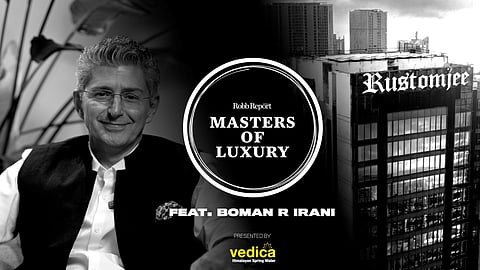
In this episode of Masters of Luxury, he speaks about building a city people are proud to call home, scaling trust across decades of real estate, and why according to him people will always remain the foundation of every great project.
Boman Irani (BI) : From the very beginning, we have believed that form follows function. Thirty years ago, luxury was largely defined by space, location and views. Over time, Indian consumers have become more widely travelled and far more discerning. They understand the difference between value and price, and they seek experiences rather than mere possessions. For us, luxury has always been about creating value. It can mean privacy without isolation, community without intrusion, or simply delivering a project on time. True luxury is both visible and invisible—it is something that can be experienced as much as seen.
BI: It begins long before someone moves into a home. Every touchpoint matters—from the first enquiry to the handover and beyond. We focus on being attentive without being intrusive. Quality is remembered long after price is forgotten, and quality must be evident in every interaction. We even established our property management company, Crest, to ensure that the experience we create is maintained after possession. Luxury is about convenience, comfort and thoughtful curation. Every sense should be engaged.
BI: Nature remains one of the greatest luxuries. Waterfront locations, green views and open spaces create a sense of calm that is increasingly rare in cities. Projects such as Bandstand, Ocean Vista and Balmoral benefit from their natural surroundings, whether that is the sea, a golf course or extensive greenery. Our role is to enhance these inherent advantages through thoughtful design and planning.
BI: The first question we ask is whether we can add value to the location and its future residents. We then evaluate the neighbourhood, the quality of the surroundings, the development potential of the site and the level of peace and tranquillity it can offer. Accessibility is equally important. A luxury home should be easy to reach and convenient to live in, both today and in the future.
BI: People have always wanted a connection with both the sky and the earth. While that is difficult to achieve in a dense city, locations such as Karjat, Matheran, Kasara and Alibaug offer opportunities to create that experience. As wealth grows and lifestyles evolve, second homes are increasingly becoming primary residences. We see strong potential in plotted developments, villas and eventually farmhouses in well-connected locations with natural beauty.
BI: We have spent decades building across the affordable, aspirational, luxury and ultra-luxury segments. Our next phase of growth includes plotted developments and villas, followed by larger lifestyle-led offerings. We are focused on locations that combine accessibility with natural landscapes, creating spaces where people can truly disconnect and recharge.
BI: Technology is transforming every aspect of development. Artificial intelligence already allows us to visualise and test multiple design possibilities in real time. What once took weeks can now be achieved in minutes. Homes are also becoming more flexible, personalised and technology-ready. In the future, convenience and comfort will increasingly be enabled by technology, and those qualities are central to luxury living.
BI: Sustainability and wellness are closely linked. Today's consumers are looking for homes that support healthier lifestyles and a deeper connection with nature. Sustainable design is no longer an optional feature; it is becoming a fundamental expectation. The future of real estate will be shaped by developments that combine environmental responsibility with a superior living experience.
BI: You've touched a raw nerve there. Design is what I enjoy most. That said, we have exceptionally talented designers at Rustomjee, and I learn from them constantly. What I bring to the table is a focus on the human side of design.
I often refer to what Steve Jobs said: the most beautiful things in life are simple, and the hardest thing is to make them simple. While our architects and design teams possess far greater technical expertise than I do, I remain deeply invested in how people actually live within the spaces we create. Livability is something I am passionate about.
My involvement in design may have reduced over the years, but it remains an essential ingredient. Like a spice in a recipe, a small contribution can have a significant impact.
Beyond design, a major part of my role involves working with authorities and ensuring projects receive the approvals they need. I must say that engagement today is far more constructive than it once was. There is a growing willingness to listen, learn and explore ideas that can improve our cities.
Through my long association with CREDAI, I have had the opportunity to engage closely with policymakers and urban authorities. Whenever I come across an innovative idea from elsewhere in the world, I often share it with them. Recently, I shared an example from Singapore on how open-air playgrounds are integrated into dense urban developments. The response was incredibly encouraging. People were genuinely interested in understanding how such ideas could be adapted locally.
I believe cities must evolve from being merely liveable to becoming lovable. If we fail to make our cities more enjoyable, inclusive and inspiring, we are not fulfilling our responsibility as developers. Small interventions and intelligent design can make a remarkable difference.
We have every advantage—environmental, commercial and financial—to create cities that are among the best in the world. The aspiration should not simply be to catch up, but to lead.
BI: Nature remains my greatest source of inspiration. Ask any architect and they will tell you the same thing—we are constantly learning from nature.
Whether it is the way a weaver bird constructs its nest, the form and function of ancient caves, or the grandeur of European cathedrals and castles, there is something to learn everywhere. Great design is not just about aesthetics; it is about creating emotion and experience.
I find immense inspiration in India's temples as well. Their acoustics, craftsmanship and attention to detail are extraordinary. Many of these structures were built centuries ago, yet they continue to teach us lessons in design, engineering and human experience.
Travel is another major source of inspiration. I observe everything—from the hotels I stay in and historic landmarks I visit to the way cities organise their roads, waterways and public transport systems.
Cities such as Singapore and Hong Kong have demonstrated how infrastructure can be seamlessly integrated into everyday life. Their approach to transport, urban planning and mixed-use development offers valuable lessons.
Ultimately, inspiration comes from maintaining an inquisitive mindset. History can teach you. Nature can teach you. Technology can teach you. The question is whether you are willing to keep learning.
BI: If I had to define luxury in a single thought, I would return to a phrase I mentioned earlier: privacy without isolation.
I want privacy, but I do not want to feel disconnected from the world. I want community, but without intrusion. I want peace and quiet when I need it, yet I also want the energy and vibrancy of life within reach.
Luxury is balance. It is the freedom to choose how you live, when you live it and on your own terms.
It is having comfort, convenience and sustainability without compromise. It is being able to retreat into your own space while knowing that everything you need is close at hand.
Ultimately, luxury is the ability to do what you want, when you want, without being constrained by time, distance or inconvenience. That freedom, to me, is the greatest luxury of all.
