
Subscribe
Subscribe
- Motoring
- Style
- Home & Design
- Travel
- Food & Drink
- Specials
- News & Tech
- Videos
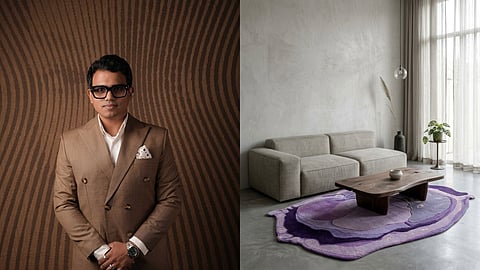
The India Pavilion at the Kyōto YouMe Triennale 2026 places Indian creative intelligence in direct dialogue with global contemporary art. And if you make your way to the historic Jushin Kaikan (Room 10, First Floor), you will see Neytt's debut — a statement collaboration with cross-disciplinary Japanese Indian designer Bijin Davis. Using the South Indian loom as a live canvas, Davis translates transient natural phenomena into complex, expressive textile art that fluidly spans both walls and floors. Sivan Santhosh, Founder and CEO, Neytt Homes, gives an exclusive peek into what the show is all about in this exclusive chat with Robb Report India.
Robb Report India (RR): Tell us all about your debut at Kyoto YouMe Triennale 2026.
Sivan Santhosh (SS): Showing in Kyoto felt right in a way that is hard to overstate. Japan and India share an instinct that the West often separates: the idea that craft and art are not two different things. Our debut there is with the designer Bijin Davis, whose own life moves between Japan and India. So, the collection did not travel to Kyoto as a visitor. It arrived somewhere; it was partly from. For a brand from Cherthala, a small town in Kerala, standing in that context mattered. It said that work made on our looms belongs in a conversation about contemporary art, not only in a conversation about floor coverings. That has been the ambition from the beginning, and Kyoto was the clearest proof of it so far.
RR: What was the creative idea behind the concentric ring and its ripple of emotion, and how did you translate that concept into yarn, colour and form?
SS: The collection draws inspiration from two distinct movements in nature. Liquid Jewels is a rug series that captures the ethereal beauty of light refracted by raindrops and rainbows, infusing colour and joy into even the greyest of days. The other is A Liquid Ballet, a rug series that captures the elegance of a splash formed by tossing pebbles into puddles, a release of emotions that mirrors a dance. Translating that onto a loom is mostly a problem of gradation. A ripple is not a line; it is a transition, so the work sits in how one tone dissolves into the next, in blending yarns so the eye reads movement rather than edges, and in using the pile itself so that light behaves differently as you walk around the piece. A rug is one of the few artworks people experience from above and from every side, and in daylight that changes hour by hour. That is a constraint, and with this collection it became the medium.
RR: How did working with Bijin Davis challenge or expand Neytt's established understanding of natural fibres and handloom craftsmanship?
SS: We choose collaborators for the story they carry, not for the name. We look for people from different backgrounds, cultures, ages and life experiences, because different lives produce different work, and our loom becomes the place where that meets a hundred-year-old craft. Bijin brought a perspective shaped by living between Japan and India and a practice built on transient things: the movement of water, shifting light, shadow, and the quiet changes in nature. That stretched us. Our craft is very good at pattern, structure and repetition, which is what a century of making teaches you. She asked it to hold something fleeting instead. Translating an impression rather than a motif demanded a different conversation with our weavers, and it left us with techniques we are still using.
RR: Neytt is moving the conversation from commodity production to high-value design and branding. What needs to change in the way the global market perceives Indian handloom?
SS: Two beliefs need to go. That Indian craft means inexpensive, and that heritage means old-fashioned. India has been treated as the world's workshop for decades, with brilliant hands and somebody else's name on the label. We exist to correct that. The world does not need India to be cheaper. It needs India to be distinctive. That means paying for design, authorship and craftsmanship, and knowing who made the work.
RR: How do you balance the integrity of a century-old craft legacy in Cherthala with the need to experiment and create work that feels contemporary and globally relevant?
SS: What we carry forward is material honesty and craftsmanship, the refusal to cut corners that runs four generations deep since 1917. What we changed is the ambition. For a hundred years we made beautiful things under other people's names. Neytt exists, so the name on the work is finally ours, and so the story of the people who make it travels with every piece. This collection is a good example of how that balance works in practice. The making stays rooted in the discipline we inherited, while the design language moves into abstraction, emotion and colour through collaboration. Tradition is the root, and innovation is the branch. You do not cut the root to grow taller.

RR: What role does the human hand play in this collection, and are there particular imperfections or variations that you deliberately preserve rather than conceal?
SS: No two pieces are identical, and we tell our clients that before they buy rather than after. The small variances of the human hand, which industry calls imperfection, are exactly what we preserve, because that is the luxury. The people who make our work are not behind the brand; they are the brand. When we win an international award, we name the key people involved, because the recognition belongs to the hands.
RR: Do you see collaborations such as this as a new model for sustaining artisan communities, where craftsmanship is valued not simply for its heritage, but as a source of contemporary innovation and luxury?
SS: What keeps a craft alive is demand at a price that makes it worth doing, and that comes from relevance, not from nostalgia. Collaboration is how relevance happens. It brings new ideas onto old looms and forces the craft to prove it can still say something new. The economics follow. A rug that carries design and authorship earns many times what the same fibre earns as a commodity, and that difference is what stays with the cluster. So. our answer to sustaining artisan communities is not charity or heritage status. It is value addition, and it is the single biggest opportunity Indian craft has.