
Subscribe
Subscribe
- Motoring
- Style
- Home & Design
- Travel
- Food & Drink
- Specials
- News & Tech
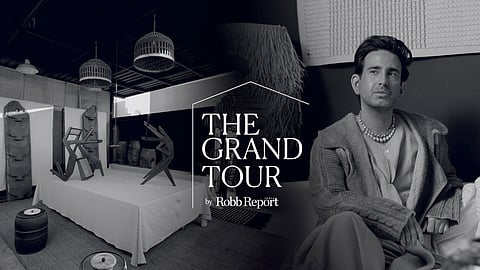
This house is not for show,” says Tahir Sultan. “It’s for me.” The distinction is immediate. In a city increasingly defined by traditional carved architecture and ornamental motifs, the designer’s home in Jaipur resists such stereotypical sensibilities. Instead, he has done up his space as a living museum of craft and cultural memory—one that refuses to separate art from design.
Over two and a half years, Sultan has gutted what once stood here: raising ceilings, erecting walls, and transforming the structure into something far removed from its original persona. In its place now stands an interior anchored in unpolished black stone, with walls introduced where none existed before. Candidly, Sultan confesses he was advised against using the stone. “They said, ‘Unpolished black stone? It will get very dusty.’” For him, it was never a deterrent. “I said, no problem—then we’ll clean it.”

Sultan wanted even larger slabs than were deemed practical. “They told me the wastage would be insane. Please don’t do it.” He did it anyway. This defiance sets the tone for the design aesthetics of the entire home: a series of small rebellions against what could be considered impractical or unconventional. In conversation, it becomes clear that the house is less a stylistic exercise and more an extension of its owner’s temperament. Half-Kuwaiti, half-Indian, this designer strays from sticking to a singular field. As the founder of Makaan, a Jaipur-based concept store, his practice spans fashion, art, interiors, food, and design. It is this curiosity across fields that also animates his multi-storied bungalow.
My initiation to his aesthetics—and, by extension, his curious mind—begins right at the gate. After all, in a quiet neighbourhood that is disturbed only by the sound of crickets, it’s easy to spot a home with soaring black stone earthenware hidden amid lush foliage.
Providing an explanation for my wandering eyes, Sultan says, “The house is like a living museum. Stuff keeps changing.” Truth be told, I have no idea what to expect, especially given Sultan’s extensive travels and multicultural upbringing. Raised in Kuwait during his formative years, the multi-hyphenate found himself drawn to the geometry of Islamic architecture and the vibrancy of Middle Eastern clothing. What followed was a rigorous immersion in Renaissance art history, photography, and interior design in Florence, culminating in formal training in fashion design at Central Saint Martins in London. “I’ve always been influenced by where I’ve lived,” he says. “Kuwait gave me scale and ornamentation. Florence taught me proportion. London taught me how to break rules.”
Step inside, and those influences converge. Yet, underlying it all is an intention to celebrate, honour, and salute traditions and peculiarities that may be disappearing into the recesses. There are Naga panels as an ode to the state’s tribal arts; genre chairs remodelled as an interpretation of Kalaripayattu, a 3,000-year-old traditional martial art from Kerala; and pots upcycled from rubber tyres.
A quick climb up the stairs reveals the main living area where a postmaster’s desk occupies pride of place. “It’s extremely rare, almost impossible to find,” Sultan explains. “Rarer than a genre piece!”
A closer look reveals a grid of small pigeonholes designed to sort letters by district, street, or surname. Ink stains mark the surface, alongside faint scratches and indentations, as though etching memories of handwritten notes from a pre-digital era.
“Why should everything look new?” he asks. “Age is part of the story.” Most such desks, he explains, were dismantled over time. “They were all chopped up.” His operates as both sculpture and storage. Not far from it sits the brass-leaf table he conceptualised with a local artisan. The surface appears as though a cluster of withered leaves has been fused mid-collapse.
“I wanted it to look like crumpled old leaves had come together and created this life,” he says. “All these leaves are hand-beaten,” he adds, almost as a reminder that every nook here has been shaped with care and attention to detail. It is this impulse to honour technique while reshaping its form that defines Sultan’s larger practice. His latest project titled The Dissection of Lineage of Craft revolves around a deceptively simple form: the egg. “The egg is the embryonic beginning of all life and all ideas,” he says. From this primal geometry, he collaborates with artisans across regions— working in terracotta, wool, carpet weaving, wood, and brass—to reinterpret inherited skills through a contemporary lens. “You start with the egg as a base,” he explains, “and then you move outward.”
For now, they remain in rotation. An egg shifts from one surface to another as new works arrive. Nothing is fixed, as Sultan resists static compositions. Instead, arrangements are recalibrated as the collection expands. He describes the house as a working environment rather than a finished interior. Pieces are lived with before being relocated—or returned for refinement. “If something doesn’t sit right, we change it,” he says. “I’m not sentimental about placement. I’m sentimental about the work.” For all its layered references and rare acquisitions, the home ultimately functions as intended: a space to inhabit. Everything else is secondary. “If I can’t live here comfortably, what’s the point?” Sultan shrugs. After all, as he rightly says, the house is not for show.