
- Motoring
- Style
- Home & Design
- Travel
- Food & Drink
- Specials
- News & Tech
- Videos
"I didn't set out to build a figurative collection," smiles Saloni Doshi, the Mumbai-based collector and founder of the arts foundation, Space 118. Yet, she admits sheepishly, “Figuration is one of the first genres or themes I collected, which is also why figuration is everywhere in my collection.”
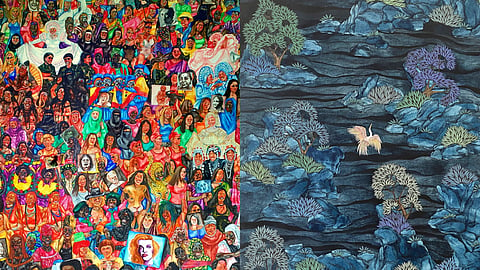
Recently opened at Space 118 in Mumbai's Mazgaon, In Quiet Measure is an eclectic output of figurative art from the Saloni Doshi Collection. The show, which she hopes will help audiences discover new facets of Indian figurative art, is curated by her close friend and fellow collector Jaiveer Johal. In what seems like an unusual act of trust and understanding between two, Doshi invited Chennai-based Johal to dig into her personal archive and gave him carte blanche so that he could return, as she puts it, "your own collection to you in a form that feels new."

In an era when art is increasingly becoming post-human—designed by Artificial Intelligence, minted as NFTs and often mediated by cutting-edge technology—In Quiet Measure returns to the rooted simplicities of the representative tradition. "What I find exciting about this exhibition is that it makes you realise that figuration doesn’t necessarily mean representation. A figure can be a body, but it can also be memory, trauma, identity, desire or history," Doshi tells Robb Report India, explaining that the show's aim is to transcend the human figure toward the "edge of recognition," as Johal points out in his curatorial note.
Artworks in the exhibition are dotted across the different studios within the Space 118 warehouse. As you move between the rooms, you realise that figures offer much more than just realistic depictions of the human condition. An artist can either remain faithful to his/her subject, or distort and fragment it to unravel hidden emotions. (Cue from art history: Francis Bacon and his screaming Popes). He or she can draw just a few sketchy lines to suggest the semblance of a figure and leave the rest to your imagination. Or an artist can conjure an entire world in rich and sumptuous detail, allowing audiences to feel the human presence and reconnect with their own humanity. Either ways, In Quiet Measure presents all the possibilities.
In the first room, titled Inner World, we see works by celebrated artists like Nityan Unnikrishnan, Kulpreet Singh, Anupam Sud, Atul Dodiya as well as lesser-known but equally talented names like Aditya Pande and Karishma D'Souza. Artists featured in this room turn the gaze inward, evoking a sense of stillness and providing a more private glimpse into their brooding self. The second room implies that the body carries both positive and negative memories. Standout works here include Anju Dodiya's tongue-in-cheek Studio Guests (riffing on the 19th-century Company School paintings) and Jitish Kallat's Traumanama (The Cry of the Gland).
The third room examines the material possibilities of the body, while the fourth ventures beyond the human realm in search of something greater. Aptly enough, the final room closes where the collection essentially began—reflecting on Doshi's own journey in the art world. "In some works," Doshi observes, "the body is very present. In others, it is fragmented or almost disappearing."
The title also speaks to the way she collects. "I don’t collect according to one rigid thesis. A collection evolves slowly, through instinct, relationships and encounters. There is a certain quiet accumulation over time, and then, when someone like Jaiveer brings these works together, you suddenly see connections that you hadn’t consciously made yourself," explains Doshi, whose foundation has so far provided over 450 artists with studios and residencies in the heart of Mumbai.
Getting Johal to curate was important for Doshi because he brings a different eye, aesthetic flourish, personality and creative vision. "When you live with a collection for many years, you develop a very intimate relationship with individual works," she states, adding, "You remember where you saw them, why you bought them, and what drew you to them. Sometimes that intimacy can actually prevent you from seeing the collection objectively."
In Quiet Measure is the last in a series of exhibitions that began in 2023 with a show called The Right To Look. Since then, the art patron has dived into her treasure trove of modern and contemporary art, each time revealing a distinct aspect of her collection including photography, abstraction and sculpture.
All the shows have been curated by different people. She considers this one as a personal milestone of sorts: "In many ways, it is a conversation between a collection and a curator. The works are all figurative, but they approach the figure in very different ways, sometimes directly, sometimes through distortion, memory, gesture, fragments or even absence."
Although this exhibition is being seen as a closing statement, she insists that "it is not a conclusion so much as a pause, a chance to look back at what has been revealed through these shows and think about where the collection goes next."
In Quiet Measure is on view at Space 118, Mumbai until December 12.