
- Motoring
- Style
- Home & Design
- Travel
- Food & Drink
- Specials
- News & Tech
- Videos
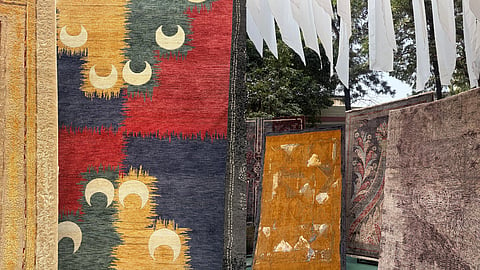
A Jamawar shawl, a Chanderi sari, antique frames, an everyday gamcha and Ottoman-era motifs may seem unlikely sources of inspiration for carpets. However, these disparate references come together at Obeetee’s pavilion at Jnan Pravaha, Varanasi, in a collection of 16 carpets reinterpreting familiar elements of Indian and global design.
Part of the first edition of Banaras Biennale, the display brings together works by designers including JJ Valaya, Tarun Tahiliani, Abraham & Thakore, Eeshan Kashyap, Anjali Sobhani and Shantanu & Nikhil. While the designs draw from diverse sources, all 16 carpets have been made in Mirzapur, Uttar Pradesh, a centre known for its carpet-weaving tradition.
“Through Threads of a Living City, Obeetee’s installation at the Jnana Pravaha Pavilion, we draw inspiration from the fluidity of Banarasi sarees to reimagine carpets as architectural and artistic expressions. It is a tribute to the city’s extraordinary weaving heritage and a reflection of our belief that tradition is not merely to be preserved but continually reimagined,” expresses Angelique Dhama, President, Obeetee Carpets & Home.

Among the collections on display is JJ Valaya’s ‘From Kashmir to Marseille,’ inspired by the Jamawar shawl and its distinctive paisley patterns. The collection traces the motif’s journey from its early associations with Persia to its popularity in Mughal India and its eventual adoption by European textile manufacturers. The carpets bring together intricate Jamawar-inspired patterns, floral borders, and contemporary graphic elements. Most of the pieces in the pavilion are hand-knotted, with wool and silk among the principal materials used.
Tarun Tahiliani draws inspiration from antique frames, bringing their ornamental details into carpet designs. Abraham & Thakore’s pieces are influenced by Chanderi sari. Interestingly, another carpet of the duo takes its cue from the modest gamcha, an everyday textile that is not really noticed. Its checks and colours lend themselves to a different visual vocabulary. A few of the Abraham & Thakore pieces are made entirely of wool.
Eeshan Kashyap’s pieces are informed by Ottoman references. His ‘Nowstalgia’ series draws on the Chintamani motif, which is traditionally associated with power, spirituality and protection. One of the designs, ‘Ottoman Echo’, features a deep red ground with yellow Chintamani patterns recurring all over. The Chintamani motif is believed to be used on the garments of Ottoman sultans and officials. Unlike the other carpets in the pavilion, Kashyap’s piece is hand-tufted. His work, along with Anjali Sobhani’s painting-inspired carpet, uses wool and viscose.
Shantanu & Nikhil explore ideas of nationhood through carpets that draw on insignia, emblems and symbols associated with independent India and the armed forces. Their designs bring together references to regimental identity and national pride, translating these visual codes into floor coverings. Anjali Sobhani, meanwhile, brings her artistic language to the medium, with a carpet inspired by her paintings.
The collection offers a view of how design can move between disciplines and traditions from clothing and painting to historical motifs and everyday textiles. The making of these pieces remains rooted in the skills of Mirzapur’s artisans. With 15 carpets hand-knotted and one hand-tufted, the Obeetee design booth also underlines the range of techniques and materials that can thrive in carpet-making.
Anu Gupta, Creative Director, Obeetee Carpets & Home, says, “A designer gives a carpet its visual language, but it is the weaver who gives it character. From interpreting the naksha to understanding the nuances of colour, yarn, texture and tension, our artisans bring generations of inherited knowledge to every design. At Obeetee, we see the weaver not merely as an executor of a creative vision but as its co-creator. That distinction is what makes a handmade carpet a work of art.”