
Subscribe
Subscribe
- Motoring
- Style
- Home & Design
- Travel
- Food & Drink
- Specials
- News & Tech
- Videos
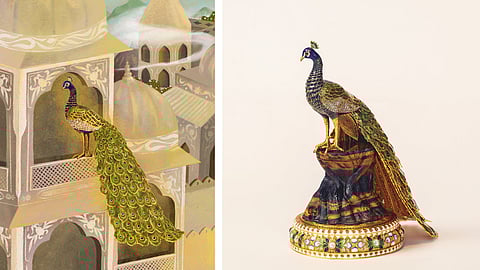
The peacock epitomises India’s beauty— majestic, graceful and steeped in cultural symbolism—and in Mayura, it finds its most resplendent expression. Crafted as a sculptural masterpiece by Zoya from the Tata Group, Mayura celebrates India’s enduring artisanal spirit.
Conceived as part of Saar meaning “essence” in Sanskrit, the objet d’art draws inspiration from the nation’s most graceful emblem, weaving its beauty and symbolism into a sculpted, bejewelled piece that bridges tradition and modernity. At its core, Mayura is a creation where craftsmanship becomes poetry. It unites over a dozen rare, time-honoured techniques—many safeguarded today by only a handful of master artisans.
The striking signature blue-to-green Jaipuri meenakari gradation on the iridescent plumage shimmers like the colours of a peacock’s feathers, immediately drawing attention. Each feather is individually casted, enamelled and strung, using piroi, Bengal’s traditional stringing technique, allowing the sculpture a subtle sense of movement. This sense of fluidity finds its anchor in Banarasi meena, with enamel meticulously hand-painted in the style of miniature art, creating a golden base that serves as the bird’s canvas. Complementing this is Jodhpuri meena with its solid enamels, lending quietude and depth, and creating a refined interplay between movement and stillness.

Diamonds, both champagne-hued and white, trace the contours of the peacock’s body, while polki diamonds reimagined in platinum collets speak of a bold, contemporary sensibility. Even the soulful eyes are painted with reddish-brown meena pigments, an intimate detail that underscores the depth of this creation.
The pedestal upon which Mayura rests is a masterstroke in itself. Spade-shaped emerald cabochons are precision-set using takkar ka kaam, a centuries-old stone-setting tradition in which custom-cut stones are placed into hand-crafted bezels with mathematical precision. Partaj ka kaam—the vanishing art of hand engraving metal with chisels of varying gauges—is a labour of days, sustained only by the unwavering focus of a seasoned master. It creates rhythmic, ornamental patterns. At its core rests a 1,200-carat hand carved Tiger’s Eye representing the tree trunk, a testament to India’s lapidary tradition. Even in areas left untouched by embellishment, there is still meaning. A specially prepared antique finish blended from pigments and essential oils lends the gold depth, texture and a timeworn richness that speaks to the soul of heritage
Created in collaboration with second- and third-generation artisans, including families of national awardees, Zoya has elevated heritage into high art. It is a confluence of vision and virtuosity, a tapestry of techniques from Jaipur, Banaras (now Varanasi), Jodhpur, West Bengal and beyond, seamlessly woven into a single, sculptural narrative. Limited to a single, one-of-a-kind piece, Mayura is not revival—it is resurrection with reinvention. It is a future heirloom—a creation where legacy and luxury meet in quiet majesty.