
Subscribe
Subscribe
- Motoring
- Style
- Home & Design
- Travel
- Food & Drink
- Specials
- News & Tech
- Videos
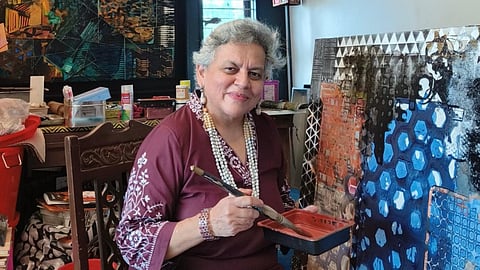
Few artists embody the interplay of discipline and spontaneity as naturally as Brinda Miller. Trained in the rigor of JJ School of Art and shaped by the expressive freedom of New York, her work today is richly layered. Her practice—often influenced by her architectural surroundings and her involvement in Mumbai’s cultural landscape, including the Kala Ghoda Arts Festival—has steadily shifted towards abstraction and layered textures.
As she marks over four decades of experimentation, Miller sits down with Robb Report India to discuss her shifting visual language, the pulse of Mumbai, and the joy of an artistic process that remains defiantly unplanned.
Robb Report India (RRI): Your art blends architecture, abstraction, and texture. How do you see these elements evolving in your current body of work?
Brinda Miller (BM): My art does blend architecture and landscape. It’s extremely textural. I don’t see it going away ever from my work—I think it’s always going to have a place in my work. Over the years, I have done various techniques; I have used architecture as my inspiration. I have a family background in that, and my husband and children are all architects. I work in a studio which is within an architectural office. That’s probably the reason why I use it.
Yes, I began my career as a landscape artist, and I even graduated a little bit to the figurative. Sometimes it reappears in my work, and I go back and forth with my style. I don’t stick to any one style, but yes, there are a lot of straight lines, and a lot is based on basic shapes.
RRI: You’ve consistently experimented with collage, metallic leafing, and mixed media. How do you approach these materials?
BM: Mixed media has been a part of my own life. I think art imitates life, life imitates art. That is my mantra. Even in my life—whether it is cooking or whether it is [picking] clothes—I always mix and match everything. I enjoy interior design. I draw a lot of inspiration from textiles too. Therefore the collage.
RRI: After four decades of practice, what has remained constant in your work, and what has radically evolved?
BM: After four decades of work, there has been a lot of experimentation. The base of my work remains similar—more abstract now, with far more layering. Like I said, it imitates my life. My life is very layered; I do many things, and my work reflects that. I also work on multiple paintings at a time, so I end up mixing and matching, which I enjoy.
I find painting extremely relaxing, and it’s very intuitive—exactly like how I am. Over the years, my process has become increasingly unplanned. Intuition and impulsiveness work better for me. My life isn’t planned; my work isn’t planned; my paintings aren’t planned. I don’t know what I’m going to do in the future. But at the same time, there is discipline and consistency in what I do.
RRI: You’ve been exhibiting since the early ’80s. Looking back, how do you see the shifts in your visual language across these decades?
BM: I’ve been working for the last 40 years, since the early ’80s. Some of my early pieces are barely recognisable now, but I think all artists experience that. In the beginning, I did a lot of realistic work. Later, after a few exhibitions, I felt it wasn’t enough. That’s when I went to New York and studied at Parsons for a while. It changed my work and my life. New York inspired me—it reminded me a lot of Mumbai—and I learnt to let go and loosen up.
Before that, at JJ School of Art, there was a lot of discipline, which I don’t regret. That foundation was important. My career began with realistic landscapes, straight lines, and structured forms. Gradually, the work became more figurative, more playful. My colours grew brighter and warmer because that made me happy.
I feel I’ve evolved a lot. I’m more careful now; I don’t make the same mistakes. Sometimes when I look at my older work, I wonder, Did I really do that? That happens far less today. I’m much happier with what I’m creating now.
RRI: Can you describe your process when beginning a new work? Is it meticulously planned, or guided by intuition once you’re at the canvas? And, how do you know when a work is complete?

BM: My work isn't planned. I used to do that, but no, I don't like to plan my work because I think I overthink it. And I don't have anything ready if you ask me. How long did this paint painting take? I can't say because some paintings take two days, some paintings take one. Sometimes it's just there in front of me and I keep working at it also because I'm not satisfied.
I think the last 10 per cent of my work takes the longest to complete, because I never quite know when it’s truly finished. The beginning is easy, and the middle flows, but the end is where I keep pausing and looking. It takes me a long time to understand that a painting is finally done. Sometimes a piece will hang on my wall for years, and I’ll still go back to it. Even now, I revisit older works and keep working on them. It may look complete to others, but I have to be satisfied and happy with it!
RRI: Mumbai frequently features as both muse and subject in your works. How does the city inspire your artistic language today?
BM: Mumbai has been an important part of my life. I was born and brought up here, and everything I’ve achieved is because of this city—its people, its energy, and the inspiration it gives me. My father, who was Sheriff of Mumbai, was passionate about caring for and beautifying the city. I grew up watching that, and I think it’s in my genes. That’s partly why I went on to organise the Kala Ghoda Arts Festival. It feels like a natural extension of what I’ve always seen and believed in.
RRI: You’ve been instrumental in shaping Mumbai’s art district and creating public art projects across the city. How do you see the role of art in public spaces compared to gallery walls?
BM: The Kala Ghoda Arts Festival brings together every form of art—visual arts, architecture, music, dance—and I think I draw as much inspiration from it as I give to it. Its narrative and visual energy have shaped me in many ways. I’ve also learnt a great deal about creative management through the festival; it has taught me lessons that are as valuable to me as my painting practice. It feels like one of my biggest achievements, and I truly love being part of it.
Through the festival, I also feel responsible—and genuinely happy—that I’ve been able to bring art into public spaces. It has been my dream for many years, and Kala Ghoda remains one of the few places where installation art becomes truly accessible to everyone. For those nine days, people can simply walk through and experience it without barriers.
I’ve also curated art at the airport, which has become almost like a gallery or museum in itself, attracting interest from people who may never step into exclusive gallery spaces. Making art available to the “common man” is something I value deeply.
RRI: How did you select the works you chose to show at recent Gateways and Pathways exhibition at Tao Art Gallery, Mumbai?
BM: For Gateways and Pathways, I didn’t select existing work—I created new pieces specifically for the show. From my initial conversations with Ranjit Hoskote, the curator—and a close friend who’s also deeply involved with the Kala Ghoda Arts Festival—I immediately understood the spirit of what he envisioned. His brief was open and interpretive, which gave me the freedom to respond intuitively.
While the theme didn’t require literal architectural gateways or pathways, I approached it through an abstract lens. For me, it became about the pathways of my own life—my inspirations, experiences, and the layers that shape my work. Even the title resonated deeply; it felt perfectly aligned with how I see my artistic journey.
RRI: What does being part of this exhibition mean to you at this stage of your career?
BM: I’m very proud to be part of this show—to be in a public gallery and to contribute to a 25th-anniversary exhibition. Tao and I have been together right from the beginning, and we genuinely love working together. Being included in this moment feels both personal and meaningful.
RRI: When a collector encounters your work for the first time, what feeling or idea would you most like them to take away?
BM: I love it when a viewer or collector looks at my work and simply says they love it, without needing to ask too much about the interpretation. I often feel the collector should have their own reading of the piece—they shouldn’t tire of it. I’m a collector myself, so I understand this deeply. A work must never bore you; it should keep revealing something every day. That’s why I layer my pieces so much. I want them to tell a new story each time, for you to keep discovering new things within them.
RRI: What excites you most about where Indian art is heading?
BM: I’m extremely excited about Indian art today because I feel it has truly come into its own. It’s reaching new levels, and importantly, it has now become a viable career—something it certainly wasn’t considered when I began working as a fine artist. What’s especially energising is seeing so many emerging women artists.
In terms of value as well, the market has grown. Although I’m personally uncomfortable when art is compared to the share bazaar or equated with buying jewellery—I feel it deserves its own identity—it’s undeniable that a stronger market has formed. The unfortunate part is that art is still often bought only after ‘everything else’ has been acquired. Yet, despite these nuances, art in India is doing far better than it used to. Overall, it’s in a very good space.