
Subscribe
Subscribe
- Motoring
- Style
- Home & Design
- Travel
- Food & Drink
- Specials
- News & Tech
- Videos
AI generated summary, newsroom reviewed
It's going to be an Indian summer in Venice. As the international art world descends upon the ‘city on water’, India will present its contemporary art on the global stage with much pomp. The country has a big and impressive presence at Venice this year — from the main biennale project curated by the late Koyo Kouoh, to a national pavilion (only the third time in the biennale's 131-year history), plus official collaterals and parallel exhibitions. It is probably the strongest showing India has ever had.
And then there are the parties. Isha Ambani and the India Pavilion curator Amin Jaffer are hosting one for the Nita Mukesh Ambani Cultural Centre — a key supporter of the pavilion, alongside Serendipity Arts Foundation and the Ministry of Culture. Kiran Nadar, the founder of the Kiran Nadar Museum of Art, hosted a India music soiree during the official opening of veteran artist Nalini Malani’s multi-channel video work, Of Woman Born. There is more. The Kochi-Muziris Foundation, now under the aegis of its new director, artist Jitish Kallat, will announce the curator of its next edition in 2027.
Here’s the lowdown on all the India action at the Venice Biennale this summer.

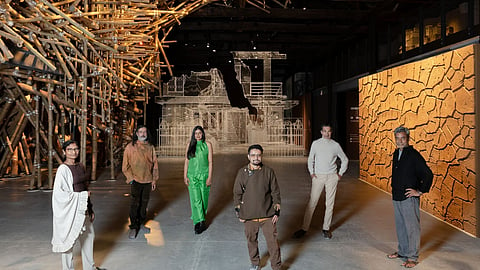
Out of the 100 national pavilions at the biennale this year, India’s stands out for its use of indigenous material and exploring the idea of home in the 21st century. At the Arsenale, Geographies of Distance: Remembering Home sees Jaffer explore what home means to a rapidly changing India and its diaspora — and, by extension, to a world more mobile and displaced than it has ever been. While Jaffer has contemplated the concept of home for a very long time, his immediate prompt for the pavilion was artist Sumakshi Singh’s delicate embroidered panel with which she reconstructs her grandparents’ ancestral home in Delhi, after they moved to India during the Partition. “I wanted to capture what happens emotionally to you when the physical home disappears,” says Jafer. “While Sumakshi’s project is autobiographical, it's intended to be understood and felt by every human being because home is at the core of it, which is not unique to India,” he adds.
Alwar Balasubramaniam’s Not Just for Us presents a sculptural panel from clay and soil drawn from rural Tamil Nadu, where he works. The cracked soil embodies the idea of both the fragility and resilience of the earth in the face of climate change.
Under the Same Sky by Ranjani Shettar is a beautiful, monumental work that she, very impressively, has intricately crafted all by herself. The large chain of suspended flowers evokes a beautiful garden, positioning nature and craft as integral to the emotional landscape of home. It has also become one of the most sought-after selfie points at the biennale.
Skarma Sonam Tashi has created traditional Ladakhi homes and structures for his work, Echoes of Home. It presents the idea of how beautifully the indigenous architecture merges with the natural landscape, also conducive to its ecology. But sadly, concrete and cement are taking over, too.
Chaal by Asim Waqif is another favourite among the visitors. His large-scale installation looks similar to scaffolding, but is made with bamboo, a material long embedded in vernacular architecture. The work suggests a structure in the process of becoming, signalling both renewal and disruption, foregrounding the inevitability of change in the urban environment.
Furthermore, the India Pavilion will also run performance programmes produced by Serendipity Arts Foundation, directed by Bikram Ghosh, across Venice.
The Kiran Nadar Museum of Art (KNMA) presents a powerful, evocative work by veteran artist Nalini Malani, titled Of Woman Born. Housed in the Magazzini Del Sale, a historic salt warehouse, the video work — built from hundreds of iPad drawings — invokes the figure of Cassandra from Greek mythology to examine war, violence, and the disproportionate suffering borne by women. “Nobody asks a mother who lost her child in a war about what she thinks,” says Malani. “The images of genocide only evoke anger in me, and this work is a response to that,” she adds. Malani has championed works from a feminist angle throughout her practice of 60 years.
The thought-provoking work is at the Venice State Archives, which has opened its doors for the first-time ever for a public project. As a tribute to Singh’s 25-year relationship with Italy, the show explores how memories and knowledge are organised in an installation that features approximately 300 photographs on movable wooden pillars and cubes that can be rearranged, suggesting that archives are living, breathing organisms rather than static histories. It is also a comment on the poor state of archives in India (old papers often tied up in pothis) and across the world. Not getting the care and importance it deserves as keepers of history.
Presented by the prestigious Pinault Collection at Palazzo Grassi, this exhibition brings together two major multimedia installations of Kanwar along with Kenyan-British painter Michael Armitage. Kanwar’s The Torn First Pages honours Burmese bookseller Ko Than Htay, who protested military rule by tearing out the first page of every book he sold. The Peacock’s Graveyard is a recent acquisition by the Pinault Collection, which is a cinematic meditation on death and injustice. It features seven "invisible" screens in a dark room with floating text and abstract imagery, set to a haunting raga soundtrack by pianist Utsav Lal. The show remains open until January 10, 2027.
A 3D brass and metal sculpture is a public installation displayed at the Marinaressa Gardens, a historic waterfront walkway between the Giardini and the Arsenale. A continuation of his work in the 2024 biennale, the piece is structured around the four cardinal directions and their cosmic counterparts, presenting the ideas of balance, universal order, and harmony through a series of clean, geometric lines and intersecting planes. Presented by Art Alive Gallery, the work is one of the pieces of the Personal Structures: Confluences, hosted by the European Cultural Centre, Italy.
Pooja Singhal’s atelier recreates the Pichwai, traditional maps made in Nthdwara, Rajasthan, as the maps of Venice at the Palazzo Barbaro. It runs until July 6.