
Subscribe
Subscribe
- Motoring
- Style
- Home & Design
- Travel
- Food & Drink
- Specials
- News & Tech
- Videos
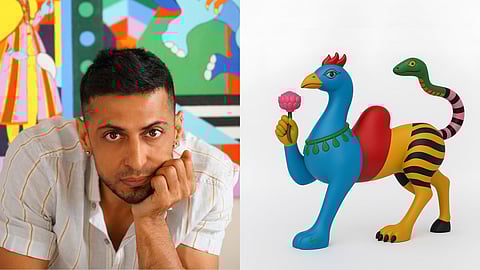
To step into artist Jayesh Sachdev's universe is to enter a realm where hybridity thrives. In his world, myth meets modernity, and digital interfaces expand physical form. A creative polymath whose works span art, sculpture, design, and immersive technologies, Sachdev approaches each medium as a part of a single narrative arc that sees the familiar through a surreal lens.
Trained as a design graduate, Sachdev first started experimenting with digitals before moving onto large-format paintings, and eventually interactive installations. The tying thread, though, remained spotlighting mythology. His recent works incorporate immersive technologies, including augmented reality and sound-responsive interfaces. These integrations allow his artworks to activate in response to touch or proximity, creating evolving viewer-led encounters. Sachdev views these tools as natural extensions of his visual language, enabling him to explore scale, movement, and multisensory engagement without abandoning traditional craft.
Alongside his studio practice, Sachdev has collaborated with global brands such as Zara, and has exhibited across India and Asia. His participation in Mumbai-based Tao Art Gallery’s 25th anniversary exhibition, Gateways and Pathways, further positions him within current conversations around Indian contemporary art and its increasing intersections with digital innovation and hybrid storytelling.
Robb Report India (RRI): You’ve been described as a “multi-hyphenated visionary.” How do you navigate these multiple identities—artist, sculptor, designer, creative entrepreneur—without diluting your vision?
Jayesh Sachdev (JS): I don’t look at them as separate. For me, it’s all one continuum of expression. Whether I’m painting, working with three-dimensional form, or designing, the language is always the same: visual storytelling. The medium changes, but the narrative doesn’t. Medium is literally only a medium of the story.
RRI: How does an idea move from concept to finished form in your studio?
JS: An idea often begins as something that’s been playing in my subconscious for a while. When something continues to linger as a thought, the curiosity to search for it persists. This could stem from a conversation, a visual reference I may have seen, an exhibition I’ve visited, or a travel experience where something inspires one to create. It brews in my mind for a while before it comes into form. Given that I am primarily a design graduate, my first instinct is to create a version of it digitally, play with it, and adapt it into how I envision the outcome.
RRI: Your work blends hybridity, mythology, pop culture, and technology. How do you balance tradition and innovation in your works?
JS: I see mythology as a form of surreal storytelling. I’m drawn to its characters, creatures, and symbols because they already live between worlds and have fascinated me since childhood. I try to bring them into new worlds, into a present-day context. For me, it’s less about tradition or innovation, and more about reimagining these stories through a contemporary lens.
RRI: What draws you to these archetypes, and how do you reinterpret them for a contemporary audience?
JS: I’m drawn to these because they’re timeless. They’ve existed as long as stories have, and been re-told over and over. They speak to emotions and energies we all recognise and are familiar with. When I reinterpret them, I strip away the religious or traditional layers and rebuild them through a modern, playful, and surreal lens, so they feel fresh and relevant today.
RRI: You’ve described art as a “multisensory journey.” Could you expand on how you build immersive experiences through your pieces?
JS: For me, there is joy in watching people respond to and experience the art I create. I want my audience to feel, not just think or see. Scale, texture, light, sound, and movement—these become sensory points. In one of my exhibitions, I encouraged people to touch the painting, and when they did, the artwork responded with sound and voice. In another, augmented reality brought static paintings to life, adding movement and depth to what was once still. I like creating spaces where art reacts, speaks, and invites you in. It becomes a dialogue between the viewer and the work, making it a multisensory experience that makes both the art and the audience feel alive.
RRI: From your Zara collaboration to awards across Asia, your work exists at the intersection of fine art and mainstream culture. How do you approach such collaborations while keeping your signature style intact?
JS: I see collaborations as an extension of my art or design style, and I believe both my art and design mirror each other, and also exist because of each other. Whether it’s Zara or any other brand, I bring my world into theirs. My style is playful, surreal, rooted in storytelling, often with an overload of elements and a multitude of colour. The medium or platform may change, but the visual voice is mine.
RRI: You recently exhibited at Gateways and Pathways, which brought together 50 diverse voices in Indian contemporary art. What does it mean for you to be part of Tao Art Gallery’s 25th anniversary celebration?
JS: Tao Art Gallery in Mumbai has always been a space where some of the most important Indian artists have grown and thrived. To be part of their 25th anniversary feels special—like being part of a legacy, and hopefully even a small part of the future of that history. I feel truly honoured and grateful to be included in this moment.
RRI: Can you tell us about the works you showed at the exhibition, and how they converse with the larger curatorial narrative?
JS: I showed two anthropomorphic sculptures, Navagunjara and Sharanya, both inspired by myth and the idea of transformation. These hybrid forms mix animal, human, and fantasy elements to explore identity and change. In the context of Gateways and Pathways, they represented transitions between worlds, between tradition, and also between reality and imagination.
RRI: Technology increasingly blurs the lines between art, design, and experience. How do you see this shaping your own practice?
JS: As artists, it is important to stay curious. And with the evolution of mankind, medium and material will continue to change and evolve, and with it, so should our art and audience. Technology has opened up many new ways to create and experience art—LED screens, projections, new materials, and even coding to blend the physical and digital worlds. For me, technology isn’t separate from art; it’s just tool. It allows my work to transform into new ways to be experienced. I continue to experiment and seek to collaborate with people of different skills than mine to marry two forms.
RRI: As a TEDx speaker and design educator, you’ve inspired many younger creatives. What’s the one piece of advice you always give to the next generation of artists and designers?
JS: Be patient with your journey and brave with your ideas. Most importantly, believe in yourself—even when no one else does. Perseverance and curiosity will take you further than talent alone. Find good people around you who support and stand by you.
RRI: What role do you think Indian contemporary artists can play in shaping global conversations about art in the coming decade?
JS: India has always lived in layers. That chaos is our gift. Indian artists have a unique voice shaped by layers of culture, history, and imagination. As the world looks for new perspectives, our stories can bring depth and diversity to global art. We have the chance to show that Indian contemporary art can be universal.
