
Subscribe
Subscribe
- Motoring
- Style
- Home & Design
- Travel
- Food & Drink
- Specials
- News & Tech
- Videos
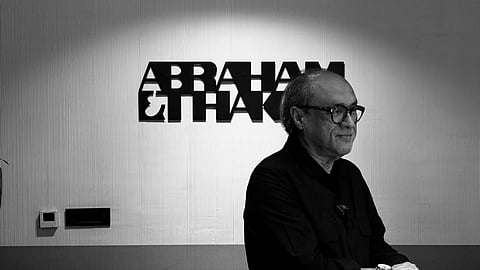
David Abraham, the Creative Director of Abraham & Thakore, is one of India's cherished assets for fashion and textiles. The Singapore-born fashion stalwart is a graduate of National Institute of Design, Ahmedabad, and has now dedicated over three decades to the reinterpretation of Indian textiles and craft traditions into contemporary design. To add but little colour for biographical illumination, Abraham's work is held in the permanent collection of the Victoria and Albert Museum, London, and has earned international recognition for its understated modernism, among other things.
Over the years, Abraham has come to be synonymous with the one crusade that has always harked back whenever mass production and quantity-mania has gripped people: to make the case for slower, more considered craftsmanship. As a member of RR Art Circle this month, Abraham agreed to tackle some of our queries along the lines of art, design, culture and fashion. Parts of the long but enriching conversation are produced here as an interview.
David Abraham (DA): I do, largely because we've always been very craft-sensitive in the textile space. A lot of this — like complex Banaras weaving work, or the broader heritage of Indian textiles — is craft. Unfortunately, craft tends to get pushed aside, often viewed through the lens of fine art, treated as secondary. I'm not sure that's valid. But right now, at least at the last few art fairs, for instance the Delhi Art Fair, and the exhibitions I've been to, there's much more engagement with textiles — everyone's noticing it. I went to a gallery opening recently in Defence Colony, at LATITUDE 28, the artists were working directly with textiles. We're beginning to see a real crossover, and I find that very interesting.
DA: A lot of it, in terms of influence, is subliminal. As a designer working in a creative space, I'm open to influence all the time, everywhere — I could be as inspired by pop art as by someone doing random painting on the back of an auto-rickshaw, to something that's in a gallery like Nature Morte or by something regal in the Victoria and Albert Museum. Everything gets absorbed and becomes part of your experience, and that should express itself in your design work. I just respond to everything.

DA: Interest in India has grown a lot over the past decade — not just in art, but in fashion, design, technology, everything. Partly, it's because we've grown more confident. We've now got a generation that has outlived the old colonial clichés and is beginning to express something indigenously and authentically Indian, without apology. That confidence is coming through in art, design, fashion, appliqué work, literature, cinema, music — even in the content we create for streaming. We're seeing a much more authentic, confident expression of our culture today, and that's an original voice, quite different from the international Western experience. It's a unique voice, and I think that's why the world is paying attention.
DA: We're in a very interesting space culturally. India has always had a strong, unique voice of its own, but has also historically looked to the West for inspiration and for acknowledgement — wanting to be validated by the West. That's been one of our biggest problems. Now we're finding a voice that has absorbed those influences and is able to express itself clearly and confidently.
DA: It's there, and it's getting stronger. We just need to support and encourage it — we need to move towards more creative freedom, not less. There's a worrying tendency in some quarters to censor, and that reflects an immature society. I don't know if you've been following the controversy around the Mohenjo-daro dancing girl figurine — that kind of thing risks pulling us backward. There are polarising forces at work, and it's important that we resist them.
DA: We just need to find our space in the world — see ourselves as part of a global phenomenon, and state that clearly and with confidence. We've already started doing this, taking part in international platforms like the Venice Biennale, and our presence there is growing. We just need to build on it consistently, rather than going backward. Sometimes that worries me — we tend to take three steps forward, one step back, then sideways. We don't yet have that consistency.