
Subscribe
Subscribe
- Motoring
- Style
- Home & Design
- Travel
- Food & Drink
- Specials
- News & Tech
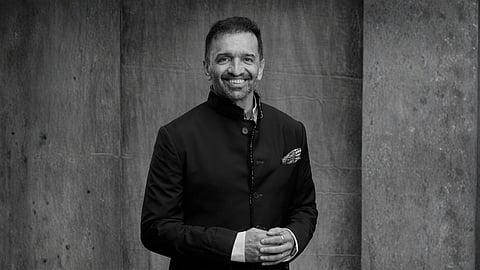
Atul Kasbekar has spent three and a half decades building India’s most aspirational visual language. Throwing a bit of limelight on his background, Kasbekar dropped out of chemical engineering at the Institute of Chemical Technology in Mumbai in his second year, flew to Santa Barbara to study at the Brooks Institute of Photography, graduated top of his class in 1988, trained under some of Los Angeles' most respected commercial photographers, and returned to India in 1990 to open his own studio, Negative Space, in Mumbai.
What followed was one of the most prolific careers in Indian commercial photography: over two decades of magazine covers, advertising campaigns for virtually every major brand in the country, more than ten editions of the Kingfisher Calendar starting in 2003, the first International Food and Beverage Creative Excellence Award won by an Indian, a celebrity management company, a corporate image consultancy, a Bollywood production house — Ellipsis Entertainment — behind critically acclaimed films including Neerja and Tumhari Sulu, and the honorary chairmanship of the Photographers Guild of India.
But at his core, Kasbekar has always maintained that he is a people photographer. HONEST: Portraits of Character, his first solo exhibition, is where he finally proves it. Opening at Jio World Plaza on June 4, the show features a series of large-format black and white portraits of some of India’s most respected actors — Anupam Kher, Pankaj Tripathi, Naseeruddin Shah, Neena Gupta, Kalki Koechlin, and Boman Irani, among others. These portraits were shot in his studio in Worli against a plain white background with a single light source, zero retouching on faces, and no brief but honesty. It took three years to make — most of it spent convincing actors to leave their homes and come to him. It is, by his own description, where it all started.
Ahead of the preview, Robb Report India spoke to Kasbekar on the exhibition, the actors he chose, and why it took 35 years to make something purely on his own terms.
Atul Kasbekar (AK): My interest in photography began with faces. In my mid-teens, that usually meant portraits of unsuspecting sisters, friends, and the assorted pets in the building. Nobody paid me to take those pictures. With this exhibition, I’ve essentially gone back to where it all started. Nobody paid me to take these either. This was simply a compelling call from within. As a producer, sitting behind a monitor for years, I found the nuance, integrity, and emotional labour that our character actors bring to every frame nothing short of staggering. This exhibition is my hat-tip to those artists.
AK: As a photography student, I was deeply influenced by Richard Avedon. In my opinion, the greatest to ever pick up a camera. A lot of Avedon’s work was made against a white seamless with unremarkable light, which is precisely why his images became remarkable. It was about revealing something intimate. For me, the hat-tip would’ve been compromised if I’d gone to everyone’s homes and photographed them in their personal spaces. You can already visualise it: actor sprawled on a sofa, moody window light, cigarette plume, existential gaze. Lovely image. Also, slightly déjà vu. So, the honesty came from stepping back and refusing to show off. Plain white background. One clean light. It took three years. Mostly convincing people to leave their homes and come to my studio in Worli. Which, if you know actors, is a heck of an achievement.
AK: A good people photographer needs to become whatever is required that day to get the subject into a comfort zone. So, over the years, I’ve happily played best friend, confidant, therapist, shoulder to cry on, or just an occasional grapevine columnist. Most people turn around afterwards and say, “We’re done? That was painless.” That’s the goal. Lighting is preset and tested. My assistants are brilliant and invisible. There’s good food, the right music, and great conversation. Whatever it takes. I’m inherently a people person and, if I may say so myself, reasonably good at making people forget there’s a camera in front of them. The technical stuff is easy.
AK: Better late than never. Also, now that I’ve started, there will be more. Apparently, I’m entering my difficult artist phase rather late in life. Presented across Levels 1 and 2 of Jio World Plaza, HONEST will transform the venue into an immersive cultural experience where photography, cinema, and contemporary storytelling intersect.
AK: To be fair, most commercial photography is dishonest to some degree. And I’ve been a willing accomplice. For this exhibition, I’ve studiously done zero retouching on faces. The only post-production, beautifully done by Craving Digital, was controlling contrast for crisp black and white prints. My subjects are achingly honest in their craft. Anything less from me would’ve felt disrespectful.
AK: On the tombstone (a morbid name for an image descriptor) beside each image, I’ve asked every artist to leave behind a line that resonates with them. A life lesson perhaps. These aren’t portfolio pictures. They’re moments before the director called “Action” and after the director called “Cut”. I’m hoping viewers look at an expression and begin inventing stories for it. And somewhere in that process, they become curious about their own art. Whatever form that takes.
AK: One can have a great idea, but it remains exactly that until someone shares the vision and backs it properly. A destination that continually shapes contemporary luxury through immersive and thoughtfully curated experiences, Jio World Plaza was a natural synergy with HONEST — an exhibition that celebrates rawness, individuality, and human expression in its purest form.
