
Subscribe
Subscribe
- Motoring
- Style
- Home & Design
- Travel
- Food & Drink
- Specials
- News & Tech
- Videos
The ambition is to take whisky to Scotland before launching it in your own country. After all, Scotland is widely considered the spiritual home of whisky, making it an unlikely place for an Indian distillery to prove itself. Yet in 2004, a small, family-run distillery from Bengaluru did exactly that. And in the process, it helped change the world’s perception of where great whisky could be made. The distillery was Amrut and its story begins but with the birth of a nation. Founded in 1948, in the same year India stepped out from under the shadow of the British Raj, Amrut Distilleries was the creation of J.N. Radhakrishna Rao Jagdale.
Its earliest years were unglamorous by design, which included a blending and bottling operation supplying rum and brandy to the Indian army, then to a thirsty domestic market hungry for home-grown spirits in a newly independent country. There was little in those beginnings to suggest that, decades later the same family firm would be toasted by critics as producing one of the finest single malts on earth.
In the 1980s, Amrut began experimenting with malted barley, laying down stocks of aged malt whisky largely to enrich its cheaper blended spirits. Until under the stewardship of Neelakanta Jagdale, that tinkering hardened into a genuine conviction that India could produce a single malt worthy of standing alongside anything Scotland had to offer.

But convictions mean little without proof. So in 2004, Amrut did something almost provocative. It took its single malt straight to Glasgow. It was a calculated gamble and a shrewd one. European drinkers, weaned on the idea that fine single malt could only ever be Scottish, were sceptical that a distillery in tropical southern India could produce anything of real pedigree. But Amrut's answer was not argument but evidence. The distillery arranged blind tastings, setting its whisky alongside celebrated Scotch malts and letting the liquid speak for itself. Time and again, tasters mistook Amrut for a Speyside or an Irish dram, an unwitting compliment that did more for Indian whisky's reputation than any marketing campaign could have managed.
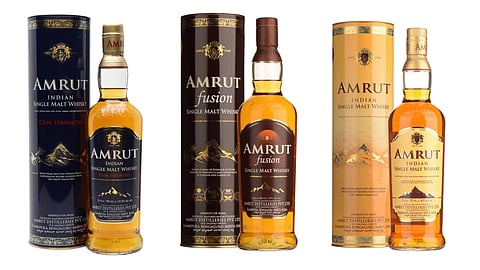
The vindication that followed was emphatic. As Amrut Fusion, a blend of Indian and imported Scottish malts, built with a thread of peat smoke running through its spice and fruit was ranked third-best whisky in the world by the critic Jim Murray in his Whisky Bible of 2010. Only then, with its credentials proven on foreign soil did Amrut bring its single malt home launching in Bengaluru the following year to a domestic audience newly proud of what its own distillers had achieved. More than twenty international awards have followed since.
What makes Amrut's whisky genuinely distinctive is the science of its making. Ashok Chokalingam, the distillery's long-serving chief distiller and the brand's global ambassador describes Amrut's whiskies as a bridge between two very different whisky traditions. Distilled in a manner reminiscent of Scotland, yet matured in conditions that owe more to Kentucky bourbon country. Bengaluru's elevation of roughly three thousand feet, combined with its relentless tropical warmth, drives an intense "angel's share" (the portion of spirit lost to evaporation in the cask) something Scotland's cooler cellars never see. The whisky matures faster, extracting flavour from the wood with unusual speed and intensity. The result is a house style marked by honeyed barley soft caramel and a distinctly tropical, fruit-forward character, occasionally shot through with chocolate notes that no Highland glen could replicate.
For all its achievements, Amrut has remained conspicuously understated about them. The Jagdale family, by most accounts never much cared for fanfare, preferring to let the whisky and the awards do the talking. It was during the isolation of the Covid-19 pandemic that writer Sriram Devatha decided to put the story on paper. His book, Amrut: The Great Churn, chronicles the distillery’s rise, a story that had been quietly unfolding for nearly seventy years.
It is in the end, a very Indian sort of triumph. Amrut did not simply make India's first single malt. It made that terroir and tradition need not belong exclusively to Scotland.