
Subscribe
Subscribe
- Motoring
- Style
- Home & Design
- Travel
- Food & Drink
- Specials
- News & Tech
- Videos
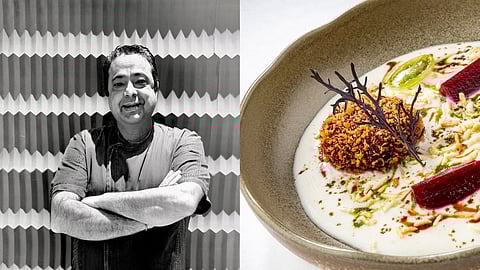
For nearly 15 years, Chef Manish Mehrotra shaped the way India, and the world, understood contemporary Indian dining. Walking away from that kind of legacy is never easy, but he did. And now he’s back after a refreshing sabbatical. When Robb Report India met him at the pre-opening of Nisaba, his new restaurant in Delhi, there was a flicker of nerves beneath the calm. When you’ve helmed one of the top restaurants in the country for that long, everyone waits to see what you’ll do next. His answer is simple, with a light-hearted chuckle: “you won’t find any gold, silver or precious stones on the plates; just honest, deeply satisfying food”.
Nisaba marks a shift not just in the chapter, but also in responsibility. As chef-owner, Mehrotra’s role now stretches far beyond the kitchen. His attention spans everything from menu development and wine pairings to lighting, window blinds, and artwork—each detail mindfully chosen to support the food, never overshadow it.

Having pioneered multiple food trends, Mehrotra is keen to move past culinary labels. He resists terms like ‘modern Indian’ or ‘regional cuisine. “We’re past all that now,” he says. The guiding idea behind Nisaba is deliberately uncomplicated. He has kept the entire focus on food and made it easy, accessible, and not intimidating. This simplicity is carefully engineered. “I wanted it to be casual,” he adds, “yet not so casual that you compromise on a good wine menu or warm, attentive service.” The result is a sweet spot—somewhere between stuffy fine dining and everyday casual restaurants—polished, but never stiff; relaxed, but never careless.
One of the biggest dilemmas Mehrotra faced was whether to start entirely afresh or bring along some signatures of his past. After much deliberation and conversations with people whose opinions he trusts, he chose balance. A handful of beloved signatures make their way onto the menu—black dairy dal, pork ribs, blue cheese naan—acknowledging continuity but leaving ample room for fresh creations.
Located on the first floor of the Humayun’s Tomb World Heritage Site Museum at Sunder Nursery, Nisaba occupies a coveted address in Delhi. The space was won through a competitive bid, and the heritage location adds a charm of its own. Designed with warmth, natural light, and clean lines, the interiors transition seamlessly from bright and open during the day to intimate and dramatic in the evening. Lighting subtly accentuates the bar, lounge, and dining areas, while a private dining room seats up to 14 guests.
Between the lounge and the main dining area is a striking sculpture by artist Dhananjay Singh—an abstract meditation on grain, growth, and renewal. It reflects Nisaba’s name, drawn from the ancient goddess of grain and writing, and mirrors the restaurant’s philosophy of creation and interconnectedness.
“Nisaba draws inspiration from everyday dishes found across India,” says Mehrotra, “flavours shaped quietly over time in homes, small towns and neighbourhoods.” His influences are the cooks who work outside the spotlight—street vendors, dhabas, thelas—people who rely on instinct, skill, and repetition. He and his team have skillfully translated these ideas into a contemporary restaurant format. Offered à la carte and through seasonal menus, guests can expect clean flavours, with oodles of familiarity and some sprinkling of surprising combinations. While the à la carte offerings are wholesome, there are plans for future chef’s tastings and high-tea menus.
We started with one of the most predictable dishes of any Delhi restaurant—the butter chicken—curious to see how it is reimagined at Nisaba. Juicy chunks of chicken come smothered with smoky makhani sauce, it is further elevated with whole toasted cashews, paired with slices of achari lal mirch and delicate onion rings to replicate ‘lachha pyaaz’—a fitting example of familiar comfort in a refreshing new format. Mutton seekh kebabs arrive bathed in blue cheese butter, best scooped up with the accompanying sweet baked naan.
There’s village-style mutton roast with chilli crisp and aloo papad, Belgian pork ribs that melt-off-the-bone with mango chunda and sour fennel, and tandoori bacon prawns paired with green thecha yogurt. With so much choice in the small plates, one could easily make a meal out of them, but there are hearty mains to choose from as well. The piece de resistance is the slow-cooked raan that gets its final char on a coal-fired ‘sigri’, served with seasonal shakarkandi and hara chana chaat. Perfect as it is, it also comes with an anchovy curry on the side to add extra oomph. Our meal finds a fitting finale in chilli tomato crab ghotala with butter buns—perfectly comforting yet indulgent.
The beverage program complements the kitchen’s ethos. Wines are thoughtfully chosen to pair with the food, while cocktails and non-alcoholic options follow a back-to-basics approach—simple, balanced, and seasonal, without unnecessary theatrics.
Desserts at Nisaba offer gentle, lingering sweetness. The baked rasmalai with fried chironji has a range of textures and is not overly sweet; the unmistakable flavour of nolen gur on the makhana provides the delicious explosion in an otherwise mellow dessert. Then comes the treacle tart with Gurgaon doda and pecan ice cream, again the textures offering a fine contrast—the warmth of the tart against ice cream, utterly delicious.
Set to open on January 17, 2026, under the Manish Mehrotra Culinary Arts (MMCA) banner, Nisaba is rooted in comfort. From just-right lighting and inviting seating to the thoughtful details on every plate and perfectly paired drinks, everything flows together in an easy, effortless harmony.