
Subscribe
Subscribe
- Motoring
- Style
- Home & Design
- Travel
- Food & Drink
- Specials
- News & Tech
- Videos
AI generated summary, newsroom reviewed
Yellow is Bellow came first, featuring golgappa, tuna and bottarga, then came Think Green with green leaves, ama ebi and basil seeds. Memories of a Summer in Versilia brought together turbot, fennel and tomato dashi, while Non Dire Cassate reimagined the familiar through spaghetti, pistachio and bergamot. More followed at Indian Accent, Delhi, as it hosted Gucci Osteria da Massimo Bottura Florence for an exclusive one-day pop-up.
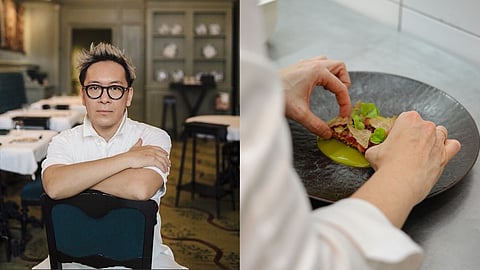
Leading the whole experience was Chef Takahiko "Taka" Kondo, Head of Gucci Osteria Florence. The Japanese-origin chef who came from Italy has spent 17 long years working alongside Massimo Bottura at the iconic three-Michelin-starred Osteria Francescana. It was before he joined Gucci Osteria Florence in 2022.
For his pop-up at Indian Accent, the travelled culinary master brought a menu that playfully glided across interpretations of Italian classics and ingredients. By now, you know the multi-national and multi-cultural training that he hones. To get a taste of what such cosmopolitanism means, especially when it comes to the eating table, Robb Report India spoke to Chef Kondo. The conversation steered from his beginnings to his impressions of India and the Indian palate to dishes with a memory and more, parts of which are reproduced here in the form of a Q&A interview.
Takahiko Kondo (TK): When I came to Italy in 2000, I discovered Italian food and a familiar kind of depth in the culture. Italy taught me food, history and tradition, a lot of religions and many things. Everyone has their own identity and is deeply connected to the places they come from, like India. So after spending so many years in Italy, I learnt that cooking is not only about techniques but about your own traditional food and dishes. When you understand your own culture, you understand the ingredients behind the dishes.
At the same time, being Japanese gives me a different perspective on Italian cuisine. In Japan we have sensibility and seasonality. Japanese cuisine is seasonal, minimal, simple, and preserves natural flavours. So I think Italy taught me how to express myself through Italian cuisine in my mind, but Japanese roots gave me a different way to look at the cuisine. That's why I say — I have Japanese roots, but an Italian soul.
TK: First and foremost, you must understand Italian traditions before you can interpret Italian cuisine. It has a very strong identity, but at the same time I don't want to change things just to make it different. I always connect with Italian culture, as it is one of the most impressive ingredients in my cuisines.
Why does a food culture exist? Where does it come from? What is important about it for inspiration about my dishes? So, once I have understood this, I can interpret my own dishes. I've been here for more than 30 years so my cuisine is all Italian, but my accent still remains Japanese. I think about season, balance, and ingredients for every dish I prepare, keeping my Japanese roots. I use my own individual perspective and interpretation in each dish, to tell a different story with the ingredients and techniques used.

TK: I’ve been working with Chef Massimo for 23 years now. He has taught me many things but he gives me a lot of freedom. He may not have necessarily taught me about just cooking, but more importantly, he has taught me that cooking is about having something to say, a way to express yourself and tell a story through what you create. For example, he taught me that you respect the past while looking at it from a different perspective and gave me the courage to think beyond the plate. So, after so many years of working with him, I have also learnt to let go.
I stopped thinking what he would do and started asking myself what I wanted to say, which was the most important thing. It's a great apprenticeship and gives you knowledge, but at one point you need to use that knowledge to make it your own. I made my own version of the Lemon Tart, which is our most famous dish and important to learn, although I made mistakes but I made my own version.
TK: Working in Gucci Osteria changed the way I see dishes. I always change the menu, but the concept remains the same about the food, culture, colours, texture, memory and emotions. The connection between food and art is a common thing. Sometimes I don't start with ingredients at all, but with colour or imagining pieces of art, stories or even memories. So, for example, sometimes I see colours and I immediately think about ingredients or flavours. Other times I remember places or moments from my own life and that becomes the starting point for a dish.
I think food and fashion have something in common: before you experience them, they are already part of your past emotions but the tasting completes the story. For example, you go to a museum and you see something there, but without a story or history, it's incomplete art. But for me, beauty is never in the art. The dishes have ideas, story and culture to make the best flavours. They have imagination as the starting point, but the ingredients come later.
TK: Memories are very useful for all chefs, but nostalgia can become a limitation at times. It's good to feel nostalgic, but sometimes it can disturb your imagination. Nostalgic memory can limit your imagination, because memory gives you emotions which can be a very strong part of starting a dish. But I want simplicity to create the past, so when I remember a dish or place or moment from my life, I ask myself what did I feel in that moment? Perhaps it was comfort or happiness or curiosity or even a surprise. I try to translate that feeling into flavour, temperature and texture. For me, memories become a dish when I can transform the emotion of the memory into something another person can experience and relate to. So I don't stick to nostalgia but memory to start something new.
TK: I love Indian food, is what I can say about this question. I've always loved Indian food, but now I love it even more. After experiencing Indian cuisine, the possibility of having my own ideas about flavour changed, for example, mango lassi. India has so many sophisticated food cultures, that's why people use spices, acidity, sourness, fermentation (like in dosa) and balance, which is very different from Italy or Japan.
So, my mind has opened as I eat more Indian food during this trip. But I'm excited about the ingredients and I'm even more interested in understanding how Indian people think about flavours, and have had conversations about this with the team at Conosh, as well as with Chef Shantanu Mehrotra at Indian Accent Delhi. I don't want to come to India to just cook Italian dishes using Indian ingredients, but to develop more connection with both the cultures. I would love to carry all Japanese, Mexican and Italian cultures, but now Indian too.
It was a learning experience in India and I want to discover what more I can learn and understand. You may look at my cuisine differently, which is the most interesting part about cooking. You bring your own identity, but you also have to be open enough to let the visit change you.
TK: This is a question I ask everyday — I can easily say how it's different. It’s not about the 30 years of professional kitchen experience, I think curiosity is more important than experience. Because there are still so many things that I don't understand and they keep me interested in learning, that's why I want to learn how to make a dosa or bheja fry. I travel to discover the use of fermentation in different cultures, learn something more about ingredients or ways of using them in cooking, that make me question what I already know.
It is also interesting outside the kitchen, culture, fashion, music, art, even how people live daily in their respective countries. Sometimes the ideas for dishes come from something that has nothing to do with food. It's all about connection. At this stage of my career I am not interested in showing what I can do but also I am more interested in understanding why something works and what can I experience through it. When you stop being closed is the moment you start reinventing yourself and realise there is so much to see and learn. I don't want to repeat myself.