
Subscribe
Subscribe
- Motoring
- Style
- Home & Design
- Travel
- Food & Drink
- Specials
- News & Tech
- Videos
Goa has never lacked places to eat well. What it has perhaps lacked, until recently, is enough conversation around the rooms in which those meals are being served. For while the state’s restaurant scene has expanded in every possible direction — beach clubs, chef-led openings, hotel dining rooms, garden cafés, late-night bars — a quieter and rather more interesting shift has been underway in the background.
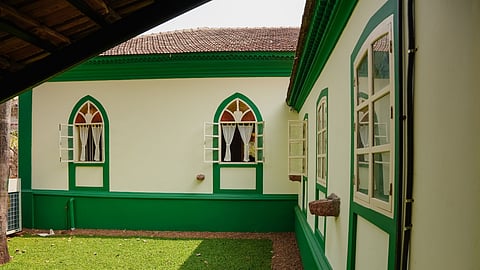
Some of Goa’s most atmospheric tables are being laid out in old bungalows: Indo-Portuguese homes with deep verandahs, shell windows, thick walls, old flooring, and high ceilings. Historic bungalows across Fontainhas, Saligao, Sangolda, Assagao, and beyond are now being restored, adapted, and reopened as dining spaces.
There is, of course, an immediate pleasure to dining in an old Goan house, which does not come from food alone. Food historian, author, and curator of Goan culinary culture Odette Mascarenhas puts it beautifully when she says that these homes create “a cosy, yet imposing and unique feel.” She speaks of the tiled roofs, the small entrance portico, the pillars, the balcao where people once sat, and the shell-shaped windows that are so rare now. “Food complements the decor and the artistic vibe,” she says, and that, really, is the point. In an old Goan bungalow, the meal is never working alone.
Heta Pandit, an independent researcher and writer on Goan heritage, resists the idea that an old Goan house is only emotionally persuasive as a dining room. “The heavy doors, the load-bearing walls, the flooring and the garden space… plus the fact that this house was once a home of a Goan family, a family with history, a legacy, makes it emotionally persuasive and compelling,” she says.

Mascarenhas recalls that in older Goan dining spaces, before the current wave of outside concepts and pan-Indian menus really took over, there was a looseness and ease to the experience — music, high ceilings, no air conditioning, a central bar, people gossiping and talking, a kind of sociability that belonged as much to the structure as to the menu. “It was not staid, never formal - just something that gave a happy vibe,” she says. That old spirit, in many ways, is what today’s bungalow-restaurants are trying to retrieve, even if they are doing so in more contemporary ways.
What makes this more compelling is the fact that these restorations, when done well, are also a form of conservation.
Preservation, in the strict sense, is about leaving things untouched; conservation, or adaptive reuse, is something else. “When you conserve, you are using and reusing existing materials available at the site… and thus saving the environment by not going out into the countryside and plundering more natural resources,” says Pandit. “You are also protecting the memory of the house, the intellectual property that has gone into the original design.” That, in the context of hospitality, becomes especially powerful.
Among the clearest expressions of this trend is The Second House in Saligao, housed in a restored 108-year-old Indo-Portuguese bungalow that now functions as a restaurant, bar, and art-filled social space. What makes it work is not simply that the house is beautiful (it is!), but that the architecture is allowed to remain legible. The rooms retain distinction, the sequence of spaces still feels domestic, and the restaurant understands that the building itself is part of the draw.
Vaarta in Sangolda operates in a slightly different register, but with a similar intelligence. Set in a restored 160-year-old Goan bungalow, it uses the old home as a mood. The architecture slows the meal down and gives it texture and a sense of context. The regional Indian fare includes dishes such as pani puri, vada pav, tokri chaat, rogan josh, keema pav, and chelo kebabs.
Chef Kunal Kapur’s Pincode Bungalow in Vagator offers another version of the same story. Here, a 193-year-old restored Portuguese bungalow becomes the setting for memory-led Indian and fusion Indian dining, and the logic is easy to understand.
Ourém, set in a 150-year-old heritage house in Fontainhas, Panaji, leans into that old-world intimacy even more directly. The stained glass, the balcaos, the courtyards, all add to the setting of Chef Ines Soares Lobo’s restaurant. Expect local dishes such as cafreal, chorico, gambas, and pau, served with artistic flair, here.
Then there is Hospedaria Venite, one of the oldest examples in this line, and in some ways the elder statesman of the lot. Housed in an old Portuguese home in Fontainhas, it has long offered exactly what many of these newer places are now rediscovering: that a house with creaking wood, balconies, and lived-in charm can do wonders for a meal.
Jamun in Assagao belongs firmly in this conversation too, not just because it is set in a beautifully restored Portuguese bungalow, but because chef Rahul Gomes Pereira — better known as Picu — has thought deeply about what it means to make a restaurant out of a family-like space.
For Picu, the space is not separate from the menu. “All of this does inspire the menu, my thought process of coming up with dishes,” he says, because when “you take so much care and love and build out a product, the menu has to reflect that.”
The bungalow-restaurant trend says something larger about what luxury in Goa wants to be right now. A dinner in a restored bungalow offers what many expensive restaurants cannot: surprise, intimacy, shadow, and a conversation with the past.