
Subscribe
Subscribe
- Motoring
- Style
- Home & Design
- Travel
- Food & Drink
- Specials
- News & Tech
- Videos
Chances are you have eaten Tamil food without ever hearing its story. The sambar, the banana-leaf meal, the fried snacks pressed by hand, most of it arrives on the plate stripped of the history that made it. Rarely does anyone ask why a dish exists at all, who first cooked it, or what it survived to get here. That question is what Chef Gokul decided to spend his career answering.
In the temple towns and coastal kitchens of Tamil Nadu and far beyond them in Sri Lanka, Malaysia, Singapore, South Africa and the Caribbean, sit generations of Tamil food that never made it into a cookbooks. For Gokul, co-founder of Tamil Quarter, documenting that food isn't a side project. It is a responsibility to make sure none of it disappears without a record.
For Robb Report India’s first anniversary, we turn to the firsts that leave a lasting imprint. From a childhood meal that sparks a lifelong love for food to the first steps towards preserving a culinary heritage, here's what Chef Gokul shares.

When the pandemic struck, restaurant kitchens across the world went quiet and it gave chef time to slow down, a shift that turned out to be as personal as it was professional. What he noticed was how many Indian ingredients were disappearing from markets and pantries, replaced by produce from elsewhere. "I realised that if we don't document these ingredients, these techniques, these stories, a lot of it could disappear without us even knowing."
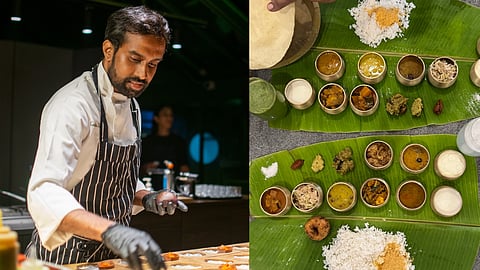
That realisation pulled him home and specifically, back to Tamil food. He had spent years training and working in Michelin-starred kitchens in the US and was preparing to move on to the next chapter of his career in Europe. Instead, he stayed. "I no longer wanted to chase opportunities abroad. I wanted to stay, research, travel, cook and tell my own story," he says. That decision became Tamil Quarter, a Tamil food revival project and dining experience based out of Chennai.
That sense of homecoming is tied to a broader mission for Gokul, one aimed at changing how Tamil food is understood, both within India and across its diaspora. Too often, he believes, Tamil cuisine is reduced to its most familiar restaurant form, its regional depth, its migration story, its many micro-cuisines left unexplored.
When asked about his favourite food destinations, he points to two cities for very different reasons: Kolkata for its emotional connection to food, memory, migration and community, and New York for the way its diverse food cultures exist side by side, pushing him to look beyond the boundaries of a single cuisine.
Translating that history into a dining experience, Gokul explains, isn't about ticking cultural boxes, he says of the tamil culinary identity. It has moved with people, absorbing ingredients and influences from the communities it met along the way, while carrying its own traditions forward.
That same instinct shapes how Gokul thinks about storytelling on the plate. He believes every dish has a person and a story behind it, from the legacy of the Cholas and the ingredients that sustained Jaffna families during the war, to the food Tamil plantation workers carried with them to the Caribbean. “There’s usually an emotion behind every dish like that of happiness, sorrow, survival, forgiveness, migration and that’s what shaped why it exists today,” he says. For Gokul, technique can make a dish perfect, but its story is what makes it memorable.
That care also extends to how he sources. Gokul is wary of the hyper-local trend turning into extraction dressed up as virtue. "We can't take more from an ecosystem simply because an ingredient has become fashionable," he says. When a dish or ingredient goes viral, he explains, everyone suddenly wants it and that demand lands hard on farmers and wild food systems never built to withstand it. It's a caution he carries from years spent with indigenous and tribal communities, whose older methods of cooking, processing and preserving food he sees as a direct window into the roots of Indian cuisine.
Millets and traditional rice varieties, native legumes, wild greens, seaweeds and coastal produce all find their way onto the table, alongside fermentation and pickling techniques that go back generations. Each ingredient, for Gokul, carries its own story of place, in the same way a dish does.
The wooden press his family has used for generations to shape adhirasam is one such object, nearly a hundred years old, brought out each year for Gowri Nombu at his grandmother's home. It is a memory, he says, that still shapes how he thinks about hospitality today. "I miss everything that came with it."
That instinct for detail runs through his dishes too, each one built around specific communities and their food. The Kongu and Nanjil Nadu traditions of Tamil Nadu's interior, the coastal cuisines, temple food, and the food carried by the Tamil diaspora into different countries. "I would want the meal to travel beyond Tamil Nadu," he says, "and show how Tamil food has evolved in these places."
It is also why he returns to K. T. Achaya for his understanding of the history and evolution of Indian food, and to Claus Meyer for his approach to locality, ingredients and the people behind them.
For Gokul, the farmers, fishermen and home cooks behind Tamil food aren't part of the brand story; they are the reason it exists. "The farmer who has saved a seed for generations. The fisherman who knows the seasonality of the coast. The grandmother who knows exactly how to ferment something without measuring a single gram," he says. "They are the real custodians of Indian cuisine, and they're the ones who deserve far greater recognition."
The same thinking shapes his idea of success. Beyond pop-ups and press, what matters to Gokul is whether the research holds up, whether a dish or an ingredient gets remembered because someone finally wrote it down. The next decade, he hopes, will see that story travel further, from Chennai into every kitchen the Tamil diaspora has ever cooked in.
"This one is deeply emotional for me," Gokul says of the shift he's watched take shape over the last decade in how Indian food is spoken about globally. Indian cuisine, he believes, is finally getting a platform beyond the old conversation around curry and spice, with more attention now paid to individual ingredients, regional micro-cuisines, fermentation traditions and indigenous grains. "India is one of the most culinarily diverse countries in the world and I think we're finally beginning to communicate that with more confidence," he says.
On Michelin's continued absence from India, Gokul is unbothered, almost matter-of-fact. "It's an important system and it's shaped the global restaurant conversation, but I don't think it should be the measure of Indian cuisine,". Some of the most profound meals of his life, he adds, came from homes, roadside stalls and small community kitchens, places that will never be considered for a star.
Looking ahead, he sees India's culinary conversation shaped less by chasing global systems of recognition and more by confidence in its own voice. "We don't have to make Indian food look European for it to be considered sophisticated," he says. "We can take our own ingredients, techniques, memories and stories, and present them in a contemporary way." Over the next decade, the ambition is to carry Tamil food's story further, into fine dining rooms and home kitchens alike, without losing the research and travel that built it.