
Subscribe
Subscribe
- Motoring
- Style
- Home & Design
- Travel
- Food & Drink
- Specials
- News & Tech
- Videos
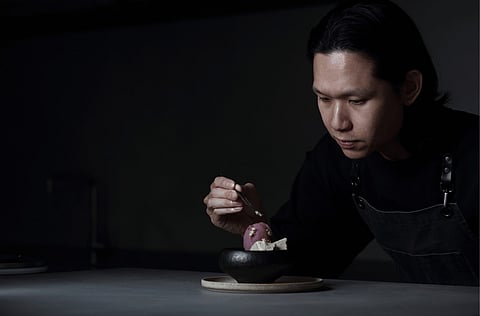
Minimal in Taiwan is truly one-of-a-kind. In 2024, it reached a historic milestone by becoming the first ice cream boutique globally to earn a Michelin star. We chat with Chef Arvin Wan, the brain behind Minimal to understand how did it feel to make history this way, his love affair with ice cream and the vision behind his ice cream shop.
He says, "I’ve always admired Michelin-starred restaurants abroad, so naturally, earning a star was something I quietly hoped for. Still, as there had never been a precedent for an ice cream shop to receive such recognition, I didn’t harbour overly high expectations. I simply focused on creating what I imagined and wanted to express — more like fulfilling a personal vision than chasing accolades."

Arvin: The word “Minimal” means “smallest” or “most essential.” Today, it is also synonymous with minimalism, and I find both meanings deeply connected to ice cream. Ice cream is pure and honest: in the mouth, it is a smooth, melting texture that disappears naturally. Yet behind that simplicity lies an extraordinarily complex process of calculation, testing, and balance. Every ratio affects the final texture and flavour.
On another level, “Minimal” also speaks to the microscopic. For ice cream to be smooth, its internal components — ice crystals, fats, proteins, and sugars — must be broken down to the smallest possible particles.
Arvin: Perhaps precisely because ice cream is seen as casual and comforting, most traditional ice cream shops feel to me like fruit stands or ingredient stores — familiar, fixed flavours like chocolate, mango, and strawberry. People come seeking those “products” they already know.
But I believe ice cream can be a medium for creativity, no different from cooking — only the final form is frozen rather than cooked. I approach ice cream with a culinary mindset: designing and composing flavours to express the identity of the shop, rather than merely transforming an ingredient. That is what gives it meaning for me.
My favourite is actually a very traditional Taiwanese shaved ice — just ice, sugar syrup, and a flavouring we call “banana oil”, an artificial banana essence. It’s simple, sweet, and aromatic — something many would consider cheap or synthetic. But for me, it defines childhood nostalgia. I still love it deeply and often use it as inspiration, reinterpreting and transforming it in my own way.
Arvin: Fine dining is a complex experience — for both the restaurant and its guests. It demands meticulous preparation, precision, and even a certain level of knowledge and awareness from diners. But I’ve never believed that good food should be inaccessible.
Ice cream, to me, is pure and approachable — it can be everyday yet extraordinary. I want it to have depth while remaining simple enough to enjoy without pretence. It mirrors my own relationship with ice cream: casually, it brings childlike joy; professionally, it inspires analytical precision. Perhaps that’s why I still love humble, everyday ice creams — they remind me of simplicity and happiness.
I hope Minimal can bridge both worlds — like music that can be enjoyed for its melody, or, if you listen closely, reveals intricate layers of instruments and harmonies beneath. Both experiences are valid. I want my ice cream to resonate with everyone, not just a select few.
Ultimately, I hope guests rediscover the act of truly tasting ice cream. Everyone loved it as a child — no one disliked it. Some grow out of it, perhaps because it ceases to surprise.