
Subscribe
Subscribe
- Motoring
- Style
- Home & Design
- Travel
- Food & Drink
- Specials
- News & Tech
- Videos
AI generated summary, newsroom reviewed
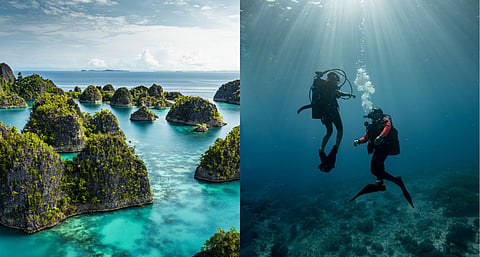
The remote Indonesian archipelago of Raja Ampat is located off the tip of Papua, comprising more than 1,500 islands, atolls, and cays, spread across the heart of the Coral Triangle, a vast marine region stretching from the Philippines to Papua New Guinea. This secluded corner of our planet has been recognised as the most biodiverse underwater ecosystem, home to rich coral and marine life systems. Coupled with lush tropical rainforests, towering limestone cliffs, and dense mangroves, it is one of the most sought-after diving destinations today. Things, however, weren’t always this way.
For decades, Raja Ampat had remained a shared secret among a small pool of serious divers. Travelling there required not just a diving certificate but also a rigorous sense of commitment to spending days and nights on basic liveaboard vessels to navigate its isolated waters. Fast forward to today, the secret is slowly spilling.
With increasing accessibility and improvement in infrastructure, including the rise of eco-luxury resorts, the visiting demography has diversified. The Raja Ampat Statistics Bureau reported the highest visitor count in 2019, with a total number of 46,375 visitors. The numbers took a sharp hit in the years following COVID, with a record low of a mere 2,230 visitors in 2021.
However, Raja Ampat has managed to quickly recover over the past half-decade, with the latest available reports from 2024 recording 33,277 visitors, registering a soaring 1,392.24 per cent spike since 2021. In 2025, the Raja Ampat Regency Tourism Office targeted a footfall of 45,000 visitors, and though reports are yet to be made publicly accessible, the region's allure is real and the numbers show for it. Despite the spike in numbers, Raja Ampat continues to maintain its seclusion and exclusivity, paired with active conservation efforts. Here’s a deep dive into why it is becoming the most coveted diving destination in the world.

Beneath Raja Ampat’s stunning turquoise and emerald waters lie 600 coral species that make up 75 per cent of the world’s coral reefs. Fishes abound in equal variety, with over 1,700 species swimming through its waters. No other destination in the world offers such intense marine diversity — a new surprise awaiting you with each dive. Giant manta rays glide effortlessly past slow green turtles, and schools of barracuda move in dizzyingly large numbers while reef sharks and wobbegong sharks swim with the attitude and elegance of a celebrity.
What sets apart Raja Ampat from other popular diving hotspots like the Maldives and Australia’s Great Barrier Reef are the rare inhabitants that populate its water. Divers come in search of the Denise’s pygmy seahorse—no larger than a fingernail—as well as the electric-blue giti damselfish, the deep-reef cardinalfish and Jamal's dottyback, a species distinguished by its striking aqua-rimmed eyes. Elsewhere, flamboyant cuttlefish, Mandarinfish and even dugongs—which almost feel unreal—make an appearance, revealing a new set of species at every diving spot.
At a time when the world is grappling with the realities of climate change, coral bleaching, and declining fish population, Raja Ampat stands out as a rare conservation success story. Across the archipelago, marine protected areas and community-led conservation efforts have worked towards creating one of the healthiest reef ecosystems on the planet. This positive transformation is responsible for raising the region’s appeal because it not only allows you to experience marine life at its best, but it also offers a glimmer of hope by highlighting the effectiveness of sustained conservation efforts.
Raja Ampat has become a powerful example of how conservation and tourism can go hand-in-hand to support marine reserves, local communities, and secure long-term protection goals, tying preservation directly to tourism revenue. For modern day luxury travellers, this has become part of Raja Ampat’s attraction. Luxury here is no longer restricted to access; it has brought in conservation within its fold by ensuring that the islands and its inhabitants — both aquatic and terrestrial — are protected for future generations.
For years, travelling to Raja Ampat was an arduous affair, requiring multiple connecting flights and days long journey on rudimentary liveaboard boats. On ground, accommodation options were scarce, infrastructure was minimal, and some of the most spectacular dive sites could only be accessed by expedition-style boats. This was one of the primary reasons why this pristine region had earned the reputation for being the last true frontier of underwater exploration.
Over the years, travelling to the archipelago has become easier and on-ground facilities have improved. Simultaneously, luxury eco-resorts have sprung up on some of the islands, perfecting the balance between luxury and sustainability. Spearheading this change is Misool Eco Resort, set on a private island in Raja Ampat’s southern reaches. Once serving as the site for shark finning, the resort helped establish a new blueprint for luxury hospitality in the region. Built from reclaimed timber and designed with minimal environmental impact, it also features an on-site hydroponics lab and is surrounded by a 300,000 acre marine reserve that it has helped create.
Conservation has become the defining tourism philosophy in Raja Ampat and a new generation of resorts have followed suit such as Papua Paradise Eco Resort and Sordido Eco Resort which have elevated the standard of island living with overwater villas, personalised dive programmes, and wellness offerings rooted in local culture. As luxury travellers now seek destinations that offer both exclusivity and purpose, where sustainability is organically embedded into their stay, these luxury resorts have laid a solid foundation for these experiences. For guests, this means waking up in an overwater villa overlooking the most biodiverse marine environments in the world, where the best dive spots are just a quick jump away, and for Raja Ampat, it proves that luxury tourism and conservation can and should be inseparable.