
Subscribe
Subscribe
- Motoring
- Style
- Home & Design
- Travel
- Food & Drink
- Specials
- News & Tech
- Videos
Somewhere over Saudi's seemingly endless desert, we hit turbulence that makes me white-knuckle the plush leather seats of Lance Mortensen’s Phenom 300. I’m not a nervous flier, but the rough air doesn’t stop. One hundred miles ago, oil wells stood as signs of civilisation; they’re long gone. Outside either window now: sand as far as the eye can see. It was 105 degrees Fahrenheit (40 degrees Celsius) when we left Luxor, Egypt, and it’s no doubt hotter here. Chances of survival if we go down? Probably not very high.
But it’s business as usual for Lance, who is piloting, and his wife, Natasha, on the comms. He and his fellow pilots on this trip tell a story about being GPS-spoofed, most likely by the Russian military, while flying over the Black Sea last year. The avionics displayed Africa, but the planes were most definitely in Central Asia. Things could go bad here, too, my overactive imagination warns: engine flameout, pilot error.
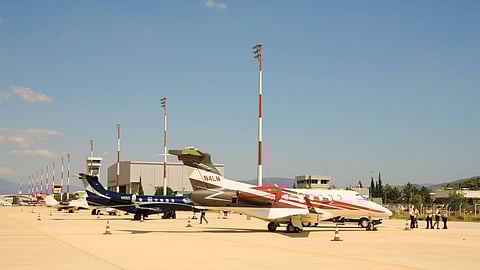
Lance motions me forward to put on a headset. Instant comfort hearing familiar voices on the “family channel,” the frequency shared by Lance’s plane and five other private jets travelling together across Saudi airspace. The others identify themselves by call sign: The Professor gives his position, and when I look up, contrails appear as we push past his CJ3+, flying 135 knots faster. There are occasional messages from Shortcut, who’s pulled ahead of everyone in his Phenom 300, while the Smugglers communicate less frequently. Big Buddha, at the controls of his Citation M2, is known for his deadpan humour and for routinely arriving last. “Thanks, everyone,” he says after the others radio that they are passing. “I appreciate you constantly reminding us that we’re the slowest.”
The linchpin is Guillaume “G” Fabry, flying in a Citation M2 with that jet’s owner-pilot. He clarifies flight-path changes and final approaches and, as journey director, serves as host, buddy, photographer, and fixer for any issues with officials. In one locale, he works with customs after Shortcut’s drone is confiscated. In Dubai, he negotiates to keep the jets in an air-conditioned hangar, rather than on the 125-degree Fahrenheit (51 degrees Celsius) tarmac. “He’s the best,” says Lance, who shares the call sign Sweatheads with Natasha. “There’s nobody like him.”
In the end, the group crosses Saudi safely and lands in the kingdom of Bahrain, gliding through customs in the private terminal like rock stars.
Welcome to Air Journey’s first trip to the Himalayas, with a group of couples flying their own jets from North America to Nepal, and back again, in a 42-day odyssey that touches down in 15 countries across 17,000 nautical miles. That is a long way from where the company started in 1998. Launched by Thierry and Sophie Pouille, Air Journey first offered short hops leading small piston airplanes from Palm Beach to the Bahamas. As the geographic reach expanded to Europe and South America, clients’ aircraft skewed toward longer-range turboprops and faster business jets.
In 2007, Thierry announced a 72-day round the-world trip. “We were like, ‘You’re nuts; nobody’s going to do that,’ ” says his daughter Anais, one of the journey directors on this trip. “He went to the Sun ’n Fun [air show], and seven people signed up.” Now, Air Journey leads about 30 tours per year and has a separate concierge flight-planning service for solo trips.
The seven couples I’m flying with (one pair is hitching a ride on another’s aircraft) include serial entrepreneurs, chief executives, retired business owners, and even a former NHL star. Nicknamed the Pioneers, this group has trailblazed private jet paths to new destinations in the Indian Ocean as well as last year’s “Stans” Air Journey trip to rarely visited countries in central Asia. They might fly into Paris, Macao, or Singapore, but they could just as well be landing in hair-raising, high-altitude airports such as Uyuni, Bolivia— where customs officials searched the planes for hours looking for smuggled cocaine—or Madang, Papua New Guinea, where there’s no tower, just an air-traffic controller standing on the tarmac “directing” aircraft via a handheld radio.

These pilots seem to have more stories under their collective belts than most seasoned travellers. On a 2017 trip, three couples and their jets were briefly detained at a remote Russian airport and three others found themselves wing to wing with Japanese F16s in an unexpected standoff. Then the group was sidelined by a typhoon in Taiwan before having to curtail the Bali stop because of a volcano eruption. “That journey had something happen every day,” Thierry says with a laugh.
Since the beginning, Air Journey’s mission has been to combine the adventure of flying one’s own aircraft with a luxury vacation on the ground. Sophie has stuck to three non-negotiable rules: No flying at night or in inclement weather, a three-day stay in the highest-starred hotel or resort at each destination, and minimal waiting time at airports, which typically means breezing through customs at upscale private terminals.
Safety is the primary directive underlining each itinerary, from ground-operator choices (“They have to have 24-hour security,” says Anais) to hiring a private-security firm for a gorilla trek in Rwanda shortly after a terrorist attack in the country. Other than that single occasion, political hot spots are verboten. When armed conflict broke out in Kashmir a few days before this trip’s departure, Air Journey quickly pivoted with great effort from the Stans itinerary to Egypt and the Gulf states.
For the Pioneers, seeing the world on their terms is a major motivator. “Imagine being able to say you flew your jet to Nepal and back,” says Rob Balzano, CEO of Citation Jet Pilots Inc., an association of 1,300 members who captain their own aircraft. The owner-operator is a breed apart. “They tend to be adventurous but cautious on safety,” he says. “For single-pilot operations, you’re doing everything on your own.” The payoff, he adds, is the “freedom the jet brings.”
“Most people on these trips are type A,” says Thierry, with strong personalities accustomed to being the alpha of the pack. “But when they meet each other for the first time, they realise they have the same character traits, backgrounds, and hobby. When you put them together for 30 or 60 days, they become friends for a lifetime.”
That certainly describes these seven couples, who have made multiple trips as a unit. In 2024, the Pioneers spent more than 100 days together on Air Journey voyages. In Bodrum, Türkiye, where I join the group at the Amanruya resort this past May, they look tired. This is their first significant break since departing from Quebec City, crossing the North Atlantic, and flying south through Europe, all in formation with aircraft spaced about 10 minutes apart.
The following morning, we board a 100-foot charter yacht anchored in the sun-speckled Aegean off the resort for a day exploring the coast. Conversation flows easily. “Everybody is very normal, self-made,” says Jerri Durbin, CEO of a large Dallas-area medical group, whose husband, Brandon (call sign Shortcut), is chairman and CEO of a six-state health-care firm and pilots their Phenom 300. “Nobody came from money. We just don’t have drama.” John and Carla Edwards, for instance, are from rural Geneseo, Illinois, population 6,500. Of the group, John and Karen Springthorpe have travelled the most extensively in their Citation CJ3+, with 142 destinations on 44 Air Journey trips. They’re as unassuming and folksy as Andy Griffith, who hailed from the same hometown, Mount Airy, N.C.
The group has spent enough time together to celebrate joys—children’s weddings, births of grandchildren—and sorrows. Lance and Natasha got married the week before departure, and later, with the others present, receive blessings in a Buddhist monastery in Bhutan. The bond remains tight outside the trips. Many Pioneers fly into the Mortensens’ L&L ranch in Wyoming to celebrate the Fourth of July every summer; the Wilsons and the Durbins now have second homes there.
On the yacht, John Springthorpe (call sign the Professor) is wearing a floral-patterned shirt and swimsuit, at odds with his buttoneddown demeanor, while the burly former NHL enforcer Behn Wilson (Big Buddha) is cracking jokes. Teasing is common among the pilots, but conversations always return to flying. Wrapped in beach towels, several of the men sit in the yacht’s main salon, recounting trips as they would prized war stories: the time Brandon, stuck knee-deep in mud, came face to face with an alpha-male gorilla in Rwanda; Jerri wandering the backstreets of Addis Ababa, Ethiopia, looking for works of local art, now keepsakes in her Texas home. They run through a list of favourite moments like a highlight reel, too: sitting with white Bengal tigers in Thailand; joining freedom protests in Hong Kong; spotting beluga whales in Alaska; soaking up Istanbul’s rich architecture; observing Tanzania’s elephants; haggling in the souks of Marrakech. “There are so many memories, I get the trips mixed up sometimes,” says Lance.
Behn steps into the salon, sees the men in towels, and asks who wants to go outside—it’s beautiful. Heads shake. It’s too cold. “What is this, a rest home?” he asks. “When’s the next round of meds?”
The Following Day, the Pioneers in their crisp white uniforms look like different people. Air Journey uses pilot attire outside the Americas and Europe, where flight crews are common but owner-operators are not, to facilitate movement through customs and other official channels. On the tarmac, everyone works with speed and purpose, removing covers from their jet-engine intakes, checking oil and oxygen levels, loading luggage.
Safe in the luxurious cocoon of our Phenom 300, Lance has the well-groomed appearance of a TV pilot (his hair stays perfect even in the scorching desert winds) and talks in a matter of-fact way about his wildly successful career— boiling it all down to just knowing how to “sell shit.” But most entrepreneurs don’t sell their first company at age 27, launch ventures in multiple industries, and at the age of 66 become the oldest person to fly around the world in a light jet.
In the cockpit, he’s methodical and decisive, working the avionics, adjusting throttles, toggling between screens. Natasha, meanwhile, is dealing with air-traffic control over the radio. After thousands of flight hours, she’s a capable wingman. Lance has even taught her to land if he’s incapacitated.
These flights are the highlight of my 12-day trip, as they clearly are for the pilots, who love the adrenaline and the challenges of flying into the world’s most remote airports. “You can’t have an entitlement attitude,” says Brandon. “It’s their rodeo, and we’re just along for the ride. If you keep that attitude, it’s another great adventure. If not, you’ll just be frustrated. I can get all the frustration I want at home.”
The US air-traffic-control (ATC) model is used around the world. Having English as the common language also helps the pilots in potentially stressful situations. But customs issues, ground snafus, and local ATC accents can make solo flying a challenge. Handling such impediments is a big part of the journey director’s job.
The Pioneers’ dynamics are not the stereotypical husband pilots, wife sits in the back. For those who started flying in their late teens, the women play less-active support roles, but for those who learned in their late 40s or early 50s—Behn Wilson and Lance Mortensen—their spouses are integral to the cockpit’s navigation and communications. Rita Wilson and Natasha Mortensen are at every pre-flight briefing, with the next day’s flight plans loaded on iPads, asking as many questions as the pilots.
Trish and Dennis Drew (the aforementioned Smugglers) are the unicorns. They took up flying together in 2005 and have now been co-pilots for two decades with four ever-larger aircraft. For this trip, Trish is pilot in command of their Citation Mustang.
After leaving the serene Amanruya, Luxor is a culture shock: hot, poor, colourful, pulsing with life. The neighbourhood around the Hilton is rough. Security checks the undercarriage of our van for bombs. A government bodyguard, sub-machine gun peeking out from beneath his sport coat, joins our group every time we leave the hotel. The Hilton offers quiet refuge, with an exceptional view of the slow-churning Nile 30 feet from the swimming pool and desert hills beyond. For two days, Atef, our guide, takes us on a greatest-hits temple tour: Hatshepsut, Medinet Habu, Luxor Temple, the nearly two-mile-long Avenue of Sphinxes, and special entry to the tombs of Ramses VI, Seti I, and Tutankhamen.
Karnak Temple is the group favourite. Its wide avenues and fewer visitors make the complex early engineering of the limestone pillars and sculptures inside the 200-acre grounds apparent and even more remarkable. It’s hard to fathom the proliferation of art made during the New Kingdom’s 500-year golden age—tens of thousands of hieroglyphics, richly detailed ceiling frescoes, multistory statues—for just a few deities and royalty. “It makes the Renaissance look like a summer art camp,” quips someone in the group. A few days after we depart for Bahrain, three more tombs are discovered.
These stops between flights are not so much crash courses in history or culture, or just stamps in a passport, but curated experiences that leave a lasting impression. Jerri Durbin thinks of the 42 days as a series of three-day weekends, which makes it easier to wrap her head around flying into 21 destinations over the course of six weeks. Before their Africa trip in 2018, the couple had dismissed the idea of being away from work for so long, but Zoom calls, WiFi, and a little flexibility make it viable.
One midnight, in business attire, Jerri runs a four-hour board tele-conference with headquarters in Dallas. She has also done an all-night video mediation from an over-water bungalow in the Maldives with nobody else the wiser. On a previous trip, a Swiss pilot took a more direct route: He organised a large business conference to coincide with the Air Journey stop in Marrakech so as not to interrupt his vacation.
In Terms Of extracurricular activities, the real hit with the car buffs is a private insider tour of the Bahrain International Circuit’s F1 complex, a masterpiece racecourse with Arabian architectural statements and a future-tech media centre. Their excitement ramps up even more when Trish and the men don full F1 uniforms and helmets to kart-race in heat that radiates at 120 degrees Fahrenheit (48 degree Celsius) on the track.
Next up is Dubai. Like Bahrain, it exhibits an intriguing adoption of Western culture, including downhill ski slopes alongside such high-end retailers as Gucci, Valentino, and Dolce & Gabbana in the 630-plus-brand Mall of the Emirates, where the group shops. Arriving via Rolls-Royce, Brandon also plays a round of night golf, oryx grazing nearby under the spotlights. Our sojourn takes an even more luxuriant turn at the Jumeirah Burj Al Arab.
This sail-shaped hotel perched on its own spit of land is, by turns, stunning, dramatic, tacky, and gorgeous. A gold-columned 590-foot atrium rises inside the building, with egg-shaped exteriors of nearly 100 suites that resemble a giant hive rather than something designed by humans. Our two story suites are lavish, with royal blues, bright reds, and lots of gold trim.
“As they say, money talks,” says our guide, Sameh, as we enter Abu Dhabi, the largest oil rich Emirate. The Sheikh Zayed Grand Mosque is its most impressive structure, a shining, almost surreal 1.78 million–square-foot complex with 82 domes and four minarets, clad in marble. Capable of holding over 40,000 worshippers, the mosque puts the wealth of the Emirates on clear display. We buy appropriate attire in the adjoining underground mall before entering on a private tour.
Lunch at Em Sherif Café on Abu Dhabi’s waterfront offers the best Middle Eastern cuisine I’ve ever had. The food on this trip has been generally top-notch but Western. This restaurant, on the other hand, serves local specialties such as ras asfour debs remmame (lamb sautéed with pomegranate molasses) and riz bi halib (orange blossom and rose rice pudding). Authentic national cuisine also awaits the group in Nepal and Bhutan. Dubai, though, is my last stop.
Tomorrow, the Pioneers leave for Kathmandu. There is already talk about another Eurasia trip next year, with fresh destinations. Before heading off, I see another pilot, Larry King. He and his wife, Judy, had left their plane at home and tagged along on the Durbins’ aircraft this trip, but they’ve decided Larry will steer their Citation M2 on two more Air Journey voyages this year. “For me, it’s not about the destination,” he says, echoing his fellow Pioneers’ zest for taking to the skies. “I’m more of a journey guy.”