
Subscribe
Subscribe
- Motoring
- Style
- Home & Design
- Travel
- Food & Drink
- Specials
- News & Tech
- Videos
AI generated summary, newsroom reviewed
Steeping in hot water is for teabags, not for humans. At least, that was what I had always believed. But on that pleasantly chilly spring evening, the idea held great appeal. I gave in completely to the experience, sinking deeper into the tub, and sighing in relief with the loosening of my tight and achy muscles.
As I took a deep breath to inhale the intense, herby aroma of the artemisia (wormwood) leaves, my eyes went to the late winter landscape outside, coloured in the orange glow of the setting sun. And I felt all my senses converge on that moment, with my breathing calmer and heartbeats slower. For the next few minutes, it was as if the birds had also paused their chirping, and there was complete silence but for the occasional crackle and sizzle of the odd stone.
I was in the spa at the andBeyond Punakha River Lodge, soaking in the traditional Bhutanese hot stone bath known as datsho. The bath area was designed to be partly open to the elements, allowing the sights and sounds of nature to complement the therapeutic process of the ritual. Further lulled by the soothing music and the warm candle lights, I smiled blissfully, with a renewed appreciation of Bhutanese culture.

In this wellness ritual, stones are carefully chosen from the riverbed and heated in an open fire until they glow red. When they are placed in fresh water, they release minerals that help treat a range of muscular ailments like arthritis and joint pains, and according to the Bhutanese, even hypertension and stomach disorders. Aromatic artemisia leaves are added for further goodness, since they are believed to have anti-inflammatory and anti-bacterial properties, often used to treat fevers, aches, and infections.
While upscale spas like the one in andBeyond still retain the basic structure of the traditional wooden bathtub, they also come with enhanced design elements and luxurious amenities like the shelf stocked with cold water and watermelon juice to rehydrate (much needed), and assorted nuts and dried fruit (not strictly needed, but nice to have).
When the water began to cool down, I called out to Kumbu, the spa supervisor, who dropped two freshly heated stones via a narrow chute connected to an outer chamber, and the water instantly began to get hotter. It was only when I felt like I was almost falling asleep that I finally dragged myself out of this balmy cocoon.
“The datsho tradition is more than 1000 years old, and used to be very common everywhere in the country, even in small villages,” Kumbu tells me. “For instance, after women deliver babies, they were always made to soak in this bath for relaxation and pain relief.” This makes sense, given that one of the old names for Bhutan is Menjung or Land of Medicinal Herbs, with therapies borrowing from both Indian Ayurveda as well as 7th-century Tibetan medicine, and focusing on balancing three key elements within the human body.
But in my travels through Bhutan, I realised that there was a more holistic healing to be experienced beyond the hot stone baths and restorative massages. Just a few hours after I landed in Paro, I felt I was switching off physically and mentally. The modern world, with its incessant noise signals, felt far away from this land where men broke into a happy dance at archery matches and children grinned toothily at strangers, and the predominant sounds were birdsong, Buddhist chants, and the swish of the wind whistling through towering pine trees.
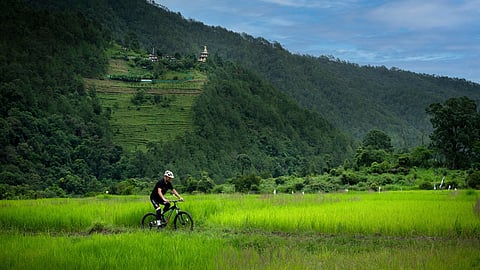
Risha Sarma, General Manager at the andBeyond lodge, says, “The country is more than 70% forest. Especially in Punakha, there is so much to do outdoors like hiking, cycling, and rafting, and so you are actually taking in pure air all the time. That itself is a wellness activity.” Complementing this is the food at the lodge, often basic and comforting, but always fresh and seasonal, sourced personally by the chef from local farmers.
I found Sarma’s words coming true also in the high altitude Phobjikha valley, just a two-hour drive from Punakha. After a long and challenging half-day hike, I headed straight to the bathhouse at Gangtey Lodge, the boutique hilltop property where I was staying. I had never been so grateful to soak into hot water as I was then, given my sore calves and pounding head after the walk in the cold and thin air of the mountains.
Here too, I felt my muscles unknot themselves slowly, as I closed my eyes and let the healing warmth of the water wash over me. Straight from the bath, my therapist led me to the massage table set up in my suite for an hour-long therapy with flowing strokes and warmed oil, which promptly sent me into a deeper state of repose.
It is not a surprise that cultures across the world – from Japanese onsen and Icelandic hot springs, to hammams in Turkey and thermal mud baths in New Zealand - have traditionally believed in the power of moist heat as a panacea. And Bhutan provided a wonderful reminder of the fact that sometimes, a soak is all it takes for an instant reboot.