
Subscribe
Subscribe
- Motoring
- Style
- Home & Design
- Travel
- Food & Drink
- Specials
- News & Tech
- Videos

Driving from Trichy airport to Chettinad, the landscape changes dramatically as the urban landscape of the city makes way for the rural vibes of a village. But that’s not the end of the transition. An unexpected burst of colour jolts me out of my reverie as my destination, THE Park Hotel’s Lotus Palace, Chettinad’s ornate façade, takes my breath away. The ombre-ochre and indigo-hued façade has stucco sculptures with architectural influences from Indian, colonial, Gothic, Saracenic, and Art Deco styles. And perhaps this was the best introduction I could have had for the first edition of the four-day Chettinad Art & Architecture Festival, Kalai. I am welcomed by Kathiravan Karunanithi, General Manager, THE Lotus Palace Chettinad, who explains, “Our chairperson Priya Paul suggested we promote Chettinad as a destination, so we chose to focus on art and architecture. "
Kalai means 'art' in Tamil, and this is a showcase of the architecture of the mansions that are well known here.” The event was curated by THE Lotus Palace Chettinad in collaboration with The Bangala, Visalam, Chettinad Mansion, Chidambara Vilas, and Saratha Vilas.
After a short break for a quick refresh, I settle down for a talk by architect Sujatha Shankar on the evolution and planning principles of Chettinad architecture. For the uninitiated, the semi-arid regions of Pudukkottai, Karaikudi, and Sivaganga in the southeast of Tamil Nadu are called Chettinad and are spread over 600 square miles with 75 villages. The people here call themselves Nagarathars, meaning 'people of the town of Nattukottai Chettiars', and these people were merchants, bankers, and traders in spice, gems, pearls, and diamonds.
“Chettinad is a gem in the tapestry of Indian architecture, and the Chettiyar community has done a great job in documenting their heritage. The Nagarathars went to Ceylon, Burma, Malaysia, Vietnam, and many areas of the Far East, and the riches that they earned in those countries were used to build mansions of massive proportions in their native land,” she explains.
The homes here are within a classic gridiron street layout that ensured rectangular plots that had an entrance on one street and the rear entrance on another street, thus spanning the entire town block between parallel streets.
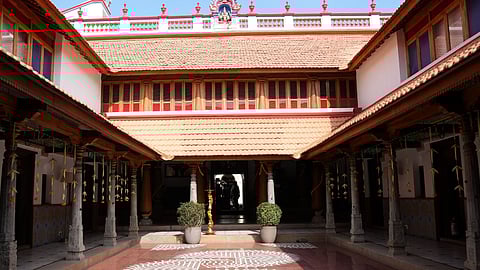
The structure is typically a front raised platform, which is the thinai, a shaded veranda, and a sloping roof supported by wooden pillars. The homes evolved into elaborate mansions with stone pillars, multiple floors, decorative parapets, and expansive courtyards between 1850 and 1950. If you touch the walls. The cream-hued walls have a smooth feel and sheen that is quite unique.
I find out that these are lime-plastered walls and have been made using kadukkai, a vegetable, palm sugar, and loads of egg whites. Senthil Kumar, General Manager, Chidambara Vilas – A Luxury Heritage Resort, adds, "Not egg yolk or shells, but only lots of egg white." The Kadukkai works as a bonding agent, absorbing the smell of the eggs and the sweetness of the palm sugar.”
One of the defining aspects of these homes is also precision, as every element has been thought out carefully. Speaking on the importance of living in resonance with physical and cosmic energies, renowned architect Sashikala Ananth took us through an interesting session at the heritage AR House. Measurements were often derived through Ayadi Ganita, a traditional calculation based on the owner’s birth star, creating personalised spatial proportions following principles of Vaastu.
“Traditional homes were designed to maintain harmony with nature and the five elements, using passive cooling methods such as courtyards, ventilators, and airflow systems like the Vamsha Moolam, which is the central axis or backbone of the house,” said Ananth. The open courtyard connects earth and sky, symbolising cosmic energy entering the living space. Architecturally, buildings followed a modular system called Pada Vinyasa, where spatial layouts were based on rhythmic mathematical modules. Residential structures used odd-numbered modules, ensuring energy lines meet in a space rather than a single point, which is reserved for temples.
This was followed by a visit to watch how the famed Athangudi tiles are made in a factory. Here we saw workers explain how they are made using local sand, cement, and coloured oxides. The workers pour colour pigments into a brass stencil on a glass plate. This is covered with layers of cement and sand and is set aside for curing for 10 days. The glass then separates, and the vibrant hues tile is ready.
A visit to the Athangudi Palace, Periya Veedu, followed, where we saw a fantastic prototype of the Chettiar mansion. The space is a visual treat with patterned floors, carved pillars, ornate ceilings, and large hallways that give you a glimpse of how the community lived. There is also a small display of some of the items used by them, from vessels to cupboards and artefacts. This space is also so Instagrammable, your camera will certainly be in overdrive mode.
Historian and author Pradeep Chakravarthy's guided walk at the Thirumayam Temple was an interesting insight into the temple’s architecture, inscriptions, and historical context. The two temples here are part of the rocky outcrop of the Thirumayam fort. You find inscriptions from 1245 CE that document intense conflict between the Shaivite and Vaishnavite communities and how it was resolved by Appanna Danda Nayaka, a commander serving Veera Someshwara of the Hoysala dynasty.
Peppered with storytelling, fantastic food, and local tales, this festival was a great introduction to the glory of Chettinad and how it is being revived through hospitality.