
Subscribe
Subscribe
- Motoring
- Style
- Home & Design
- Travel
- Food & Drink
- Specials
- News & Tech
- Videos
AI generated summary, newsroom reviewed
When speaking of summer houses, one must first have a clear picture of what a summer house is. The concept of summer houses is as old as history itself, however, it was in the medieval ages that summer houses — as a distinct architectural concept — saw their realisation. As far as India is concerned, you will find summer houses of various styles and patterns depending on the geographical location they are built in; good architecture always has as much to do with form and style as with its geography.
As a country that witnesses atrocious heat, even the regular houses in India are technically summer houses with a central courtyard, shaded, awning-heavy edges, and thick walls. The medieval palaces in India, too, have always been mindful of summer insulation with thick stone walls, high thermal mass, small openings, and passive cooling. Often, they'd also have a 'taikhana' (underground bunkers) for families to descend into when the heat would be unbearable. Then came the colonial hill stations, planned and executed by the British in higher, verdant altitudes of India, such as Shimla, Ootacamund, and Darjeeling, to name a few.
These were bungalows and mansions, seen as the summer residence of British families, built in British revival styles. In the current climate, climate-responsive homes with minimalist, muted interiors, vast courtyards, verandas, and jaalis for draftiness are constructed using local materials.
With a thriving cumulation of all these styles of summer houses, India is a country where intense heat is a cause for respite in these destinations. From mist-laden hilltop bungalows to meticulously designed mansions for heat insulation in the plains, every summer house is a centre of languorous luxury that attunes you with the slow siesta life of the Indian summer.

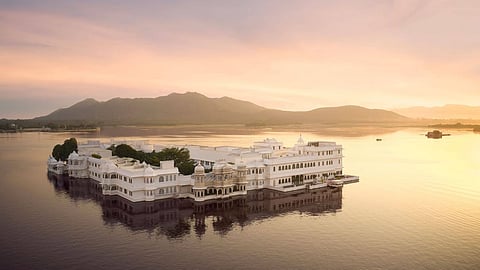
Some of the most exquisite summer houses in India are found in the middle of what's seen as 'pleasure gardens'. To one-up these marvels, some summer houses are found right in the middle of vast lakes. Often dubbed as the ‘Jewel of Udaipur’, Lake Palace is a feat of architecture wrapped with romance and royalty. The story of Lake Palace goes as far back as the 17th century, when Maharana Jagat Singh II of the Mewar dynasty commissioned it as his summer retreat.
Built like a crown in the centre of Lake Pichola, the palace served for the longest time as the summer escape of the royal family. The splendour of its design, with an ivory-facade, elegant domes, and the most intricate carvings along with latticed windows, seen reflected on the lake during golden hours, makes it one of the most breathtaking visuals a man can behold. Among other things, the site was also used as a backdrop in the 1983 James Bond film 'Octopussy'.
In this unblemished white marble magic of a palace which is now a Taj property, you can indulge in fine dining on a royal barge in the lake, marvel at magnificent wall art within its suites and rooms, take a royal tour around the palace and much more.
Peterhoff Estate is what atmospheric horror films, novels and shows are made of. Think snow-clad mountain vistas, remote, isolated settings, old heritage houses with creaky old timber doors, gothic architecture, mist, fog, oppressive clouds, dense forests at hand, and the whole shebang.
In Peterhoff Estate, all of this is atmospheric set-up drips with history of not one, not two, but seven Viceroys and Governor General of the British Raj. The first Viceroy, Earl of Elgin, moved into Peterhoff in 1863. After independence, the place served as Punjab High Court. It is this house where the trial of Nathu Ram Godsey, the assassin of Mahatma Gandhi, took place in 1948-49.
Later, the building doubled as the Raj Bhawan. In 1981, the building suffered a terrible fire and was restructured in 1991. Today, this heritage hotel can be booked and makes for an ideal 'Essex in India' experience.
Hidden away in the dense foliage of Kerala, Indian Summer House is where architecture leaks into nature. An impressive aspect of this property is that it is both a private residence and a boutique hotel. The place is a brainchild of Bali-based architect Made Wijaya. Here, you'll find coconut trees standing beside pepper vines and medicinal plants. The plantation, which is the icing on top of this place, was done by a professor of horticulture.
Situated at a leisurely 20-minute walk from Holy Magi Forane Church, Indian Summer House boasts of vernacular, laterite-tiled roof architecture, drafty, big verandas, swimming pools to simmer down, amenities of all types and nature, and above all, greenery that goes right into the last alveoli of your lungs.
Understated and serene, private hospitality is a strong suit of the property. On a scorching summer afternoon when you find yourself in a palatial house in the lap of Kerala's nature with giant ceiling fans running above you and a vast expanse of tropical garden right outside, you know you are at the peak of Indian summer house experience.
Tea, hilltop colonial-era, family-run bungalow, and enviable views of mist-foiled Himalayas - that's a mix of spending your summer like a baron. At Glenburn Tea estate of Darjeeling, that is just what you get. Conceived by a Scottish tea company in 1859, Glenburn passed into the coddling hands of The Prakashes, one of India's leading tea planting families.
Spread regally across 1,600 acres - out of which 600 is reserved for tea - Glenburn dedicates the other 1,000 to forests with two rivers penetrating the land. The estate is home to just eight suites enclosed in two colonial-style bungalows. Namely, they are the Burra Bungalow and the Water Lily Bungalow. Antique furniture, cosy fireplaces, vast verandahs, libraries, and intricate interiors make you feel at home.
Apart from a gamut of activities such as tea estate tours, tea tasting, guided hikes through nearby forests and villages, a vacationer at Glenburn Tea estate also retains the liberty to embark on trips to Darjeeling, Kalimpong, and other iconic hill stations that are just at a stone's throw.
Not many people know of the 1924 Clock House. The trip to 1924 Clock House in Munnar starts right when you visit their website for bookings and information. With a layout and aesthetic that of a Gothic book with arcane illustrations, the 1924 Clock House website alone gives you a hint of what you can expect at the place. Surrounded by tea plantations, the property houses English clubs, tea factories, golf courses, tea bungalows, stone churches, and all a person might expect to have in a hill station escapade.
Run by a family, the heritage property is built in the style of Devonshire Greens bungalows of the British era. To expand your rich stay experience, the summer house offers rejuvenating Ayurveda therapy, exhilarating Jeep safaris in the valleys of Munnar and guided sightseeing tours and excursions. The rooms here are made to mirror the rooms of Victorian London with fireplaces, white curtains, rustic interiors and windows opening to green, misty landscapes.
Here, traditional wood-fired over experience, high tea, waterfall exploration, and campfire stargazing add to the colonial charm. Birds of all descriptions abound on the property. All in all, this restored British-era planter's bungalow can also be seen as the "summer capital" of the tea-growing elite.