
Subscribe
Subscribe
- Motoring
- Style
- Home & Design
- Travel
- Food & Drink
- Specials
- News & Tech
- Videos
AI generated summary, newsroom reviewed
As the cogs of modernity churn out the latest landfill addition, the real luxury good becomes that which survives the most unforgiving test of all: time. It’s a tale as old as time itself: man may die, but art perseveres. Shakespeare documented it as early as in Sonnet 18 (“Shall I compare thee to a summer’s day?”), “So long as men can breathe or eyes can see, so long lives this, and this gives life to thee”. In this day and age, to be able to correctly preserve art is to account for taste, resources, patience, accountability, and to inculcate a sense of stewardship and pride.
Preservation requires inventories, condition reports, conservation audits, compatible materials, humidity control, archival housing, insurance, and a willingness to preserve age rather than cosmetically erase it. The artworks we preserve tend to have a uniqueness to them that even the best of AI and meticulous reproduction cannot completely replicate.

Legacy luxury is not merely the possession of rare objects, but the ability to create the conditions for their survival. In art, this means moving from ownership to stewardship — from asking “what do we own?” to “what will remain after us?” For example, the Dumraon royal family initiative in Bihar encapsulates the emergence of this phenomenon in India. Indian National Trust for Art and Cultural Heritage (INTACH) undertook this project at the behest of the Dumraon royal family to preserve rare artefacts and temple wall paintings and to establish a museum showcasing their artefacts preserved through the ages.
This trend isn't confined to royal families, elite collectors or India’s Tier 1 art capitals. The Bihar Museum’s collaboration with the Indian Heritage Institute, resulting in Bihar’s first modern conservation lab of its kind, built at Rs 2 crore, is proof of this wider movement. Even as we move from the privately owned to the corporate sphere, Air India collected a lot of Indian art over decades, including but not limited to paintings, sculptures, textiles/handlooms, decorative objects, and photographs. Instead of leaving that collection hidden in offices, storage, or corporate limbo after Air India’s ownership changes, the Ministry of Culture/NGMA took it over so it could be conserved and eventually shown to the public. This is why corporate collections, too, are being reimagined as cultural inheritance
In India, time is not the only threat. Heat, humidity, dust, insects, ritual soot, unstable repairs, and poor storage all become silent collaborators in decay. A painting kept in a family home, a manuscript locked in a trunk, or a temple mural exposed to lamps and moisture may survive for generations, until it suddenly does not. This is also why the best conservation does not attempt to make an object look newly made. Its purpose is subtler: to stabilise damage, retain evidence of age, and protect the work’s integrity without erasing its life.
Priya Khanna, the founder of Art Life, one of India’s leading art restoration studios, echoes the same sentiments: “The role of a conservator is not that of a creator, but a meticulous guardian, preserving every fragment of the masterpiece’s essence."
Yet such acts of conservation are not confined to paintings, sculptures, manuscripts, or standalone artefacts. They extend into the larger structures that hold culture and speak the language of luxury itself: palaces, temples, heritage hotels, private estates and neighbourhoods shaped by centuries of artistic exchange. This renders preservation not merely as the act of saving an object, but of protecting the atmosphere around it.
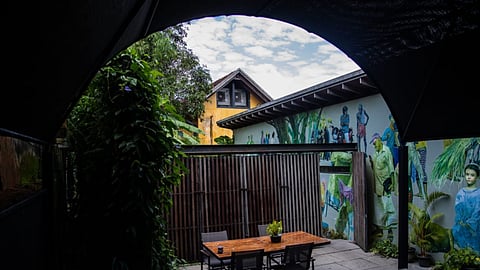
The authenticity lies in tethering grandfather clocks to olden times, allowing old walls, uneven textures, inherited proportions, and historic materials to take the stage without being buffed and befitted into sameness. At The Postcard Mandalay Hall in Mattancherry, Kochi, this philosophy takes on a living form, says Kapil Chopra, founder of The Postcard Hotel. “The 200-year-old heritage building has been restored not to look new, but to retain its age, memory and architectural soul. Its rooms, called galleries, place guests inside curated artistic environments rather than around decorative art".
Located within Kochi’s layered cultural landscape, and in conversation with the wider energy of the Kochi-Muziris Biennale, Mandalay Hall shows how preservation can move beyond the museum and into hospitality, a culture people can partake in as a lived experience.
What is changing is the afterlife of private ownership. Collections that once sat in royal homes, corporate offices, family archives, or private storage are increasingly being reframed as cultural inheritance. Their prestige now depends not simply on who owned them, but on whether they can be preserved, studied, and eventually shared. We see an increasing trend: private assets acquiring a public afterlife, echoing a simple principle: what we preserve becomes more than a simple inheritance. It becomes evident that memory had guardians, the present has custodians, and that the future was deemed worthy of receiving both.