
Subscribe
Subscribe
- Motoring
- Style
- Home & Design
- Travel
- Food & Drink
- Specials
- News & Tech
- Videos
Despite global economic uncertainty and bombshell tariffs announced during Watches & Wonders—the horological industry’s largest annual trade show—watch companies released a flurry of ultra-high-end timepieces in 2025, suggesting they’re betting on the wealthiest consumers to keep businesses ticking.
It’s a continuation of a trend from last year. According to Morgan Stanley’s 2024 Swiss Watch Industry Report, watches priced above $30,500 (approx. H27.2 lakh) accounted for 69 per cent of market growth and 44 per cent of the industry’s total value. This refocusing has resulted in groundbreaking advancements, from feats of micro-engineering that make timepieces smaller and more accurate to long-awaited simplifications of the perpetual calendar. The achievements in mechanical watchmaking were ambitious, and in some cases, grandiose.

At the apotheosis of technical wizardry, Vacheron Constantin debuted the most complicated wristwatch in the world, Les Cabinotiers Solaria Ultra Grand Complication-La Première. The Solaria packs 41 complications into one piece and is the work of a single watchmaker over eight years of development. But beyond its marketing bravado and singularity as a collector’s item, one can imagine that the R&D—such as shrinking and re-engineering components including 10 patented inventions (three more are pending)—will likely be used to improve other Vacheron pieces in the future.
Other technological innovations were more immediately practical. Audemars Piguet’s game-changing perpetual calendar, launched in February, revolutionised the user experience with calendar functions that can all be adjusted (backward and forward) via one crown, eliminating the infamous headache that accompanies setting this kind of complication. At least seven top luxury watchmakers release perpetual calendars this year—some in multiple iterations, others in combination with minute repeaters. But apart from technological advancements, there were other over-the-top offerings, too. A few box sets from Chanel and Hublot proposed sixto seven-figure collections in one fell swoop for a single buyer. Elsewhere, expensive stone dials and gem-setting raised the bar for entry.
It’s a bold strategy: fewer clients, bigger statements, and timepieces that push the boundaries of what’s mechanically—and financially—possible. But it’s driving innovation. And while only the ultra-wealthy may get to wear the future first, the ripple effects of these horological marvels will ultimately shape the watches of tomorrow for everyone.
Les Cabinotiers Solaria Ultra Grand Complication-La Première
in an astonishing feat of horological complexity, Vacheron Constantin has outdone itself with a grandiose exercise in watchmaking. The Solaria crafts 41 complications out of 1,521 parts. Somehow, it all manages to fit in a movement measuring 36 mm by 10.96 mm within a 45 mm by 14.99 mm case. The piece is a magnum opus comprising the most challenging complications in watchmaking, including a Gregorian perpetual.
calendar, equation of time on a tropical (solar) gear, and Westminster carillon chime, to name just a few. But it also includes new ways to use existing complications, including a splitseconds chronograph linked to a complication that can track the exact time constellations or a given star will appear in the sky according to the wearer’s location. Incredibly, it was conceived and made by a single watchmaker at the company’s manufacture.
Royal Oak Perpetual Calendar
a perpetual calendar tracks the day, date, month, moon phase, and leap year—generally without requiring manual adjustment for decades on end. But setting all the little displays typically involves the use of a special tool or a visit to your local watchmaker. This sand-gold Royal Oak, released for the company’s 150th anniversary, solves for that age-old horological pain, thanks to its groundbreaking Calibre 7138 movement. The 4.1 mm-thick self-winding engine controls all functions via the crown, eliminating the need for unsightly pushers or buttons on the case. To top it off, it can be adjusted forward or backward without damaging the movement.
Tank à Guichets
introduced in 1928, the Cartier Tank à Guichets took the metaphor of an armoured vehicle as a timepiece to its logical conclusion. Rather than revealing a delicate white dial with Roman numerals, its metal dial features only two small openings: one for jumping hours and the other for a draggingminutes display. A series of new limitededition Tank à Guichets in the brand’s Collection Privée presents a modern iteration in one of three precious metals, but a special platinum version—for which the apertures are rotated at an angle—promises to become the collector favourite.
Split-Seconds Chronograph
A stunning update to the reference previously offered in white gold, the new rose-gold edition of Patek Philippe’s coveted 41 mm model now comes with a masterfully executed grand feu–enamel dial in rich chocolate and cream hues set in a rose-gold case. Inside is the CHR 29-535 PS manually wound split-seconds chronograph movement with a column wheel, horizontal clutch, and seven patented features, including one for its rattrapante system. This is a thoroughly challenging piece to execute from top to bottom, and its warm, earthy hues, and chestnut-leather strap suggest a timeless appeal sure to be appreciated by the ultimate connoisseur. $2,88,700 (approx. C2.6 crore).
Ruban Mystérieux
this is the first unique watch from Van Cleef & Arpels in two years—and it is a masterwork of gem setting. Meant to evoke a ribbon that appears to wrap around the wrist, its 18-carat-white-gold frame and instantly recognisable Mystery Set emeralds and sapphires are quintessential Van Cleef. Each stone took a master cutter two to four hours to achieve. They surround a 3.72- carat colourless and flawless DIF oval-cut diamond, which displays the mother-ofpearl dial beneath. But there is serious watchmaking under that layer: It is powered by Jaeger-LeCoultre’s famous 101 calibre— the smallest mechanical movement in existence.
Chronomètre Furtif
there are plenty of sporty all-black watches on the market, but you couldn’t find a single one in tungsten carbide until F. P. Journe managed to make one last year. The extremely hard material is challenging and costly to machine, a process that requires diamond-tipped tools. The substance—typically used in less glamorous applications, such as on the tips of ski poles or cleats—is said to be nearly indestructible. Going a step further to make this timepiece cooler than the rest, the dial is finished with mirror-polished anthracite-gray grand feu enamel on white gold, with matte rhodium-plated steel hands. Flip over the 42 mm case and you’ll find an 18-caratrose-gold Calibre 1522, offering a stunning contrast to the stealthy exterior. About $1,04,000 (approx. C90 lakh).
L.U.C Heritage EHG Moon 122
set against an expansive aventurine dial in a 44 mm case made of ethical rose gold is a series of constellations, as seen from the northern hemisphere, in a beautiful astronomical display. But the craftsmanship lies in the hand-hammering and hand-engraving of this watch’s gold moon phase, so precise that the error between the trajectory of the moon and that of the complication is a mere 57 seconds. Just opposite is a small-seconds subdial with a hand-hammered and engraved gold view of the North Pole. The bonus? The calibre’s foundation is a Chopard base movement provided to students from the prestigious Geneva School of Watchmaking for their studies. The academy and the company then jointly added the moon-phase complication, part of Chopard’s effort to support the next generation. $90,300 (approx. C81 lakh), limited to 20.
Hand Made 2
a truly handmade watch is an increasingly rare object, with many companies relying on CNC machines, robotics, and other modern tech to produce timepieces at scale. Greubel Forsey’s 40.9 mm hand-wound Hand Made 2, which consists of 96 per cent handmade components, is about as close as you can get to old-school watchmaking craftsmanship, today. (The sapphire crystals, spring bars, case gaskets, mainspring, and most jewels are the only parts not made by hand.) Exquisitely finished and entirely assembled by a single watchmaker, the white-gold Hand Made 2 is produced in only two or three examples per year, making it one of the high-end independent brand’s most exclusive timepieces.
Reverso Tribute Monoface Small Seconds
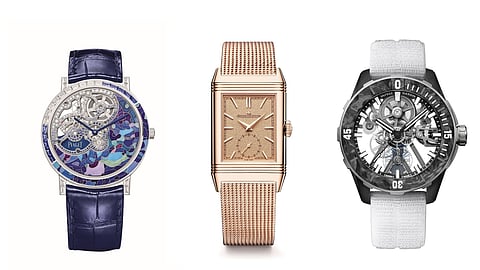
though the jaeger-lecoultre Reverso is already available on a metal bracelet, its classic configuration is as a steel timepiece on a leather strap—its original form was created in 1931 for polo players in India during the British Raj. But a fresh pink-gold Reverso Tribute Monoface Small Seconds on a matching pink-gold Milanese bracelet promises to pleasantly upset the norm: With its elegant looks and comfortable feel, the bracelet beautifully complements the watch’s precious-metal case, which measures just 7.56 mm thick. Flip the case over and a blank caseback reveals an ideal canvas for a personalised engraving, making the watch a perfect gift or heirloom. $41,300 (approx. C37 lakh).
Altiplano
Piaget is known for its expertise in jewellery techniques, but it also lays claim to some of the thinnest high-end watch movements in the world. Here, the brand combines both. The bridges of the 40 mm timepiece—powered by the 3 mm thick, self-winding 1201D1 skeleton movement—are delicately adorned with diamonds and blue sapphires, which extend to the bezel in baguette cuts. The other half of the dial and bezel is decorated in a burst of varying blue, green, and purple hues in grand feu cloisonné enamel executed by the celebrated artisan Anita Porchet. Even the portion of the movement that is invisible beneath the enamel is set with diamonds and sapphires. With no surface left untouched, this piece wows at every angle. $3,32,000 (approx. C2.9 crore).
Tambour Taiko Spin Time Air Antipode
Building upon a legacy of imaginative complications, the new 42.5 mm Louis Vuitton Tambour Taiko Spin Time Air Antipode rethinks the world timer by displaying two cities at each of the dozen hour indices, thus making for 24 antipodes—points located at exact opposite ends of the globe. Emanating from the watch’s automatic Caliber LFT ST12.01 located at the case’s centre, the city cubes appear suspended in air and spin 90 degrees as the world timer is adjusted. A brilliant feat of in-house engineering, the Antipode is proof that there is still plenty of room for visual and mechanical innovation. $99,500 (approx. C90 lakh).
Diver Air
there’s something reassuring about the heft of a robust steel sports watch. But what if you could retain the tank-like build without the bulk? That’s the promise of the 44 mm Ulysse Nardin Diver Air, officially the world’s lightest mechanical dive watch. Made from titanium and carbon fibre, it features a 199-part automatic movement designed to reduce weight to a bare minimum. A skeletonised dial, meanwhile, reveals a startling truth: Within the case, componentry makes up just 20 per cent of the volume, while 80 per cent is air. The result? A timepiece that clocks in at just under 52 grammes including its strap. $38,000 (approx. C34 lakh).
Toric Perpetual Calendar
due to the amount of information contained in a perpetual calendar, the dials of these timepieces are often so packed they can be difficult to read or just look busy on the wrist. The 40.6 mm Toric Perpetual Calendar puts a new minimalist spin on the complication, using dual coaxial displays to convey all the relevant readings on two subregisters. The leap year and month are read on one subdial, and the day of the week and date on the other. The result is a stunningly simple and beautiful design that creates enough negative space to appreciate the beauty of the Golden Hour (pictured) or Morning Blue hues of the hand-grained dials. $91,900 (approx. C83 lakh) in rose gold and $99,400 in platinum (approx. C90 lakh), limited to 50 each.