
Subscribe
Subscribe
- Motoring
- Style
- Home & Design
- Travel
- Food & Drink
- Specials
- News & Tech
- Videos
For years, bigger meant better: larger cases, louder designs, and more complications. After years of oversized cases and busy dials, designers are being drawn towards the more restrained. But behind that simplicity lies serious engineering. Most automatic movements measure between 4.5 mm and 6 mm thick. Going thinner than that requires redesigning gear trains, recalculating tolerances, and reworking how energy moves through the movement. When every fraction of a millimetre counts, there’s no room for error. Brands including Piaget, Bulgari, and Jaeger-LeCoultre continue to push these limits, while independent makers bring their own approach to precision and proportion. Ultra-thin watches are the result of years of research. More than luxury objects, they are compact demonstrations of skill, and proof of how much can be achieved in very little space.
Here are some of the best ultra-thin watches that money can buy.

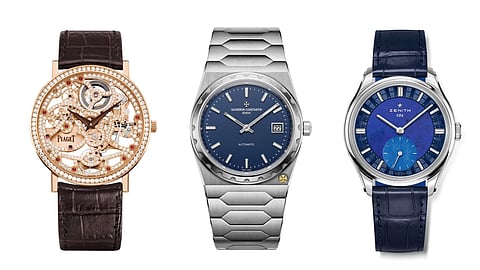
Housed in a 38 mm rose gold case, the Manufacture 1200D self-winding movement measures just 3 mm in height, yet retains full automatic functionality. The main plate, rendered in rose gold, integrates 259 brilliant-cut diamonds. An oscillating weight in rose gold-hued platinum traces its arc across 11 cabochoncut rubies. The result? A watch that reveals the extreme discipline required to compress mechanics, aesthetics, and gem-setting into a tight space.
Slim d’Hermès Squelette Lune
Hermès brings a different cultural DNA to ultra-thin watchmaking that is rooted in material and perfection. The skeleton moon phase complication sits within a case profile that honours the original Slim d’Hermès proportions. The manufacture movement visible through the dial reveals itself gradually. The moon phase disc rotates within openworked bridges, celestial mechanics made visible through architectural precision.
This watch claims to take its proportional inspiration from the golden ratio of phi, 1.618, the mathematical relationship governing aesthetics from Renaissance paintings and nautilus shells. Within the 40 mm case measuring 8.9 mm thick, the UT01 movement architecture has been reduced to essential bridges and gears, allowing for less mass, which means less inertia and friction, leading to more efficient energy transfer from mainspring to escapement.
At 7.70 mm in total thickness, this watch occupies a middle ground where ultra-thin calibre architecture meets daily wear. The manufacture 96.12-L movement inside measures just 3.3 mm, featuring Chopard Twin technology with two stacked barrels providing 65 hours of power reserve. The Twin barrel system stacks power reserves vertically, allowing the movement to remain thin and extending running time beyond typical single-barrel ultra-thin calibres.
The original Caliber 135 from 1950 established benchmarks for thin movement architecture. This contemporary interpretation maintains the original’s 5 mm height and incorporates modern materials’ science. The movement bridges carry the same architectural language as their 1950 predecessor, updated with surface treatments and metallurgy unavailable seven decades ago.
At 1.85 mm total case thickness, this is Bulgari’s 10th world record as the thinnest tourbillon watch ever created. The 19th-century tourbillon complication to counter gravitational effects on timekeeping accuracy has been reconceived through skeletonisation that maximises light diffusion. The baseplate is milled from titanium with tolerances measured in microns.
The integrated bracelet sports watch in steel is powered by the ultra-thin Calibre 2455/2. The movement, at 3.6 mm thick, includes a micro-rotor that allows for a slimmer profile and maintains automatic winding efficiency. The case finishing, with alternating brushed and polished surfaces, creates a tactile landscape and shifting patterns. The 1977 design reimagined for contemporary wrists is testimony that robustness and refinement can occupy the same case.
The Calibre 978, measuring 7.1 mm thick, houses 302 components including a tourbillon cage of 77 parts. The movement won the 2009 Chronométrie International Timing Competition with a rate deviation of +0.13 seconds per day. The titanium tourbillon cage and flat two-level hairspring operate beneath a Grand Feu enamel dial featuring hand-guilloché work of 180 sunrays. That is 1,080 individual lines executed by hand, then covered with translucent enamel fired at extreme temperatures.