
Subscribe
Subscribe
- Motoring
- Style
- Home & Design
- Travel
- Food & Drink
- Specials
- News & Tech
- Videos
AI generated summary, newsroom reviewed
Since their discovery in 1881, the fabled sapphire reserves of Kashmir have gained a reputation that is typically associated with the world's ancient gem mines. This reputation is based on a combination of fact and fantasy. Only a small number of qualified geologists have ever visited the location, which is tucked in the high Himalayan mountains in northwest India.
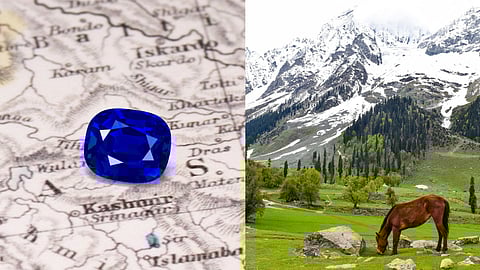
Kashmir sapphire is distinguished by its remarkable clarity and rich, velvety colour. Found in the breathtaking valleys of Kashmir in the late 19th century, these precious gems have a deep cornflower blue colour and a smooth, luminous look because of tiny silk inclusions. These sapphires, which were mostly mined between the 1880s and the early 1900s, are today extremely uncommon and fetch high sums at auctions. They are among the most sought-after stones in the world because of their distinctive qualities, which set them apart from sapphires of different sources.

These exquisite sapphires were discovered by a group of traders from the Padder Valley in the Zanskar mountain range in 1882 after a landslide. When the Maharaja of Kashmir learned about the sapphires, he sent out miners. Located on a high plateau with a harsh climate, the Kashmir sapphire mines were only accessible for about three months each summer. Miners toiled day and night between 1882 and 1887, discovering sapphires as large as three to five inches.
Later on, this time frame was dubbed the "Golden Age" of the sapphire mines in Kashmir. The miners relocated to the valley level after the "Old Mine" was mostly exhausted in 1888. The royal guards guarded the mines for up to five years until they were exhausted, and the Maharaja then asked British India to find more mines in the valley floor. There was occasional mining post that, but the quality of the early discoveries remained unmatched. According to official documents, the mines were shut down in 1927. This indicates that the "Old Mine", more than a century ago, is the source of all premium Kashmir sapphires with unmistakable provenance.
Similar to the "cornflower blue" of a peacock's neck, Kashmir sapphires have a rich, deep colour that seems radiant in any light. Sapphires from this region are known for their distinctive colour, which is naturally combined with a velvety soft shine. One of the main characteristics that sets Kashmiri sapphires apart from sapphires from other regions is their "velvet" texture, which is generated by light being scattered by parallel small silk inclusions within the stone.
The Paddar district still has a number of undiscovered mineral deposits of sapphires and other gems. The task of systematic mining and exploration, however, is extremely complex due to the challenging access. Additionally, political constraints hinder the Kashmir region's realistic potential. Tension has always existed in the mountainous state of Pakistan since its separation from India in 1947. China's takeover of Tibet in 1950, the two Indo-Pakistan wars in 1965 and 1971, and Russia's invasion of Afghanistan in 1979 have all further contributed to this instability. In such a setting, political and military concerns take precedence over the development of mineral resources.
Production of Kashmir sapphires on a commercial scale may be nonexistent today. Nevertheless, every year a trickle of fine gems finds its way to the world markets through the hands of the local people although the mines are not operating anymore. We can only hope that the extraordinary scarcity of superb Kashmir sapphires will sustain their recognition and demand till this scenario changes.