
Subscribe
Subscribe
- Motoring
- Style
- Home & Design
- Travel
- Food & Drink
- Specials
- News & Tech
- Videos
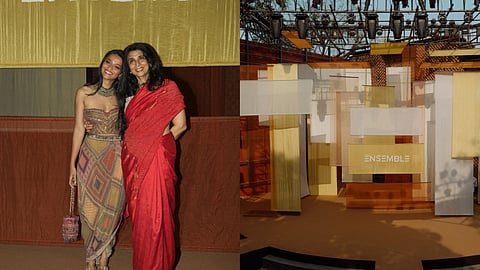
Ensemble India returned to the runway in Ahmedabad after 18 years to showcase how wardrobes are thoughtfully built over time. Hosted at Mallika Sarabhai’s Natarani Amphitheatre, the show brought together over 50 established and emerging Indian designers showcase across contemporary, evening glamour and occasion wear segments.

Indian textiles and craftsmanship remained central throughout, reinforcing Ensemble’s long-standing commitment to material, technique and longevity. The choice of Ahmedabad was deeply personal for Tina Parikh, whose understanding of modern Indian design was shaped by the city’s progressive outlook and lived relationship with craft and architecture. The show also saw Mallika Sarabhai walk the runway, reinforcing the dialogue between heritage and modernity. Founded in 1987, Ensemble continues to champion Indian design through thoughtful curation, mentorship and a belief in meaningful, intentional fashion.
Tina Tahiliani Parikh (TTP): Ensemble has a long history of doing shows. In fact, before fashion weeks existed, Ensemble hosted annual fashion shows where people came specifically to see what designers like Rohit Bal were doing that season and to understand where fashion was headed. Those shows played a role in shaping the Indian fashion industry as we know it today. Once fashion weeks began and commerce became central, we stepped back from doing shows. Our last major one was our 20th anniversary show in Mumbai.
This show evolved organically. What started as a simple request to do a show in Ahmedabad became far more introspective. It gave me the opportunity to pause and reflect on where the industry is today, what Ensemble stands for now, and how we want to represent the designers we work with. Rather than focusing on individual collections, the idea was about presenting Ensemble’s point of view.
TTP: We consciously moved away from the idea of a traditional couture show. At Ensemble, we work across verticals like womenswear, menswear, textiles, accessories, contemporary and Indian occasion wear. The show was divided into three segments: everyday chic, evening, and occasion.
In India, occasion wear is often reduced to weddings, but we wanted to broaden that idea to include festivals, pre-wedding events and even being a wedding guest. The styling encouraged people to think differently to mix and match, understand their bodies, and express individuality. The idea was to step out of familiar lanes and create your own look.
TTP: Including younger and niche designers, we work with over 80. While a significant portion of our turnover comes from the top 20, we are equally committed to nurturing emerging talent. We believe in giving designers time and space to grow if their work has integrity and originality.
TTP: India’s craft heritage is extraordinary, not just in Indian wear but also in contemporary fashion. You can buy a white shirt anywhere, but [in India], it might feature jali work, chikankari or subtle hand detailing that transforms it.
When we saw Mallika Sarabhai’s space, it felt like a natural fit. Fashion exists at the intersection of culture, art and craft, and presenting the show at a dance institute felt right. Initially Mallika [Sarabhai] was only a venue partner, but then she became excited about the idea and offered to walk the show, which made it even more meaningful.
TTP: For me, luxury has always been about experience. While Indian designers were my fashion school, I learned the most about retail experience from architect Bijoy Jain, who designed our Kala Ghoda store.
At a time when luxury was associated with Italian marble and chrome, he showed how Indian materials like Banswara marble, brass, bamboo, terrazzo could feel deeply luxurious when used with restraint and intention. That philosophy continues today, from our couture rooms to the materials we choose. Authenticity matters, not just in clothing but in spaces too.
TTP: For me, it’s about longevity. Most of what we sell is timeless and well made. I wear my clothes repeatedly, my daughter wears them, my nieces borrow them.
We work with designers who respect labour, ensure ethical working conditions and use natural fabrics and dyes. Sustainability isn’t a trend for us, it’s how we’ve always lived.
TTP: We look for originality, integrity and consistency. We observe designers over time: the quality, fit, construction and point of view. It’s easy to have one strong collection; longevity is harder.
TTP: Staying true to our principles of curation, quality, point of view and relationships. We don’t see fashion as a transaction. We’re honest with our clients, even if that means telling them not to buy something. That trust is everything.
TTP: Discipline, curiosity, humility and perseverance. The 10,000-hour rule really works. If you keep going, clarity comes. You must constantly question why you’re doing what you’re doing.