
Subscribe
Subscribe
- Motoring
- Style
- Home & Design
- Travel
- Food & Drink
- Specials
- News & Tech
- Videos
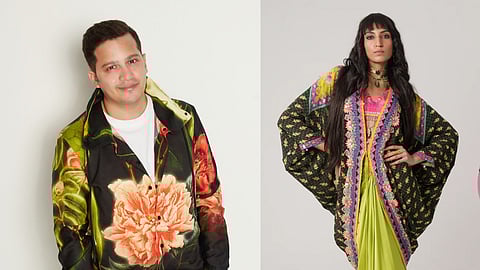
In an industry that often swings between tradition and modernity, Siddhartha Bansal has quietly carved a space that perfectly balances the two in the Indian fashion spectrum. From kaleidoscopic prints to mythological motifs, Bansal’s design language is unmistakably his own. His work feels playful and precise, where strong cultural motives meet a quietly emotive sensibility. There is an ease to his aesthetic, but behind it lies a considered approach shaped by years of learning, experimentation, and instinct. What stands out most is the visual appeal and the intention to tell a story and travel beyond borders without losing their origin.
At the heart of his work lies the idea of ‘wearable art' — pieces that move seamlessly through everyday life and are beautiful at the same time, while drawing from India’s legacy as the ‘Golden Bird’ nation, abundant in heritage and imagination. Siddhartha has also unveiled his latest Paradise City Spring Summer 2026 Travel Edit collection, creating a buzz across the fashion scene.
Robb Report India spoke to the ace designer to understand the journey behind his label, the evolution of his aesthetic, and how he continues to navigate an industry that is changing faster than ever.

Siddhartha Bansal (SB): I studied textile design, and during college, my final-year collection was awarded the most innovative. That early recognition gave me confidence in my voice. I went on to work with Satyapaul, which was also where I did my first internship, my first exposure to the industry. I’ve always been drawn to aesthetics, graphics, lines, symmetry, colours, and storytelling. Every decision I made early on was quite strategic; I chose places where I could learn and evolve. My graduation project at Studio B taught me to deal with home textiles,that phase really shaped my design language and helped me grow creatively.
SB: There was a great deal of learning. I worked with a few brands before starting on my own, and interestingly, I never planned to launch a clothing label. When I took a break from assisting designers, I wanted to explore lifestyle products instead. My first independent venture was a brand called Design Guns, where I collaborated with artists and designers from different disciplines. We created lifestyle products, essentially extending a concept that had begun as my college project.
At the same time, friends encouraged me to apply for the Gen Next programme at Lakmé Fashion Week. I wasn’t entirely convinced, but I applied, and we were selected on the first attempt. That moment changed everything for the brand. Retailers began showing interest, even with a small capsule collection. As a bootstrap brand, that validation was crucial. Orders started coming in, and gradually, the clothing line took centre stage while Design Guns moved to the background. From there, we continued building, applying to emerging designer platforms and eventually showcasing with FDCI. International buyers from the US and Middle East began engaging with the brand, and that’s when the journey truly gathered momentum.
SB: A contemporary luxury ready-to-wear label that intertwines traditional craftsmanship with modern aesthetics, the brand offers a unique sartorial experience that resonates with the discerning, culturally aware consumer. At its core, it’s about colour, graphics, and storytelling. The idea is to present Indian narratives in a contemporary way. Often, Indian fashion is presented in extremes, either deeply traditional or overtly modern. I’ve always wanted to bridge that gap. My work attempts to reinterpret Indian stories through a modern lens. My first collection featured motifs like the Kamadhenu Cow, the wish-fulfilling cow from Indian mythology, which continues to appear in my work in evolving forms. Additionally, I used jharokha motifs and kaleidoscopic prints, drawing from the architecture I grew up around in Old Delhi, surrounded by old havelis. That collection was symbolic as it was about seeking blessings, with the idea that they would flow through those jharokhas. It felt deeply Indian, yet visually contemporary and personal.
SB: The first one will always stay special as it set the benchmark. But every collection carries its own emotional weight. I’m constantly filled with ideas, which is both a blessing and overwhelming for any creative person.
SB: Fashion today is increasingly textile-driven, and there’s a strong push towards self-reliance in India. Our brand operates as a visual storytelling platform that blends fashion with cultural documentation. Through seasonal collections and artisan-led capsules, it explores authentic textile crafts and aesthetics. As designers, our role isn’t to teach artisans their craft; it’s to reinterpret it. These traditions have existed for centuries. What we do is evolve them into something that feels relevant, has longevity, more inclusive with due crediting the craft or the community involved . Our approach is rooted in the idea of wearable art. We design garments that can be styled in multiple ways. A jacket can be worn with denim or tailored trousers; a skirt can be paired with a crop top or a shirt. This versatility extends the life of each piece.
SB: Indian fashion is evolving by the hour. This means brands need a clear and strong voice. Anything without clarity will simply not stand out. Today, the consumer is in control; they decide what they engage with and what they remember. The brand will evolve as a cultural curator and visual storyteller, rooted in Indian craft, street sensibilities, and folk aesthetics. Its creative direction will blend heritage textiles with contemporary silhouettes, using bold prints, layered narratives, and expressive styling. Each collection will explore a different facet of India’s untold stories—through artistic collaborations, immersive visuals, and editorial-led presentations.
As for sustainability, I don’t believe fashion can be entirely sustainable; production itself has an impact. However, we are deeply conscious of our approach. We avoid overproduction and work with engineered placement prints rather than mass prints, which reduces waste. We, as a brand, produce in limited quantities and don’t rely on excess inventory or heavy discounting. We also repurpose textile waste using it in linings, trimmings, and experimental pieces. So while we don’t label ourselves as sustainable, we are mindful and intentional in our processes.
SB: The goal is to tell stories that resonate globally while remaining rooted in India. To become a global voice for India’s rich craft heritage and everyday beauty—redefining luxury through authenticity, storytelling, and conscious design. The brand envisions a world where fashion preserves culture, empowers artisans, and inspires bold self-expression across borders. It aims to build a legacy that celebrates tradition while shaping the future of ethical, art-led contemporary global brand. Our upcoming collection, World From Above, is inspired by the idea of looking at humanity as one, beyond borders, from a bird's-eye view. We begin with a universal thought, then interpret it through Indian references and translate it into fashion.
SB: Not really. Following trends too closely can limit creativity. Western trends don’t always translate well for Indian consumers. I do keep myself informed through platforms like WGSN, but more out of curiosity than influence. For me, originality is more important than trend alignment.
SB: I admire Dries Van Noten, Etro, and JW Anderson. They are masters of colour, textiles, and storytelling. What I find particularly inspiring is how brands like Etro have taken culturally rooted ideas and made them globally relevant. That’s something I aspire to achieve, presenting Indian narratives in a way that resonates global audience.
SB: I’m quite spiritual and try to meditate. Besides that, I stay connected to art and history, both of which are huge sources of inspiration for me. I travel often, especially to places rich in history and architecture, and I do love reading books as well.
RR: Which Indian regions inspire you the most?
SB: Gujarat and Rajasthan, they are culturally very rich. I’m also deeply inspired by the Ajanta and Ellora caves in the south.
RR: What does luxury mean to you?
SB: Comfort paired with emotion.
RR: Your biggest source of inspiration outside fashion?
SB: History.
RR: Favourite colour palette?
SB: At the moment, earthy Indian tones of pinks and saturated rusts.
RR: What excites you most about the future of Indian fashion?
SB: The consumer, their evolving nature and willingness to experiment and embrace authenticity.
RR: One word to describe how you want people to feel wearing your brand?
SB: Joyful