
Subscribe
Subscribe
- Motoring
- Style
- Home & Design
- Travel
- Food & Drink
- Specials
- News & Tech
- Videos
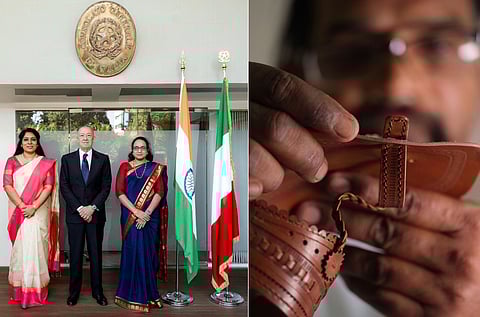
Prada’s latest move in India is less about fashion headlines and more about a cultural handshake. The Italian luxury house has partnered with two government organisations, LIDCOM (Sant Rohidas Leather Industries and Charmakar Development Corporation Ltd) in Maharashtra and LIDKAR (Dr Babu Jagjivan Ram Leather Industries Development Corporation Ltd) in Karnataka, both long-standing custodians of India’s leather craft and the heritage of Kolhapuri Chappals. The agreement, formalised at the Consulate General of Italy in Mumbai, marks a rare moment when a global luxury label steps directly into the workshops that have shaped a centuries-old Indian tradition. This partnership finally gives the artisans the recognition they’ve long deserved.
The collaboration, titled “PRADA Made in India x Inspired by Kolhapuri Chappals”, aims to create a limited-edition line of sandals. The intention is simple. To bring together Italian design and Indian handmade excellence, and let artisans from Maharashtra and Karnataka lead the way. For Prada, this is another chapter in its decade-old “Made In….” initiative, which spotlights global craftsmanship. For India, it is a recognition of something that has always been here: skill, heritage, and the quiet patience of craft.
For the uninitiated, earlier this year, Prada faced backlash after models in Milan walked in toe-braided sandals very closely resembling the Kolhapuri chappal, without any acknowledgement of its origins. As criticism intensified, the brand issued a statement recognising the design’s roots and expressing its willingness to open a “meaningful dialogue” with Indian artisans.

Kolhapuri Chappals come from eight districts across the two Indian states, each with its own subtle variations. The craft received the Geographical Indication tag in 2019, a formal stamp that protects authenticity. But for artisans, the GI tag is only as valuable as the opportunities that follow. This collaboration promises both visibility and access, two things craftspeople often struggle to secure on their own.
LIDCOM’s managing director, Prerna Deshbhratar, framed the partnership as an ethical model, one where artisans are not overshadowed by a luxury house but placed at the centre of the narrative. Her counterpart at LIDKAR, Dr K.M. Vasundhara, echoed this sentiment, emphasising how the project can strengthen livelihoods and preserve a cultural and economic legacy.
The language is careful but clear: this isn’t charity, and it isn’t tokenism. It is an attempt to build something lasting.
For the Prada Group, the collaboration is also tied to future training programmes modelled on the Prada Group Academy. These efforts will focus on upskilling artisans while ensuring traditional techniques remain intact. It’s a delicate balance, pushing craft forward without sanding away its history while creating a meaningful precedent for other global-local partnerships.
Lorenzo Bertelli, who leads the group’s CSR efforts, described the initiative as a “cultural exchange”. In practice, it is an experiment in what luxury can look like when it chooses to honour, rather than imitate, an existing craft. Luxury, after all, is no longer defined only by rare materials or exclusive stores. Increasingly, it is shaped by the stories behind what we buy, the hands that make it, and the histories that shape those hands.
India’s leather craft sector has always been vast, complex, and deeply rooted in the community. LIDCOM and LIDKAR, both created in the 1970s, have spent decades supporting artisans, modernising production, and keeping traditional skills alive. Their work rarely makes headlines. Though Prada’s involvement changes that, drawing a global audience to an art form that has survived empires, economies, and the changing speed of fashion.
The real impact, of course, will unfold when the headlines reach workshops across Kolhapur, Sangli, Satara, Solapur, Belagavi, and beyond.