
Subscribe
Subscribe
- Motoring
- Style
- Home & Design
- Travel
- Food & Drink
- Specials
- News & Tech
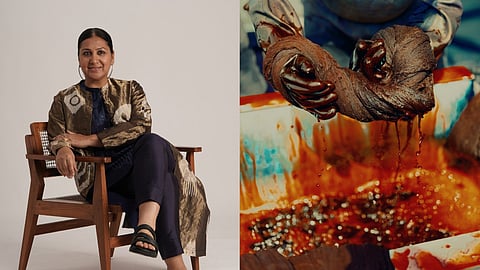
Last year, Translate-Ikat India marked 15 years of reviving and reimagining a particular kind of weave. The design house’s founder, Vinita Passary, began with a singular focus on Pochampally ikat, taking the mathematical language of the loom and turning it into a functional, global aesthetic. Over the last decade and a half of working with ikat, she has explored and expanded its possibilities, developing it in various weights of cotton, experimenting with silk, tissue, linen, and even wool. “It has been a journey of constant learning and evolution, and today, we truly see our ikats as modern heirlooms, timeless pieces that bridge heritage and modernity with grace,” she shares.
This month, at Robb Report India, as we spotlight homegrown Indian brands and their forward-thinking stories, we turn our focus to Translate-Ikat, where artisans create handcrafted collectables that can be passed down generations.

Growing up in Odisha, Passary always witnessed the Sambhalpuri ikat around her and moving to Hyderabad in 2002 made her think of the textile in the back of her yard, Pochampally ikat. In 2010, she decided to dive into the subject of taking forward the story of ikat. The idea was not to look at it from the perspective of reviving the craft, but to elevate it and look at it through a very contemporary lens. “We wanted to evolve alongside the craft and with the years we understood the different nuances that were unexplored,” she notes.
Many treat ikat as a print or a seasonal trend, but for Passary, it is the DNA. What sets her brand apart is its focus on authenticity. “For us, authenticity is the difference between wearing a pattern and wearing a heritage. One is a visual choice; the other is a conscious connection to a living history. We are always looking for authentic ways to add onto ikat without it losing the essence of textiles,” she asserts. The brand’s pattern makers and stitching artisans uphold the same high standards of precision and care, ensuring every garment carries a consistent integrity. Moreover, Translate’s products are also pre-washed with care to provide a more comfortable experience for the customers.
The label has time and again initiated artistic dialogues with craft clusters with each collection. When the brand first began working with the artisans, the collaborators were not up for any kind of change, as they were used to a certain working style. The brand’s initial efforts to contemporise the designs were met with great resistance — so much so that they have an archive full of designs, which have not seen the light of day. “Slowly, they gave in to the unfamiliar concepts. With each collection, they grew with us, learning, adapting, and eventually finding a rhythm that beautifully blended their traditional expertise with our contemporary sensibilities. We aren't just ‘giving work’; we are co-creating,” she avers.
The designer’s core motivation has always been indigenous pride. “We don't need to look West for a definition of ‘cool.’ Our methodology is built on three pillars: Authenticity, functionality, and sustainability. We try to incorporate sustainability in every part of our process, right from the resist dying, tying, weaving, to our stitching of the final product. Letting go of kathrans has never felt right, hence we take up ambitions like the Loom Table initiative, which focusses on reusing discarded yardages/kathrans and giving them a new life by making accessories and other products.”
Passary is creating a vocabulary where ‘luxury’ is synonymous with ‘lineage’. “While traditional patterns were made in a specific way, we now interpret them through our own design language, refining proportions, exploring new material, and expanding the visual vocabulary, all while preserving the soul of the craft,” she informs.
She observes that the new-age luxury is the shift from "How much does it cost?" to "Who made this and how long did it take?" In a world of mass-produced clutter, the ultimate luxury is a piece that has passed through dozens of skilled hands. “We take pride in calling our products a ‘modern heirloom’ and wearable art, as we believe the craftsmanship that goes into making them can be viewed as an art of finesse. It is slow luxury — the realisation that time is the most expensive ingredient in the garment. Our process always requires a passing down from numerous hands in each stage of the craft.”
Passary launched ANONYM — a sanctuary for homegrown labels that share our soul but speak a different craft language. She wanted a space that felt like a curated gallery of Indian craftsmanship, where the brand name is secondary to the story of the garment itself. “ANONYM is a sanctuary for craft, creativity, and conscious design.”
She partnered with 80 independent labels that share our core values: Conscious living, soulful design, and a deep respect for Indian craft. “At ANONYM, every piece is a testament to heritage and detail, elevating simple silhouettes into thoughtful masterpieces. It’s more than a multi-designer space; it’s a celebration of mindful fashion and personal style.”
Anonym has always been about intentional clothing, since its very inception 20 years ago. In an era before the digital noise of Instagram, Passary’s design vocabulary was built on the road. She travelled the country, attending fashion weeks, to connect with young designers in person, handpicking labels that possessed a raw, unique identity. “ANONNYM was never bound by the industry rulebook of favouring established names; instead, it explored the freedom to experiment and a fearless pursuit of the 'new.' The fearlessness and freshness together make Anonym a sanctuary of like-minded homegrown labels that cater to the spirit of women who are looking at independent voices.”
A lot of brands today claim to practise 'ethical fashion'. One couldn’t help but ask her how challenging it has been to incorporate ethical production practices.
“It is undeniably difficult. It’s the ‘road less travelled.’ Ethical production means longer lead times, higher costs, and the unpredictability of working with nature and human schedules. There are no shortcuts. However, we don't view it as a ‘challenge’ anymore; it’s our operating system. You have to be willing to say ‘no’ to fast growth to say ‘yes’ to your ethics. For us, the peace of mind that comes from a fair-trade supply chain is the foundation of the brand’s beauty,” believes Passary.