
Subscribe
Subscribe
- Motoring
- Style
- Home & Design
- Travel
- Food & Drink
- Specials
- News & Tech
- Videos
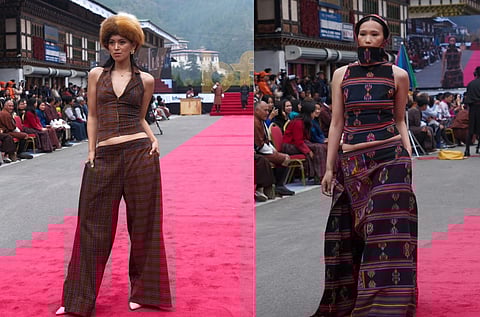
It was a cultural epiphany of sorts when Bhutan recently hosted its first-ever fashion week. When you think of serious business events like a fashion week, you don't usually think of the Himalayan country, also known as the Land of the Thunder Dragon. However, the country, which has long imposed a strict dress code for the Bhutanese defined by Driglam Namzha, the traditional etiquette that mandates the daily wearing of the national costumes, played out a street fashion spectacle embodying eclecticism and personal expression.
The Department of Media, Creative Industry and Intellectual Property (DoMCIIP), in collaboration with the Royal Textile Academy, presented a first-of-its-kind initiative that celebrated Bhutanese textiles, designs, and creativity like never before. Bringing together the artisans behind the handlooms and crafts and taking them to the world, the showcase aimed to spotlight Bhutanese fabrics and designs featured alongside renowned brands in the global market.
Moreover, the shows were staged across various historic venues in Bhutan. The Wangduechholing Palace Museum in Bumthang highlighted a 'past' theme; Paro's traditional streets represented the 'present'; while Thimphu staged a futuristic vision.

Danish-Bhutanese designer Ida Ghaley, who participated and is known for reimagining culture through upcycling, shares, "Bhutan Fashion Week represents a meaningful cultural shift - not only for Bhutan, but for the global fashion industry as a whole. Bhutan has long been a symbol of sustainability and mindful living, and this showcase amplifies that voice within the global conversation on fashion’s future," says Ida.
For the first time, Bhutanese designers presented collections that merged deep-rooted tradition with modern relevance, proving that cultural heritage can evolve while staying authentic. "It’s a powerful step toward redefining how Bhutan engages with global fashion - through slow fashion, innovation, and locally rooted craftsmanship rather than mass production," she adds.
Bhutanese textiles are among the most detailed and sustainable in the world, often handwoven and worn for decades. A platform like this underscores not only their artistic value but also their eco-consciousness. "By bringing traditional crafts into a contemporary context, we give them a new life and a voice in the global fashion scene. It’s about preservation through innovation - showing that tradition is not static, but alive and adaptable," she quips.
As someone with both Bhutanese and Danish roots, this showcase felt like a personal bridge between two of Ida's worlds. Her collection focused on upcycling, reusing old ghos and kiras, leftover fabrics from Denmark, and even the original closures and seams to create new silhouettes that respect both heritage and modern design.
"Seeing these pieces on the runway in Bhutan, in front of an international audience, was both humbling and empowering. It confirmed that sustainability and storytelling can be valued in a world of fast fashion, because the future of fashion lies in respect for slow fashion," she adds.
Another brand, Dakini by Jyenn, showcased at the platform, promotes slow fashion, mindful living, and the preservation of traditional Bhutanese craftsmanship like natural dyeing and weaving. Talking about the show, Jyenn shared, "I do see a noticeable cultural shift in Bhutan’s fashion space as the platform spotlighted wearable pieces embodying cultural expression and design innovation. As a designer we were consciously exploring how to keep our work Bhutanese but also modern, wearable and globally relevant."
A showcase like this plays a huge role in promoting local crafts such as weaving and embroidery techniques. 'Dakini' which denotes divine feminine energy, presented a collection imbued with a deep spiritual meaning. "It was a personal collection dedicated to my late grandmother and my late kittens. Also, to be part of this historical moment itself felt like a huge achievement," adds Jyenn.