
Subscribe
Subscribe
- Motoring
- Style
- Home & Design
- Travel
- Food & Drink
- Specials
- News & Tech
- Videos
Scientists, artists, and designers have collaborated to produce the world's first product manufactured from lab-grown T.rex leather. It is a handbag intended to highlight the material's potential, in a first that sounds more like Jurassic Park than high-end fashion.
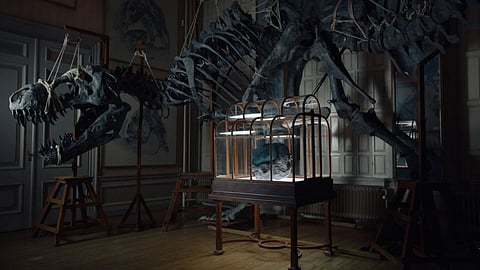
This month, T.Rex leather made its public debut in Amsterdam alongside a life-size cast of a Tyrannosaurus rex specimen. The leather was created using reconstructed dinosaur collagen without causing any harm to animals.
The Organoid Company, a leader in genomic engineering, creative agency VML (a group company of WPP PLC), and sustainable biotechnology pioneer Lab-Grown Leather Ltd. have been working on its creation since 2025. This new material will eventually be made available to luxury brands.
The innovative techwear brand Enfin Levé created a unique handbag as its initial manifestation. Founded by Polish designer Michal Hadas, the brand is renowned for its practical innovation and technical accuracy, fusing cutting-edge techwear with artisanal craftsmanship.

On April 2, 2026, the bag was unveiled at the Art Zoo Museum in Amsterdam. It is on display next to a massive T. rex building that the museum purchased from Naturalis Biodiversity Center. The structure is a cast of one of the most famous Tyrannosaurus rex specimens in the world, making Art Zoo a fitting setting for showcasing the product. The bag, when placed next to its archaic equivalent, represents a link between prehistoric biology and futuristic luxury design.
Bas Korsten, Global Chief Creative Officer at VML, said, “With T.Rex leather, we’re harnessing the biology of the past to create the luxury materials of the future. Alongside Thomas Mitchell, CEO of The Organoid Company, said, “This project demonstrates how genome and protein engineering can create entirely new classes of biomaterials."
The scientists started with fossilised T. rex collagen sequences in order to create leather from the extinct species. Scientists predicted and recreated the missing genetic information needed to create a complete collagen blueprint using computational biology and AI modelling. A carrier cell line was introduced with this fully synthesised DNA. Using Lab-Grown Leather's exclusive Advanced Tissue Engineering Platform (ATEPTM), billions of these modified cells were then grown and incorporated into its product line.
Grown without animal slaughter, deforestation, or chromium-intensive tanning methods, the result is a leather that is long-lasting, repairable, biodegradable, and completely traceable.
After the T-Rex Leather was manufactured, Enfin Le Lé was given the task of turning the biomaterial with a prehistoric feel into a unique high-end purse. The piece shows that the leather of the future can be produced by travelling back 68 million years.
Although this initial item is one-of-a-kind, T-Rex leather will still be made. Brands and designers will have commercial access to the material, and more supply information and procurement will be made accessible later. With long-term goals extending into the fashion, automotive, and other high-performance material industries, the initial uses will concentrate only on luxury accessories.
This presents a compelling vision for the future, especially as traditional leather production continues to face scrutiny for its environmental impact. In contrast, T.rex leather stands as a bold example of synthetic biology moving beyond medicine and into the realm of sustainable material innovation.
It also invites a broader reflection: dinosaurs evolved to survive extreme environmental conditions, ones that increasingly mirror today’s climate challenges. By studying and reconstructing ancient biology, such collaborations unlock new possibilities for creating resilient, high-performance materials, engineered through the lens of modern biotechnology.
Only time will reveal how transformative and practical this leather proves to be for future generations, but it already stands as an intriguing step both in the realm of luxury fashion and in the pursuit of more sustainable living.